组成图示
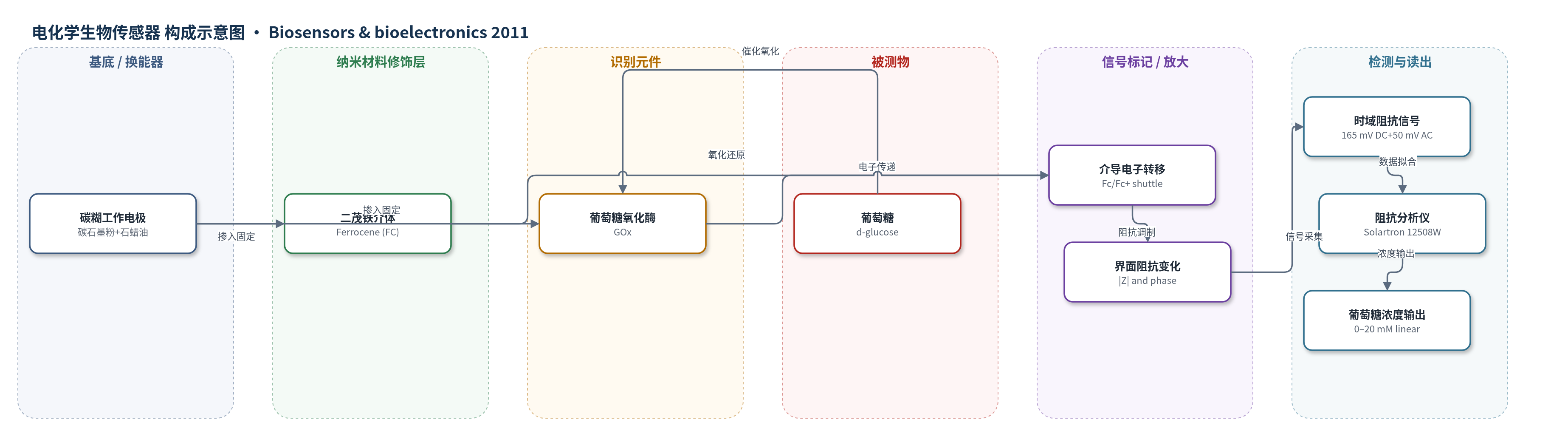
点击图片查看大图 · 依据论文自动绘制
传感器类型
电化学生物传感器
检测对象
葡萄糖 (glucose, d-glucose);样品基质:0.07 M PBS (pH 7) 含0.1 M KCl缓冲液;作者声称可应用于血液及食品/制药工业样品
检测原理
葡萄糖氧化酶(GOx)特异性催化葡萄糖氧化,使酶中FAD中心被还原;二茂铁(FC)作为人工介体在还原态酶与电极表面之间穿梭电子,形成与葡萄糖浓度相关的介导电子转移。系统施加165 mV直流偏压叠加50 mV RMS、0.4 Hz交流信号,采用时域阻抗技术(CIT)监测电极-电解质界面阻抗(EEIZ)。葡萄糖浓度升高时,酶促电子转移增强,界面电荷转移阻抗下降,阻抗模(|Z|)和相位(φ)发生可重复变化。低频下阻抗变化率最大,因此选择0.4 Hz实现实时读出;低直流电位抑制多巴胺、抗坏血酸、尿酸等干扰并减少酶降解。
检测灵敏度
线性范围: 0 mM–20 mM;相关系数: |Z| 0.9853,相位 0.9945;与比色法相关系数: R^2 = 0.9954
效应效果
该传感器在0–20 mM范围内线性响应,四重复测量RSD小于10%;结果部分进一步给出低浓度(2–10 mM)RSD<5%、高浓度(10–20 mM)RSD<10%。准确度在参考值10%以内,三个浓度精密度RSD分别为11.97%、14.65%和16.71%。与比色法平行测量四次,t检验无差异(p=1),相关系数R2=0.9954。对多巴胺(0.2 mM)、抗坏血酸(0.2 mM)、尿酸(0.2 mM)、柠檬酸(1 mM)、甘露醇(11 mM)和蔗糖(5 mM)干扰可忽略。作者认为低电位减少干扰和酶降解,可用于血液葡萄糖及食品/制药工业过程控制。
传感器的构成
- 工作电极基底:碳石墨粉(carbon graphite powder)与石蜡油(paraffin oil)混合形成碳糊(CP),提供导电界面并固定介体与酶
- 电子介体层:二茂铁(Ferrocene, FC/Fc)掺入碳糊,在GOx的FAD中心与电极表面间传递电子
- 识别元件层:葡萄糖氧化酶(Glucose oxidase, GOx)掺入碳糊,特异性识别并催化葡萄糖氧化
- 电极封装:亚克力管(acrylic tube)容纳碳糊,形成内径8 mm、高2 mm的工作电极
- 金属接触:24K金片(24-carat gold disc)插入管中接触碳糊,提供电学连接
中文摘要
将时域阻抗技术(CIT)作为新换能方法,用于基于碳糊(CP)/二茂铁(FC)/葡萄糖氧化酶(GOx)生物传感器系统的葡萄糖实时测量。系统因采用由165 mV直流电位和0.4 Hz、50 mV RMS交流信号组成的最佳刺激信号而具有高选择性。所用低直流电位降低了干扰物影响,生物传感器在0–20 mM葡萄糖浓度范围内呈现线性阻抗响应,阻抗模(|Z|)和相位(φ)的相关系数分别为0.9853和0.9945。四重复实验结果表明测量具有高重复性和重现性,相对标准偏差(RSD)小于10%。CIT具有良好准确度(在真实值10%以内),精密度在高浓度值时RSD不超过15%,低浓度时不超过20%。此外,时域阻抗法与比色法之间获得高相关系数(R2=0.9954)。当在相同条件下制备的两个样品用两种方法平行测量(重复四次)时,学生t检验显示两种方法无差异(p=1)。本文提出的生物传感器系统对葡萄糖检测具有高度特异性,并显示出比先前报道更宽的线性范围。
英文摘要
Chrono-impedance technique (CIT) was implemented as a new transduction method for real time measurement of glucose in a biosensor system based in carbon paste (CP)/Ferrocene (FC)/glucose oxidase (GOx). The system presents high selectivity because the optimal stimulation signal composed by a 165mV DC potential and 50mV(RMS) AC signal at 0.4Hz was used. The low DC potential used decreased the interfering species effect and the biosensor showed a linear impedance response toward glucose detection at concentrations from 0mM to 20mM,with 0.9853 and 0.9945 correlation coefficient for impedance module (|Z|) and phase (Φ), respectively. The results of quadruplicate sets reveal the high repeatability and reproducibility of the measurements with a relative standard deviation (RSD) less than 10%. CIT presented good accuracy (within 10% of the actual value) and precision did not exceed 15% of RSD for high concentration values and 20% for the low concentration ones. In addition, a high correlation coefficient (R(2)=0.9954) between chrono-impedance and colorimetric methods was obtained. On the other hand, when two samples prepared at the same conditions were measured in parallel with both methods (the measurement was repeated four times), it should be noticed that student's t-test produced no difference between the two mentioned methods (p=1). The biosensor system hereby presented is highly specific to glucose detection and shows a better linear range than the one reported on the previous article.