组成图示
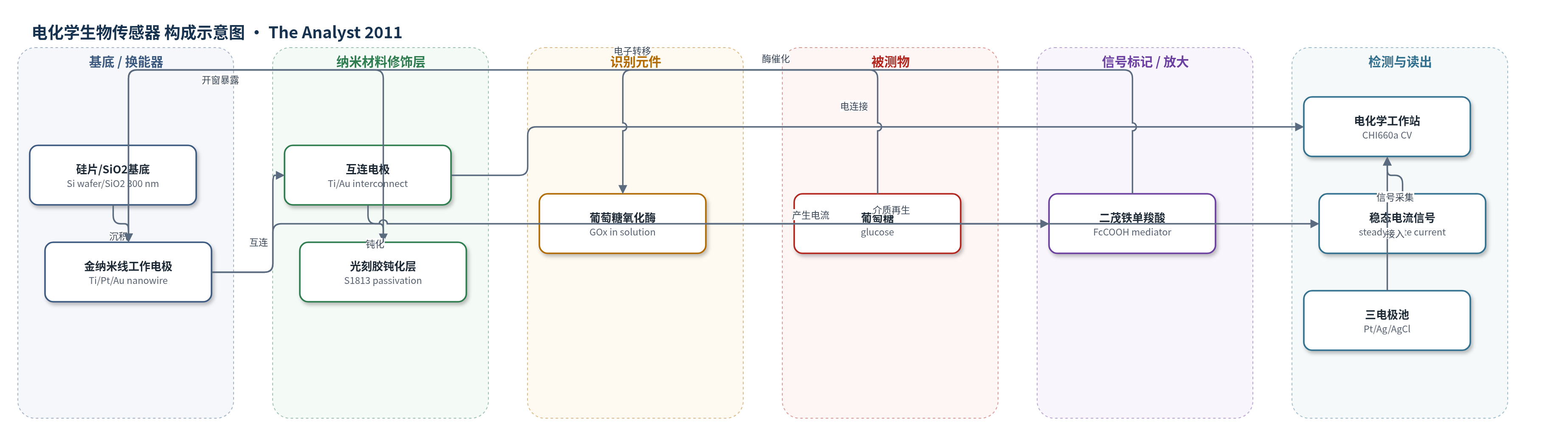
点击图片查看大图 · 依据论文自动绘制
传感器类型
电化学生物传感器
检测对象
葡萄糖(glucose);样品基质:PBS 缓冲液标准溶液,面向唾液等非血液体液。
检测原理
该传感器采用酶介导介质循环的电化学检测机制。葡萄糖氧化酶(GOx)中的 FAD 组分催化葡萄糖氧化为葡萄糖酸,同时 FAD 被还原为 FADH2(GOxred)。溶液中的氧化态二茂铁单羧酸(FcCOOHox)接受电子,将 GOxred 再氧化为 GOxox,自身被还原为 FcCOOH。随后 FcCOOH 在金纳米线工作电极表面被氧化为 FcCOOHox,产生可测量的法拉第电流。由于金纳米线处于纳米尺度,分析物/介质向电极的径向扩散占主导,传质速率提高、界面电容降低,从而获得稳态伏安响应和较高电流密度。介质循环使酶催化事件转化为持续电子转移,实现信号放大;低过电位氧化介质也减少可氧化干扰物的影响,使稳态电流随葡萄糖浓度增加而线性增大。
检测灵敏度
LOD: 3 ± 0.1 mM (S/N = 3);线性范围: 10 mM–1 mM;灵敏度: 7.2 mA mM^-1 cm^-2;R^2 = 0.993。高浓度范围: 1 mM–100 mM;灵敏度: 1.8 mA mM^-1 cm^-2;LOD: 16 mM (S/N = 3);R^2 = 0.995。
效应效果
传感器对葡萄糖选择性高。在 1 mM 葡萄糖中加入尿酸(0.2 mM)、抗坏血酸(0.5 mM)、水杨酸(0.5 mM)、对乙酰氨基酚(0.5 mM)、果糖(1 mM)和甘露糖(1 mM)后,电流响应分别为葡萄糖信号的 101.17%、98.38%、99.11%、98.89%、100.21% 和 97.41%,干扰可忽略。重复实验平均误差 5 pA(约 0.25%);纳米线间 FcCOOH 稳态电流变化约 ±13 pA(约 5%)。器件数月稳定,无电极污损;0.1 M 硫酸中 10–14 次循环可清洁,超过 200 次会断裂。未报告实际样品回收率及与 ELISA/HPLC/qPCR 对比,作者认为可用于唾液等非侵入性葡萄糖检测。
传感器的构成
- 基底/绝缘层:硅片(Si wafer)带约300 nm热生长二氧化硅(SiO2),提供绝缘支撑。
- 纳米线工作电极:Ti/Pt/Au(5/5/30 nm)单根金纳米线,宽约100±6 nm、高约50.6±0.8 nm,作为换能器。
- 互连电极:Ti/Au(10/200 nm)互连走线,覆盖纳米线端部,用于电连接。
- 钝化层:光刻胶 Shipley S1813,开窗暴露纳米线并绝缘互连。
- 封装/引线:金键合线(Au wire)与环氧树脂(epoxy),连接印刷电路板(PCB)。
- 识别元件:葡萄糖氧化酶(GOx, Aspergillus niger),溶液中游离使用,催化葡萄糖氧化。
- 电子介质:二茂铁单羧酸(FcCOOH, 10 mM),传递电子并产生法拉第电流。
- 电解液/缓冲液:10 mM PBS(pH 7.4),提供离子传导环境。
中文摘要
开发具有低检测限的葡萄糖诊断装置对糖尿病研究至关重要。为满足血液以外体液中葡萄糖的非侵入性检测需求,本文报道了一种基于单根金纳米线的电化学传感器,用于快速、可靠、定量地检测低浓度葡萄糖(10 mM–1 mM)。单根金纳米线器件在硅芯片基底上采用电子束光刻与光刻混合工艺制备,并利用扫描电子显微镜和原子力显微镜表征其关键尺寸。器件通过直接电学探测和循环伏安法进行功能表征。葡萄糖检测在葡萄糖氧化酶存在下,以二茂铁单羧酸作为氧化介质进行伏安分析。该传感器可在 10 mM–100 mM 范围内定量葡萄糖,灵敏度高达 7.2 mA mM^-1 cm^-2,检测限为 3 mM(S/N = 3)。传感器对葡萄糖具有较高选择性,尿酸、抗坏血酸、甘露糖、果糖、水杨酸和对乙酰氨基酚等可氧化物质的干扰可忽略。
英文摘要
The development of glucose diagnostic devices with low detection limits is of key importance in diabetes-related research. New highly sensitive sensors are required for non-invasive detection of glucose in bodily fluids, other than blood, and an electrochemical sensor based on a single gold nanowire for rapid, reliable and quantitative detection of low glucose concentrations (10 μM-1 mM), is presented in this paper. Single gold nanowire devices are fabricated at silicon chip substrates using a hybrid electron beam-photolithography approach. Critical dimensions of the nanowires are characterised using a combination of scanning electron and atomic force microscopies. Fabricated nanowire devices are characterised by direct electrical probing and cyclic voltammetry to explore functionality. The voltammetric detection of glucose was performed using ferrocene monocarboxylic acid as an oxidising mediator in the presence of glucose oxidase. The biosensor can be applied to the quantification of glucose in the range of 10 μM-100 mM, with an extremely high sensitivity of 7.2 mA mM(-1) cm(-2) and a low detection limit of 3 μM (S/N = 3). The sensor demonstrated high selectivity towards glucose with negligible interference from other oxidizable species including uric acid, ascorbic acid, mannose, fructose, salicylic acid (Aspirin) and acetaminophen (Paracetamol).