组成图示
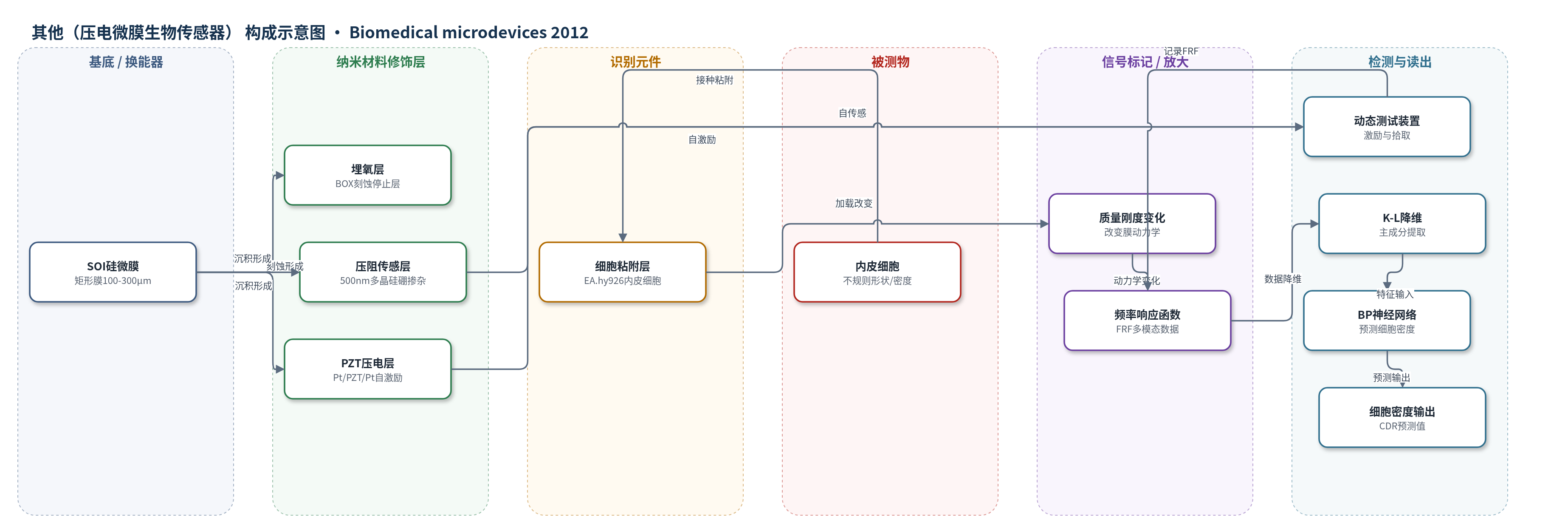
点击图片查看大图 · 依据论文自动绘制
传感器类型
其他(压电微膜生物传感器)
检测对象
EA.hy 926 内皮细胞(EA.hy 926 endothelial cells),样品基质:细胞培养基(DMEM/FBS)
检测原理
细胞接种到硅微膜表面后,EA.hy 926 内皮细胞通过非特异性粘附附着于膜表面。细胞质量、粘附刚度及阻尼改变矩形微膜的振动特性,使各阶共振频率发生偏移,模态幅值与振型发生变化。PZT 压电层对膜进行自激励,分布式压阻传感器拾取膜面振动/应力并转换为电信号,动态测试装置记录多组频率响应函数(FRF)。FRF 数据先按第一共振模态归一化,再用 Karhunen-Loeve 分解提取主成分,与平均频率差比 AFDR 一起输入 BP 神经网络。网络学习 FRF 特征与细胞密度比 CDR 的非线性关系,从而预测细胞密度。该方法无化学标记放大,主要依靠多模态分布式传感和神经网络特征识别增强信息量。
检测灵敏度
原文未报告 LOD、线性范围、灵敏度斜率或相关系数。
效应效果
在细胞培养基高阻尼环境中,矩形硅膜可检测细胞粘附引起的动力学变化。三种膜中,100 µm C-F-F-F 膜在共振频率偏移方面灵敏度最高。AFDR 可粗略估计细胞量,但 No.I 与 No.II 膜结果接近,No.III 明显较低,说明不同膜间存在差异且需要校准。BP 神经网络使用 18 个样本,其中 14 个训练、4 个验证,隐藏层 5 个神经元时性能最佳;训练参数为动量 0.9、学习率 0.1、最大误差 0.001、最大迭代 3000。预测 CDR 与 LSM 图像定量值误差在 10% 以内。作者认为该方法稳健,可抑制测量不确定、消除膜间差异、克服非线性,适合不规则形状和非均匀密度细胞,具有通用生物传感平台潜力。
传感器的构成
- 基底/换能器:SOI 晶圆与矩形硅微膜(100–300 µm,C-F-C-F/C-F-F-F/C-C-C-C),作为质量敏感振动结构
- 微加工停止层:埋氧层(BOX),用于 DRIE/ICP 刻蚀停止并形成边界孔
- 压阻传感层:500 nm 多晶硅(PCVD 沉积)经硼离子注入(50 keV,掺杂密度 1e15),形成分布式压阻传感器,将振动/应力转换为电阻变化
- 压电激励层:100 nm Pt/Ti 底电极 + 1 µm PZT 薄膜 + 100 nm Pt 顶电极,用于自激励和自传感
- 识别元件:硅膜表面直接粘附 EA.hy 926 内皮细胞,无特异性抗体/适配体修饰
- 信号标记/放大:无外源标记,细胞质量、刚度、阻尼改变膜动力学,通过多模态 FRF 变化体现
中文摘要
本文提出并研究了一种基于微加工矩形硅膜的新型生物传感系统。该系统采用分布式传感方案,通过监测传感结构的动力学响应来识别生物目标。人工神经网络被用于处理测量数据,以判断细胞的存在并估计其密度。研究未限定具体生物应用,而是将该微膜作为通用生物传感平台进行性能测试。实验将不同密度的 EA.hy 926 内皮细胞接种到微加工硅膜表面,并在细胞培养基中测量各硅膜的动力学信息,结果以一系列频率响应函数(FRF)形式记录。EA.hy 926 细胞具有不规则形状、非均匀密度和不确定生长行为,属于传统生物传感器难以监测的生物颗粒。最终预测结果表明,基于神经网络算法对分布式传感测量数据进行细胞特征识别的方法,在生物传感应用中具有较大潜力。
英文摘要
A novel biosensing system based on a micromachined rectangular silicon membrane is proposed and investigated in this paper. A distributive sensing scheme is designed to monitor the dynamics of the sensing structure. An artificial neural network is used to process the measured data and to identify cell presence and density. Without specifying any particular bio-application, the investigation is mainly concentrated on the performance testing of this kind of biosensor as a general biosensing platform. The biosensing experiments on the microfabricated membranes involve seeding different cell densities onto the sensing surface of membrane, and measuring the corresponding dynamics information of each tested silicon membrane in the form of a series of frequency response functions (FRFs). All of those experiments are carried out in cell culture medium to simulate a practical working environment. The EA.hy 926 endothelial cell lines are chosen in this paper for the bio-experiments. The EA.hy 926 endothelial cell lines represent a particular class of biological particles that have irregular shapes, non-uniform density and uncertain growth behaviour, which are difficult to monitor using the traditional biosensors. The final predicted results reveal that the methodology of a neural-network based algorithm to perform the feature identification of cells from distributive sensory measurement has great potential in biosensing applications.