组成图示
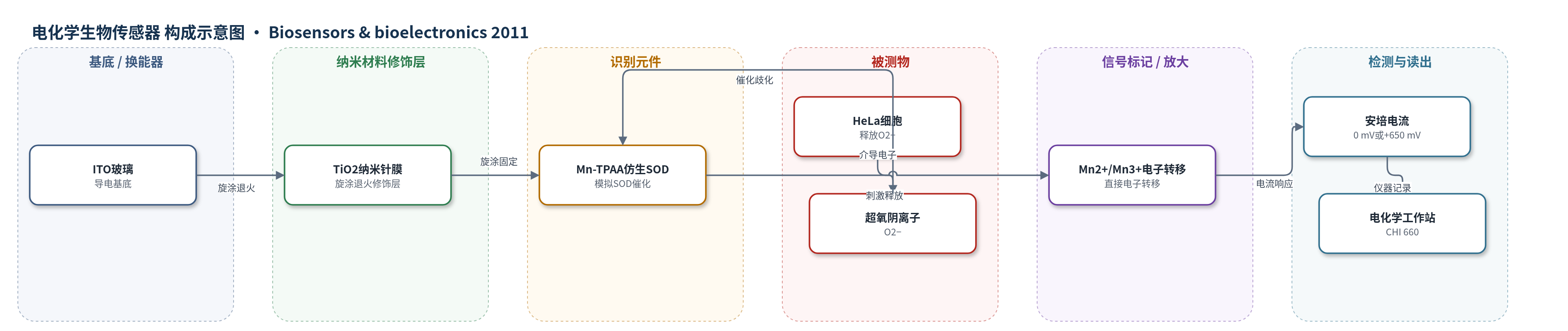
点击图片查看大图 · 依据论文自动绘制
传感器类型
电化学生物传感器
检测对象
超氧阴离子(superoxide anion, O2−);样品基质:PBS缓冲液、HeLa细胞悬液/细胞释放液
检测原理
Mn-TPAA固定于TiO2纳米针膜后实现直接电子转移,其形式电位约622.8 mV(vs. Ag|AgCl),位于O2/O2−与O2−/H2O2电对之间,因此可热力学介导O2−歧化。在+650 mV阳极过程中,Mn2+-TPAA被氧化为Mn3+-TPAA,Mn3+-TPAA将O2−氧化为O2并再生Mn2+-TPAA;在0 mV阴极过程中,Mn3+-TPAA将O2−还原为H2O2并接受电子再生Mn2+-TPAA。O2−浓度升高使仿生SOD催化循环加快,稳态安培电流随之增大,6 s内达到平台。低电位0 mV下干扰物响应小于2%,实现选择性检测。
检测灵敏度
线性范围: 10−7 M–10−4 M;阳极线性范围: 5–225 μM;阴极线性范围: 0.2–625 μM;灵敏度: 4.25 ± 0.12 nA cm−2/μM(+650 mV,n=9)、3.17 ± 0.11 nA cm−2/μM(0 mV,n=9)
效应效果
传感器在0 mV下对DA、AA、Cys等干扰响应<2%,选择性优于+650 mV(5 μM DA、10 μM AA、5 μM Cys分别产生约32.66%、26.34%、21.62%响应)。加入SOD后电流下降>96%,证实信号来自O2−。响应时间<6 s,三个月内电流变化<3%,五个独立电极重现性偏差<4.8%。作者实时监测Ang II刺激HeLa细胞释放的O2−,并用Fluo 4-AM观察细胞内Ca2+升高,表明可用于ROS信号研究,性能优于纳米金、ZnO纳米片和SiC表面的SOD型O2−传感器。
传感器的构成
- 导电基底:ITO玻璃(indium tin oxide, ITO),作为工作电极导电支撑
- 纳米修饰层:TiO2纳米针薄膜(TiO2 nanoneedle film),旋涂TiO2纳米针溶胶并于723 K退火,提供纳米结构表面并促进Mn-TPAA直接电子转移
- 仿生识别催化层:Mn-TPAA(tris[2-[N-(2-pyridylmethyl)amino]ethyl]amine锰配合物),以1:10比例与TiO2旋涂固定,模拟SOD催化O2−歧化
- 电化学检测界面:Ag|AgCl参比电极与Pt辅助电极,配合CHI 660电化学工作站,在0 mV或+650 mV恒电位下读取安培电流
中文摘要
通过将合成的Mn-TPAA固定于TiO2纳米针薄膜表面,作者开发了一种用于超氧阴离子(O2−)的电化学生物传感器,并应用于活细胞释放O2−的测定。Mn-TPAA在TiO2纳米针膜上实现直接电子转移,其形式氧化还原电位位于O2/O2−和O2−/H2O2电对之间,因而可在热力学上同时介导O2−氧化为O2和还原为H2O2。该仿生传感器具有类似超氧化物歧化酶(SOD)的催化活性,能在0 V(vs. Ag|AgCl)低工作电位下实现高选择性检测,线性范围为10−7 M至10−4 M,响应时间小于6 s。基于该方法和仿生SOD的特性,作者实现了对活细胞释放O2−浓度的实时监测,并研究了O2−浓度变化与细胞内Ca2+的关系,为活性氧信号转导及相关生理病理过程提供了新见解。
英文摘要
By immobilizing synthesized Mn-TPAA (TPAA=tris[2-[N-(2-pyridylmethyl) amino] ethyl] amine) on TiO(2) nanoneedle surface, a biosensor for superoxide ion (O(2)(-)) has been developed and applied for determination of O(2)(-) released from living cells. Direct electron transfer of Mn-TPAA is realized with a formal redox potential (E°') falling in the range of the E°' values of the redox couples O(2)/O(2)(-) and O(2)(-)/H(2)O(2). This suggests that Mn-TPAA on TiO(2) films is electrochemically active and capable of thermodynamically mediating both the oxidation of O(2)(-) to O(2) and the reduction of O(2)(-) to H(2)O(2). Therefore, Mn-TPAA immobilized on the TiO(2) films can be used electrochemically for determination of O(2)(-) due to its electrochemical activities and biomimetic catalytic activities like superoxide dismutase (SOD) toward O(2)(-). The present biomimetic O(2)(-) sensor shows high selectivity at the low working potential of 0V vs. Ag|AgCl, a wide linear range from 10(-7)M to 10(-4)M and a quick response time within 6s. By taking advantage of the developed method and the properties of biomimetic SOD themselves, we have realized the real-time monitoring of O(2)(-) concentration released from living cells and investigated the relationship between the concentration changes of O(2)(-) and intracelluar Ca(2+), which may gain additional insights on the reactive oxygen species (ROS) signal transduction and other physiological and pathological events.