组成图示
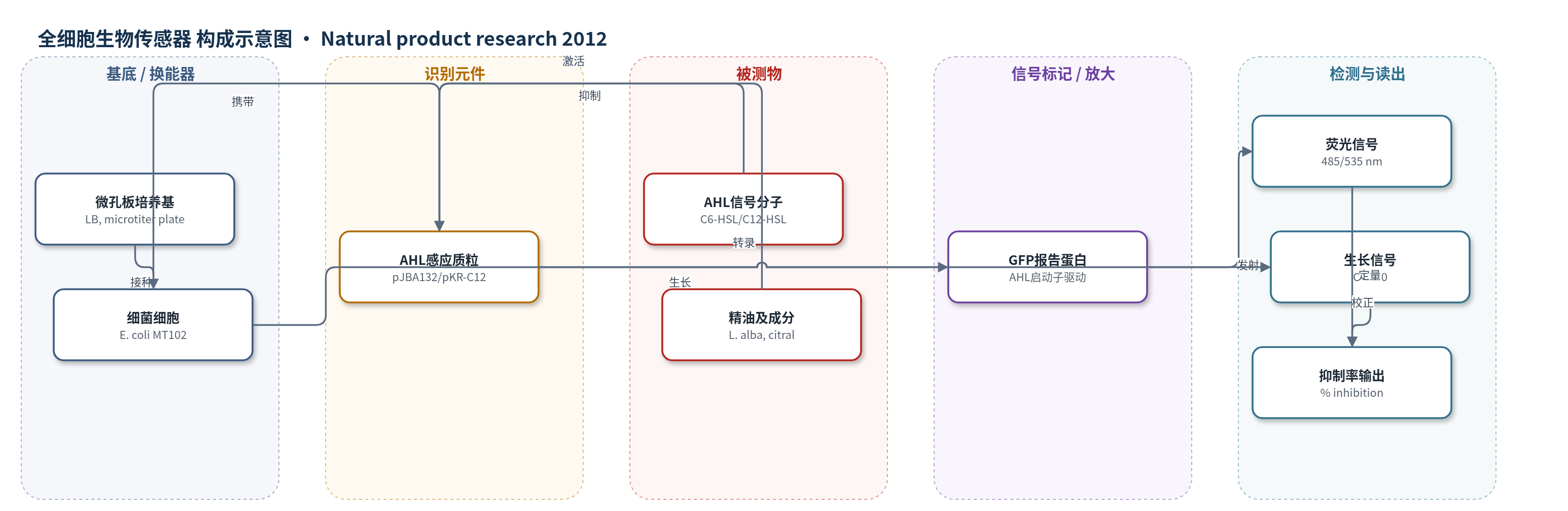
点击图片查看大图 · 依据论文自动绘制
传感器类型
全细胞生物传感器
检测对象
N-酰基高丝氨酸内酯(AHL,C6-HSL/C12-HSL)、哥伦比亚植物精油及其成分(citral、carvone、α-pinene 等);样品基质:LB 培养基微孔板
检测原理
细菌传感器菌株携带 AHL 响应质粒,其 AHL 控制启动子与 GFP 报告基因融合。当短链 C6-HSL 或长链 C12-HSL 进入细胞并与感应系统结合后,启动子被激活,驱动 GFP 表达;GFP 荧光强度随 AHL 信号增强而升高。加入精油或其成分后,若其干扰 AHL 识别、受体结合或转录激活,GFP 荧光下降。实验以仅含 AHL 的样品为阳性对照、仅含溶剂的样品为阴性对照,计算荧光诱导倍数和抑制率,并用 OD620 校正细胞生长。pJBA132 主要响应短链 AHL,pKR-C12 主要响应长链 AHL,因此可区分不同链长信号。
检测灵敏度
原文未报告 LOD、线性范围、灵敏度斜率或 R^2。
效应效果
1.2 mg/mL、24 h 下,多数精油抑制 E. coli pJBA132 短链 AHL,L. alba 最高 84%,Ocotea sp. 71–76%;对 P. putida pKR-C12 长链仅 L. alba(1) 65%、Ocotea sp. 25%、E. cardamomum 31%。citral、carvone、α-pinene 最高浓度下对 pJBA132 中等抑制,citral 对 pKR-C12 有活性。实验三重复、至少两次独立重复。作者认为其可作抗 QS 候选,但甲壳虾 LC50≤20 mg/mL,需评估安全性。
传感器的构成
- 细胞基底:E. coli MT102 或 P. putida F117 活菌,作为 AHL 感应与 GFP 表达载体
- 识别元件:质粒 pJBA132 或 pKR-C12 中的 AHL 响应启动子/受体系统,识别短链 C6-HSL 或长链 C12-HSL
- 信号标记物:GFP 荧光蛋白,由 AHL 控制启动子驱动表达
- 样品基质:LB 培养基微孔板,用于共孵育细菌、AHL 与精油/成分
- 读出装置:Victor 1420 Multilabel Counter,检测 535 nm 荧光与 OD620 生长
中文摘要
本研究对哥伦比亚植物精油进行了气相色谱-质谱(GC-MS)表征,并利用细菌生物传感器菌株评估其抗群体感应(anti-quorum sensing, anti-QS)活性。Lippia alba 精油存在柠檬烯-香芹酮和香茅醛(香叶醛-香茅醛)两种主要化学型;其他物种精油主要成分包括 Ocotea sp. 的 α-蒎烯、Swinglea glutinosa 的 β-蒎烯、Elettaria cardamomum 的桉叶素、Zingiber officinale 的 β-姜烯和 Mintostachys mollis 的胡薄荷酮。在携带 pJBA132 质粒的大肠杆菌中,多种精油对短链 N-酰基高丝氨酸内酯(AHL)群体感应系统表现出抑制作用,其中 L. alba 活性较突出。香茅醛、香芹酮和 α-蒎烯等单一成分在最高测试浓度下也显示中等活性;仅香茅醛对携带 pKR-C12 质粒的 Pseudomonas putida 长链 AHL 系统有一定抑制作用。结果表明,哥伦比亚植物精油具有作为群体感应调节剂的潜力。
英文摘要
Essential oils from Colombian plants were characterised by GC-MS, and assayed for anti-quorum sensing activity in bacteria sensor strains. Two major chemotypes were found for Lippia alba, the limonene-carvone and the citral (geranial-neral). For other species, the main components included α-pinene (Ocotea sp.), β-pinene (Swinglea glutinosa), cineol (Elettaria cardamomun), α-zingiberene (Zingiber officinale) and pulegone (Minthostachys mollis). Several essential oils presented promising inhibitory properties for the short chain AHL quorum sensing (QS) system, in Escherichia coli containing the biosensor plasmid pJBA132, in particular Lippia alba. Moderate activity as anti-QS using the same plasmid, were also found for selected constituents of essential oils studied here, such as citral, carvone and α-pinene, although solely at the highest tested concentration (250 µg mL(-1)). Only citral presented some activity for the long chain AHL QS system, in Pseudomonas putida containing the plasmid pRK-C12. In short, essential oils from Colombian flora have promising properties as QS modulators.