组成图示
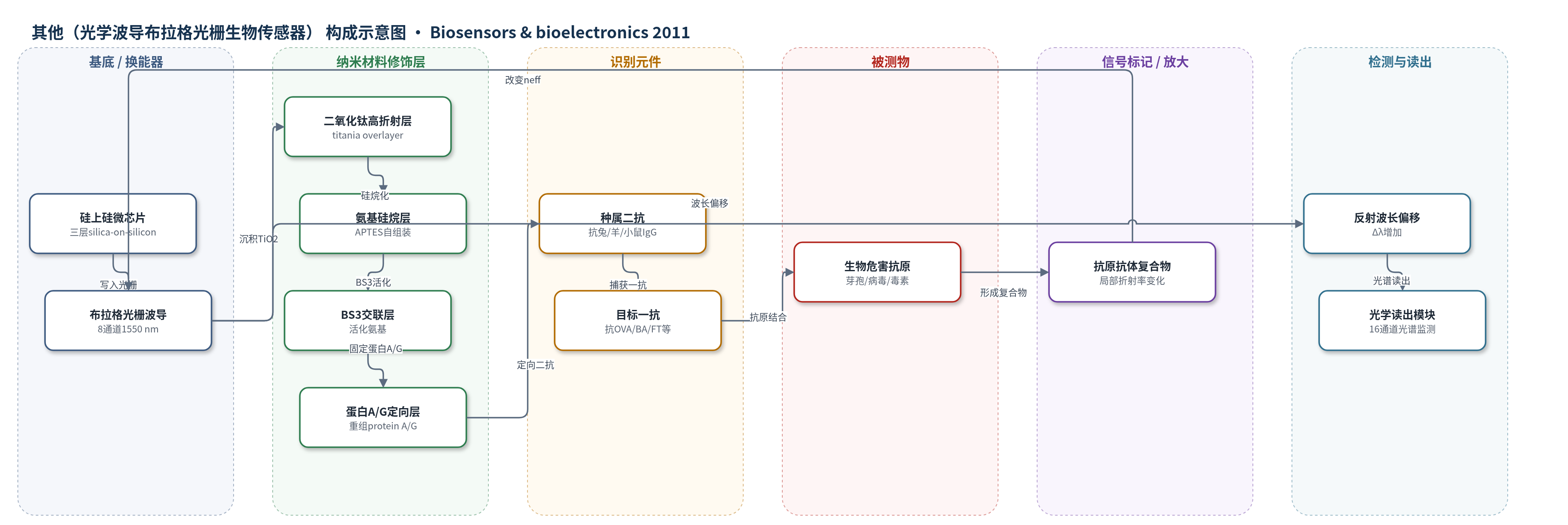
点击图片查看大图 · 依据论文自动绘制
传感器类型
其他(光学波导布拉格光栅生物传感器)
检测对象
短小芽孢杆菌芽孢(Bacillus atrophaeus, BG spores)、大肠杆菌营养细胞(Escherichia coli cells)、MS2噬菌体(MS2 viruses)、卵白蛋白(ovalbumin, OVA)、炭疽杆菌芽孢(Bacillus anthracis, BA spores)、弗朗西斯菌细胞(Francisella tularensis, FT cells)、痘苗病毒(Vaccinia viruses)、蓖麻毒素(ricin toxin);样品基质为PBS-Tween缓冲液流动样品。
检测原理
传感器由硅上硅波导和布拉格光栅构成,工作于1550 nm。光栅反射波长满足λmax=2Λneff。各通道表面经APTES、BS3、蛋白A/G、二抗和一抗定向固定。样品中抗原与对应一抗结合,在光栅倏逝场/渗透深度>1 μm内增加生物质量,改变局部有效折射率neff,导致该通道反射波长增加;非特异结合通道作为对照。信号与结合抗原质量/浓度正相关,蛋白毒素响应快,细菌/病毒颗粒因传质和多点结合延迟。无信号放大,依靠多通道差分与阈值算法识别。
检测灵敏度
原文未报告LOD、线性范围、灵敏度斜率或相关系数。
效应效果
该传感器在PBS-Tween流动体系中实现16通道同步、实时、无标记检测。选择性方面,目标通道与对照通道可显著区分,但颗粒抗原存在少量非特异结合;蛋白类抗原响应较快,OVA和蓖麻毒素约5 min内出现约0.002 nm波长偏移,MS2约10 min、BG约15 min、大肠杆菌约15 min,BA约10 min、FT约10 min(0.006 nm)、痘苗病毒约10 min。自动报警在12–15 min内触发。抗体固定引起0.1–0.2 nm波长变化;表面质量灵敏度约5 pg/mm2,最小波长变化0.05 pm,仪器分辨率1 pm。卡盒湿存48 h性能无显著下降。作者认为其便携、稳健,适合安保防御和现场生物检测。
传感器的构成
- 基底/换能器:三层硅上硅(silica-on-silicon)平面微芯片,直接紫外写入8条10 μm宽波导和布拉格光栅,工作于1550 nm,反射波长随局部折射率变化。
- 高折射率修饰层:刻蚀去除上包层后沉积二氧化钛(titania/titanium oxide)覆盖层,提高光栅对折射率变化的灵敏度。
- 氨基硅烷层:氧等离子清洗后浸入4% APTES(3-aminopropyltriethoxysilane)丙酮溶液,形成自组装氨基硅烷层,提供氨基用于交联。
- 交联活化层:BS3(bis(sulfosuccinimidyl)-suberate)活化氨基硅烷表面,用于共价连接重组蛋白A/G。
- 定向固定层:重组蛋白A/G(recombinant protein A/G)结合二抗Fc区,实现种属特异性二抗定向固定。
- 二抗识别层:抗兔、抗羊或抗小鼠IgG多克隆二抗按通道固定,用于定向捕获目标一抗。
- 一抗识别层:目标特异性一抗(抗OVA、抗E. coli、抗MS2、抗BG或抗FT、抗蓖麻毒素、抗痘苗病毒、抗BA)固定于各通道,识别对应抗原。
- 流路/卡盒:PMMA一次性卡盒和硅胶垫片流路,容纳两片8通道芯片,实现液体进样与光学连接。
中文摘要
报道一种适用于快速检测多种生物危害因子的光学波导阵列生物传感器。SpectroSens 光学微芯片传感器包含多个空间分离的波导通道,每个通道集成高精度布拉格光栅,对折射率变化敏感;通过在不同传感通道表面选择性固定不同抗体作为生物识别元件,实现多分析物选择性检测。样品中目标抗原与表面固定抗体结合引起局部折射率变化,表现为特定通道反射光波长增加。实时、无标记多重检测了8种生物因子,包括细菌芽孢、营养细胞、病毒和蛋白毒素。首先以模拟物验证:短小芽孢杆菌(BG)芽孢、大肠杆菌细胞、MS2噬菌体和卵白蛋白(OVA);随后证明可检测炭疽杆菌(BA)芽孢、弗朗西斯菌(FT)活疫苗株、热灭活痘苗病毒和蓖麻毒素。两片8通道微芯片封装于一次性卡盒,实现16通道同步采集。该装置便携、稳健,可用于安保与防御中的“检测-预警/处置”生物检测。
英文摘要
An optical waveguide array biosensor suitable for rapid detection of multiple bio-hazardous agents is presented. SpectroSens™ optical microchip sensors contain multiple spatially-separated waveguide channels with integral high-precision Bragg gratings sensitive to changes in refractive-index; selective surface-functionalisation of discrete sensing channels with different antibodies as bio-recognition elements enables selective multi-analyte biological detection. Interactions between target antigens in the test sample and respective surface-immobilised antibodies result in localised changes in refractive-index; the biosensor response manifests as increases in wavelength of light reflected from specific sensing channels. Multiplexed, label-free detection of 8 different biological agents, encompassing bacterial spores, vegetative cells, viruses and proteinaceous toxins has been demonstrated in real-time. Selective detection of Bacillus atrophaeus (BG) spores, Escherichia coli cells, MS2 viruses and ovalbumin (OVA) protein (simulant bio-hazardous agents) was first demonstrated as proof-of-concept; subsequently, detection of Bacillus anthracis (BA) spores (UM23CL2 strain), Franciscella tularensis (FT) cells (live vaccine strain), Vaccinia viruses (heat-killed) and ricin toxin (bio-hazardous agents) was proven. Two optical microchip sensors, each comprising 8 sensing channels were packaged into a single disposable cartridge allowing simultaneous 16-channel data acquisition. The specific antibody deposition sequence used in this study enabled detection of either 4 simulants or 4 bio-hazardous agents using a single consumable. The final device, a culmination of the multidisciplinary convergence of the fields of biology, chemistry, optoelectronics and microfluidics, is man-portable and inherently robust. The performance characteristics of the SpectroSens™ technology platform highlight its potential for exploitation as a 'detect to warn/treat' biodetector in security and defence operations.