组成图示
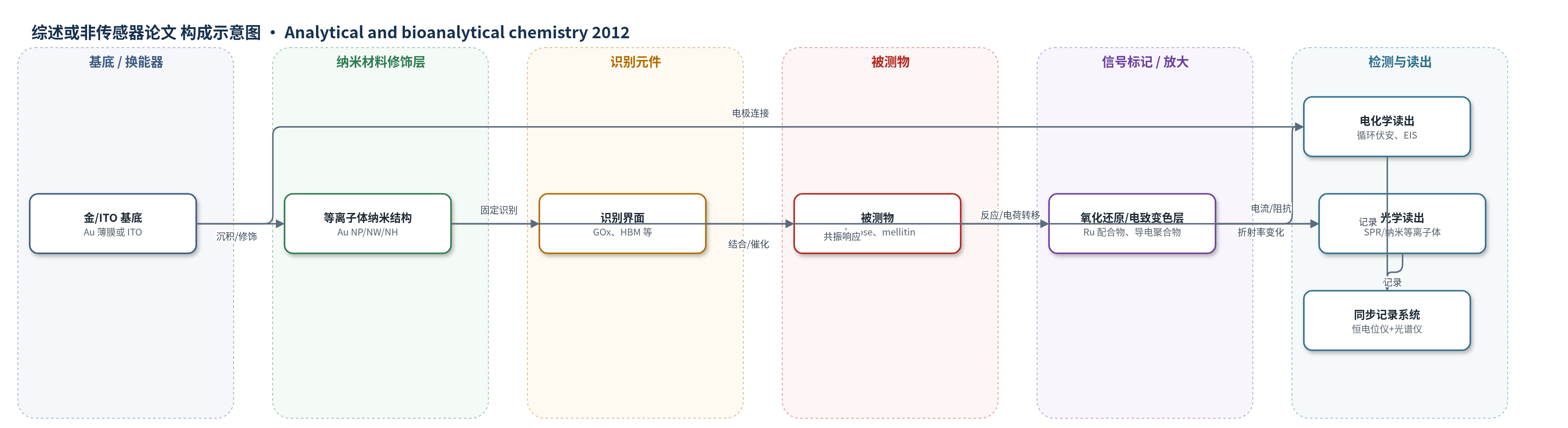
点击图片查看大图 · 依据论文自动绘制
传感器类型
综述或非传感器论文
检测对象
综述涉及多种检测对象:葡萄糖(glucose)、蜂毒肽(mellitin)、蛋白质/肽类、氧化还原活性小分子;样品基质包括缓冲溶液、人工脂质膜(HBM)、血液及复杂生物样品(综述举例)。
检测原理
光电化学生物传感器将等离子体纳米结构与电化学电极集成。被测物与识别界面(如葡萄糖氧化酶 GOx 或人工脂质膜 HBM)结合后,引发催化反应、电荷转移或膜孔形成,使界面附近氧化还原分子浓度、电子密度或局部折射率(RI)改变。一方面,电化学方法通过恒电位/循环伏安/阻抗谱(CV/EIS)记录电流或阻抗变化;另一方面,等离子体共振波长、峰宽或强度随 RI 和金属自由电子密度变化而发生位移或展宽。同步读出可区分直接吸附于金属表面的分子与通过受体结合分子,并提高定量解释。放大策略主要来自酶催化、电致变色聚合物 RI 对比和氧化还原反应,而非 HCR/RCA/CRISPR-Cas。
检测灵敏度
SPR:RI 分辨率 10^-7;LOD 低至 0.01 ng/cm2(表面覆盖度);血液中蛋白质:LOD 低至数 femtomoles/L;EIS:LOD 低至 1 fM;金纳米孔阵列:RI 的 LOD 通常为 10^-5–10^-6;金纳米线横向等离子体:17 nm 或 104 nm/RI 增量。
效应效果
作为综述,该文未给出单一传感器的完整性能指标,但总结了组合读出的优势:葡萄糖 ESPR 中,导电聚合物电致变色产生的 RI 对比可使 SPR 信噪比优于常规计时电流法;蜂毒肽(mellitin)人工脂质膜体系中,EIS 对低孔密度/单孔形成更敏感,而等离子体信号在高孔密度下与结合蛋白量线性相关,两者动态范围互补。同步电学与光学读出有助于解释 EIS 机制、区分受体介导结合与金属表面非特异性吸附,并可通过电化学功能化或电泳富集提升特异性与灵敏度。作者认为该组合适合微型化、多参数与无标记生物传感。
传感器的构成
- 基底/换能器电极:金(Au)薄膜、金纳米颗粒/纳米线/纳米孔,作为工作电极并支持表面或局域等离子体共振
- 透明导电支撑:氧化铟锡(ITO),用于固定纳米颗粒、允许光透过并施加电化学电位
- 识别元件:葡萄糖氧化酶(GOx)、人工脂质膜(HBM)等生物分子界面,用于催化或特异性结合
- 信号标记/放大:导电聚合物、电致变色聚合物、氧化还原分子(如 Ru 配合物),在电位下改变折射率或产生电流
- 界面/封闭:烷基硫醇自组装单分子层(SAM),用于阻断电荷转移或调控表面功能化
- 读出系统:SPR/纳米等离子体光谱仪与恒电位仪/电化学工作站,同步记录光学共振与电流/阻抗
中文摘要
过去十年纳米技术使多种纳米结构得以制备,金属在纳米尺度表现出特殊电学与光学性质,可用于新型传感。等离子体传感器,包括表面等离子体共振(SPR)和较新的纳米等离子体传感器,近年受到关注;但一些最成功的传感器如葡萄糖生物传感器仍基于电学读出。本综述阐述将电化学与等离子体纳米结构结合,实现电学与光学信号同步换能。文章概述金属纳米颗粒、纳米线、纳米孔及纳米厚薄膜等结构的光学性质,并讨论电化学方法实现方式,重点综述外加电化学电位如何影响不同纳米结构中的等离子体共振。由于电化学电位对等离子体共振的影响复杂,许多组合平台尚未真正用作传感器,但同步电学与光学读出具有明显优势,可提升定量解释、区分特异性结合与非特异性结合,并拓展微型化与多功能传感应用。
英文摘要
The enormous progress of nanotechnology during the last decade has made it possible to fabricate a great variety of nanostructures. On the nanoscale, metals exhibit special electrical and optical properties, which can be utilized for novel applications. In particular, plasmonic sensors including both the established technique of surface plasmon resonance and more recent nanoplasmonic sensors, have recently attracted much attention. However, some of the simplest and most successful sensors, such as the glucose biosensor, are based on electrical readout. In this review we describe the implementation of electrochemistry with plasmonic nanostructures for combined electrical and optical signal transduction. We highlight results from different types of metallic nanostructures such as nanoparticles, nanowires, nanoholes or simply films of nanoscale thickness. We briefly give an overview of their optical properties and discuss implementation of electrochemical methods. In particular, we review studies on how electrochemical potentials influence the plasmon resonances in different nanostructures, as this type of fundamental understanding is necessary for successful combination of the methods. Although several combined platforms exist, many are not yet in use as sensors partly because of the complicated effects from electrochemical potentials on plasmon resonances. Yet, there are clearly promising aspects of these sensor combinations and we conclude this review by discussing the advantages of synchronized electrical and optical readout, illustrating the versatility of these technologies.