组成图示
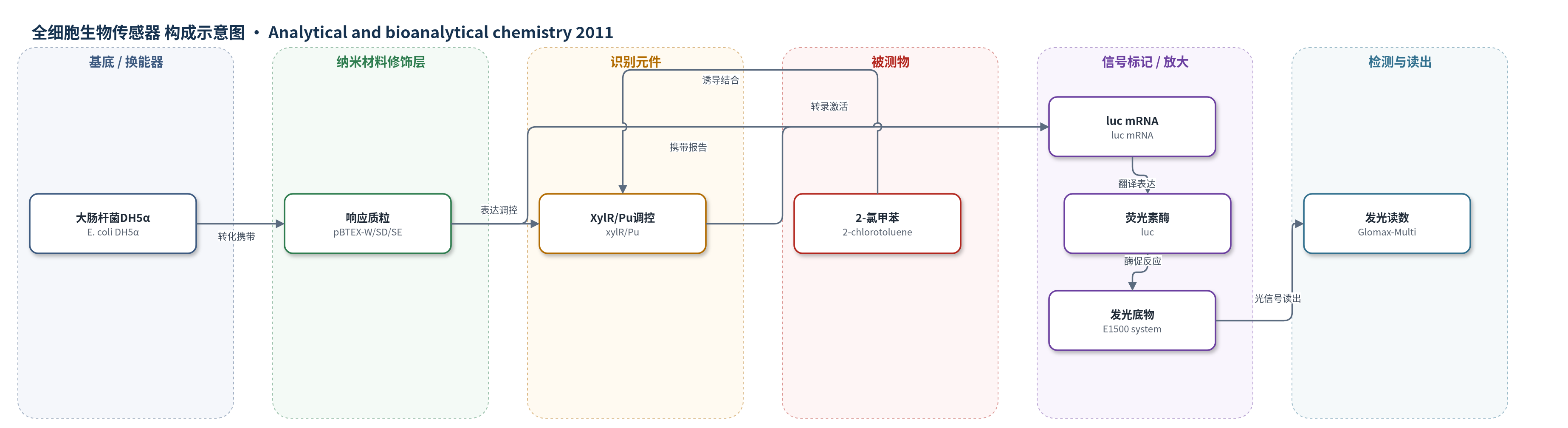
点击图片查看大图 · 依据论文自动绘制
传感器类型
全细胞生物传感器
检测对象
苯、甲苯、乙苯和二甲苯(BTEX,benzene, toluene, ethylbenzene and xylenes);实际检测模型物为2-氯甲苯(2-chlorotoluene),样品基质为LB培养基(DMSO溶解)。
检测原理
BTEX或2-氯甲苯进入大肠杆菌后,激活来自TOL质粒的XylR转录调控系统。XylR结合Pu启动子调控区,启动luc报告基因转录。工程化RBS(SD序列AGGAG和/或A/U富集增强子TTAACTTTA)位于luc mRNA 5′ UTR,提高核糖体结合与翻译效率,并增强mRNA稳定性,使荧光素酶表达量增加。加入E1500荧光素酶检测底物后,荧光素酶催化底物氧化产生光子,发光强度与细胞内荧光素酶活性及luc表达量正相关,因此随2-氯甲苯浓度升高呈Hill方程S形增加。RBS工程化在翻译水平放大信号,提高信噪比、降低检出限并缩短响应时间。
检测灵敏度
LOD: BTEX-SE 20±5 μmol L−1;BTEX-SD 25±5 μmol L−1;BTEX-W 120±10 μmol L−1
效应效果
BTEX-SD和BTEX-SE在250 μmol/L 2-氯甲苯诱导120 min时发光强度分别达1.93×10^6 U和6.43×10^6 U,约为BTEX-W的10和35倍;30 min LOD为25±5和20±5 μmol/L,低于BTEX-W的120±10 μmol/L。二者5 min内SNR达3.17±0.08和1.62±0.05,120 min达10.25±0.27和4.45±0.05,而BTEX-W仅0.98±0.02和1.5±0.02;50 μmol/L下5 min内可检测,BTEX-W不能。未报告选择性、稳定性、回收率及与ELISA/HPLC/qPCR对比,作者认为可用于原位生物可利用性评估。
传感器的构成
- 宿主细胞:大肠杆菌 DH5α,作为全细胞生物换能器,提供转录翻译环境。
- 响应质粒:pBTEX-W/pBTEX-SD/pBTEX-SE,携带BTEX响应调控盒与luc报告基因。
- 转录调控元件:xylR基因,编码XylR转录激活因子,介导BTEX/2-氯甲苯响应。
- 启动子:Pu启动子(来自Pseudomonas putida TOL质粒),受XylR调控驱动luc表达。
- 报告基因:luc荧光素酶基因,表达荧光素酶产生化学发光信号。
- 翻译调控元件:SD序列(AGGAG,来自T7噬菌体g10基因)和/或A/U富集增强子(TTAACTTTA),提高luc mRNA翻译效率与稳定性。
- 发光检测系统:E1500 luciferase assay system,提供荧光素酶反应底物并产生光信号。
中文摘要
在原核生物中,核糖体结合序列(RBS)位于mRNA 5′非翻译区,对增强翻译效率和mRNA稳定性起关键作用。为评估RBS对环境全细胞生物传感器灵敏度与信号强度的影响,作者构建了三种基于大肠杆菌、响应苯、甲苯、乙苯和二甲苯(BTEX)的全细胞生物传感器。三种传感器均含有来自假单胞菌TOL质粒的Pu启动子和xylR调节子,但报告基因luc的5′ UTR中工程化RBS不同。以2-氯甲苯诱导发光活性的时间和剂量依赖实验表明,含工程化RBS的BTEX-SE和BTEX-SD传感器信号强度约为原始BTEX-W传感器的10–35倍;其检出限也显著低于BTEX-W(20±5 μmol/L和25±5 μmol/L,对比120±10 μmol/L),且对分析物的响应速度约快3倍。结果表明,在报告基因5′ UTR中理性设计RBS是提高全细胞生物传感器灵敏度、信号强度和响应速度的有效策略。
英文摘要
In prokaryotes, the ribosome binding sequence (RBS), located in the 5' untranslated region (5' UTR) of an mRNA, plays a critical role in enhancing mRNA translation and stability. To evaluate the effect of the RBS on the sensitivity and signal intensity of an environmental whole-cell biosensor, three Escherichia coli-based biosensors that respond to benzene, toluene, ethylbenzene, and the xylenes (BTEX) were constructed; the three biosensors have the same Pu promoter and xylR regulator from the Pseudomonas putida TOL plasmid but differ in the engineered RBS in their reporter genes. The results from time and dose-dependent induction of luminescence activity by 2-chlorotoluene showed that the BTEX-SE and BTEX-SD biosensors with engineered RBS had signal intensities approximately 10-35 times higher than the primary BTEX-W biosensor. The limits of detection (LOD) of the BTEX-SE and BTEX-SD biosensors were also significantly lower than the LOD of the BTEX-W biosensor (20 ± 5 μmol L(-1) and 25 ± 5 μmol L(-1) vs. 120 ± 10 μmol L(-1)). Moreover, the BTEX-SE and BTEX-SD biosensors responded three times more rapidly to the analytes. These results suggest that rationally designed RBS in the 5' UTR of a reporter gene may be a promising strategy for increasing the sensitivity, signal intensity, and response speed of whole-cell biosensors.