组成图示
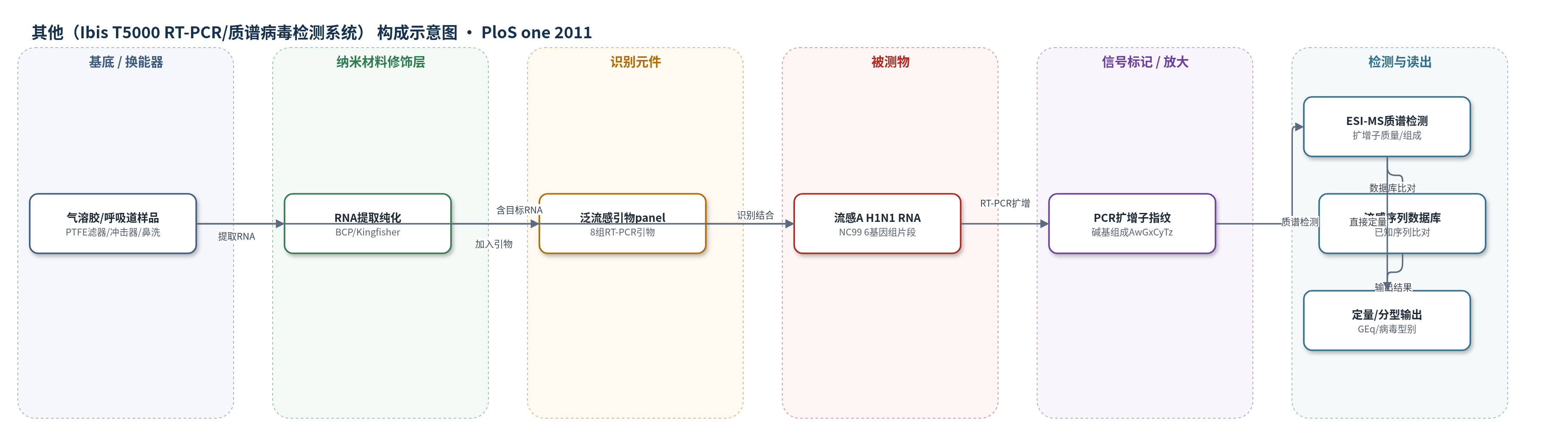
点击图片查看大图 · 依据论文自动绘制
传感器类型
其他(Ibis T5000 RT-PCR/质谱病毒检测系统)
检测对象
流感A病毒H1N1(A/New Caledonia/20/99, NC99)病毒RNA及感染性病毒颗粒;样品基质:气溶胶PTFE滤器/液体冲击器、雪貂鼻洗液与咽拭子、病毒悬液/雾化液。
检测原理
T5000系统以病毒RNA为分析物。样品经裂解和纯化后,加入泛流感及流感A/B特异性引物,对流感病毒6个基因组RNA片段进行逆转录PCR。识别事件是引物与目标RNA互补结合,PCR指数扩增产生特定长度和碱基组成的扩增子。ESI-MS通过电喷雾电离检测扩增子质量/碱基组成(Aw,Gx,Cy,Tz),形成分子指纹,并与已知流感序列数据库比对,实现病毒识别、分型和定量。信号强度/基因组当量(GEq)随病毒RNA拷贝数增加而增加。标准RT-qPCR则用TaqMan探针荧光信号,Ct值随浓度降低而升高。
检测灵敏度
LOD: 10 genome equivalents (GEq)(Ibis T5000);LOD: 30 Genome Equivalents (Geq; genome copies)/sample(RT-qPCR);mean slope = 23.5;mean r2 = 0.998
效应效果
在419份样品中,212份(50.6%)至少一种方法阳性,85份(20.3%)仅T5000阳性;RT-qPCR从未在T5000阴性时阳性,T5000总体更灵敏(P<0.0001),低RNA滤器/冲击器样品显著更灵敏(P<0.001),高RNA呼吸道样品无显著差异。T5000对92株流感分离株均产生扩增子并可区分型别;临床分离株检测灵敏度约94%、特异性99%。作者据此估算NC99 aID50为4 FFU(95% CI 1.8–186),雪貂无临床症状,上呼吸道培养几乎阴性,提示该季节性H1N1气溶胶传染性低于H3N2。
传感器的构成
- 样品采集层:PTFE滤器(2.0 μm孔径,SKC)与玻璃液体冲击器(AGI)收集气溶胶病毒,提供待测样品。
- RNA提取层:BCP裂解、Kingfisher Magmax Clear、Qiagen RNeasy Maxi或QIAamp Viral RNA kit提取病毒RNA,部分样品加入carrier RNA。
- 识别元件:8组泛流感/流感A/B特异性RT-PCR引物(1组pan-influenza、5组influenza A、2组influenza B),靶向6/8个基因组RNA片段。
- 信号标记物:无外源标记;RT-PCR扩增子碱基组成(Aw,Gx,Cy,Tz)作为分子指纹信号。
- 换能/读出层:ESI-MS质谱仪检测扩增子质量/碱基组成,并与已知流感序列数据库比对输出识别与定量结果。
中文摘要
流感病毒是全球发病和死亡的重要原因,但指导公共卫生实践的传播定量数据仍不足。为测定血清阴性雪貂的气溶胶感染剂量50%(aID50),作者将季节性流感病毒雾化进入受控气流暴露舱,仅允许直径小于5 μm的气溶胶颗粒进入接收舱。雾化期间用液体冲击器和聚四氟乙烯滤器收集气溶胶病毒。由于可培养病毒在滤器上仅能准确捕获约20分钟,1小时暴露期间的气溶胶病毒RNA采用两种方法定量:可检测6个基因组片段的高通量RT-PCR/质谱Ibis T5000生物传感器系统,以及标准实时RT-qPCR。使用更灵敏的T5000系统,A/New Caledonia/20/99(H1N1)的aID50约为4个感染性病毒颗粒。虽然血清转化和上呼吸道分泌物中持续病毒RNA提示黏膜感染已建立,但病毒培养几乎均为阴性。因此,吸入后该季节性H1N1病毒可能比H3N2病毒复制效率更低,气溶胶暴露后传染性更弱。
英文摘要
Influenza virus is a major cause of morbidity and mortality worldwide, yet little quantitative understanding of transmission is available to guide evidence-based public health practice. Recent studies of influenza non-contact transmission between ferrets and guinea pigs have provided insights into the relative transmission efficiencies of pandemic and seasonal strains, but the infecting dose and subsequent contagion has not been quantified for most strains. In order to measure the aerosol infectious dose for 50% (aID(50)) of seronegative ferrets, seasonal influenza virus was nebulized into an exposure chamber with controlled airflow limiting inhalation to airborne particles less than 5 µm diameter. Airborne virus was collected by liquid impinger and Teflon filters during nebulization of varying doses of aerosolized virus. Since culturable virus was accurately captured on filters only up to 20 minutes, airborne viral RNA collected during 1-hour exposures was quantified by two assays, a high-throughput RT-PCR/mass spectrometry assay detecting 6 genome segments (Ibis T5000™ Biosensor system) and a standard real time RT-qPCR assay. Using the more sensitive T5000 assay, the aID(50) for A/New Caledonia/20/99 (H1N1) was approximately 4 infectious virus particles under the exposure conditions used. Although seroconversion and sustained levels of viral RNA in upper airway secretions suggested established mucosal infection, viral cultures were almost always negative. Thus after inhalation, this seasonal H1N1 virus may replicate less efficiently than H3N2 virus after mucosal deposition and exhibit less contagion after aerosol exposure.