组成图示
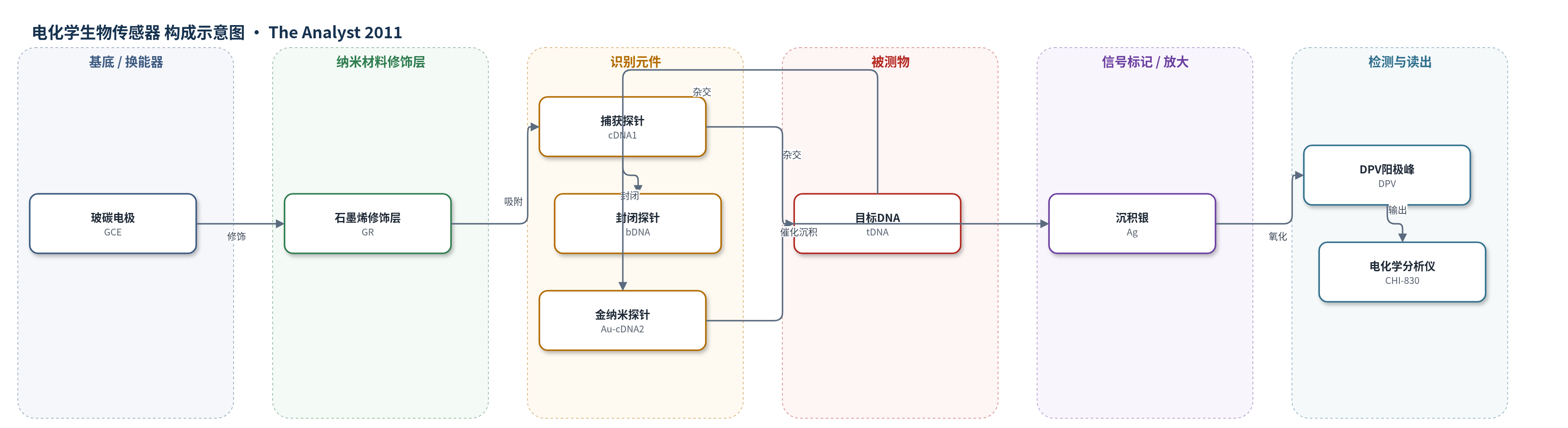
点击图片查看大图 · 依据论文自动绘制
传感器类型
电化学生物传感器
检测对象
目标 DNA 序列(target DNA, tDNA);样品基质:0.5×TBE/300 mM NaNO3 缓冲液中的寡核苷酸 DNA
检测原理
石墨烯修饰 GCE 通过 π-π 堆积固定捕获探针 cDNA1,封闭探针 bDNA 降低非特异性吸附。目标 tDNA 与 cDNA1 杂交后,Au-cDNA2 再与 tDNA 杂交形成夹心结构。AuNPs 作为催化核,在银增强液中催化 Ag+ 还原并在其表面沉积 Ag 纳米颗粒,实现信号放大。DPV 在 0.1 M KNO3 中扫描,沉积 Ag 被氧化产生阳极峰电流。tDNA 浓度越高,杂交 Au-cDNA2 越多,沉积 Ag 越多,峰电流越大,且峰电位正移。峰电流与 tDNA 浓度对数呈线性关系,I = 6.612 + 4.759 log c。
检测灵敏度
LOD: 72 pM (S/N = 3);线性范围: 200 pM–500 nM;灵敏度斜率: 4.759(I = 6.612 + 4.759 log c);相关系数: R = 0.998
效应效果
该传感器表现出良好选择性:在 200 nM 条件下,互补序列 DPV 峰电流为 17.23 mA,空白为 0.967 mA,非互补序列为 0.733 mA,单碱基错配序列为 5.551 mA,说明其可区分互补序列与单碱基错配及非互补序列。银沉积 10 min 时,200 nM 目标信号约为空白信号的 17 倍。作者认为石墨烯平台简单、稳定,避免传统金硫键固定中的电化学氧化问题,适合芯片化电子检测。论文未报告 RSD、实际样品回收率或与 ELISA/HPLC/qPCR 的对比,但主张其可用于临床诊断、环境控制、食品分析和药物筛选。
传感器的构成
- 基底/换能器电极:玻碳电极(GCE),经 0.3 和 0.05 μm Al2O3 抛光,作为工作电极。
- 纳米材料修饰层:石墨烯(GR)薄膜,由石墨烯-DMF 分散液滴涂干燥形成,提供大比表面积、导电性和 DNA 固定平台。
- 识别元件:捕获探针 cDNA1(ssDNA),通过 π-π 堆积吸附于 GR 表面,用于捕获目标 DNA。
- 封闭剂:封闭探针 bDNA,进一步吸附于 GR/cDNA1 表面,减少非特异性吸附。
- 识别/信号探针:金纳米粒子标记寡核苷酸探针 Au-cDNA2(cDNA2 修饰 AuNPs),与目标 DNA 杂交形成夹心结构并提供催化银沉积位点。
- 信号放大元件:银增强液(含 AgNO3、柠檬酸、柠檬酸钠、对苯二酚、五水合硫代硫酸钠),在 AuNPs 表面催化沉积银(Ag)。
- 检测介质/读出:0.1 M KNO3 电解液,差分脉冲伏安法(DPV)检测沉积银的阳极氧化峰。
中文摘要
DNA 在人体中具有重要作用,DNA 损伤与阿尔茨海默病及多种癌症密切相关,因此亟需灵敏、特异的 DNA 检测方法。本文报道了一种基于石墨烯与 DNA 偶联金纳米粒子组装的电化学生物传感器。该传感器以石墨烯修饰玻碳电极为平台,利用石墨烯与单链 DNA 碱基间的 π-π 堆积作用,将捕获探针 cDNA1 直接固定于电极表面,并用封闭探针 bDNA 降低非特异性吸附。目标 DNA(tDNA)与电极上的 cDNA1 杂交后,再与金纳米粒子标记的寡核苷酸探针 Au-cDNA2 杂交,形成夹心结构。随后,AuNPs 催化银增强液中的银离子在探针表面沉积为银颗粒,实现信号放大。差分脉冲伏安法(DPV)检测沉积银的阳极氧化峰电流,峰电流随 tDNA 浓度升高而增大。该传感器线性范围为 200 pM–500 nM,检出限为 72 pM,并能区分互补序列与单碱基错配序列,有望用于临床诊断、环境控制和药物发现。
英文摘要
Sensitive and selective detection of DNA is in urgent need due to its important role in human bodies. Many disorders, such as Alzheimer's disease and various cancers, are closely related with DNA damage. In this work, a novel electrochemical DNA biosensor was constructed on a DNA-assembling graphene platform which provided a robust, simple and biocompatible platform with large surface area for DNA immobilization. The as-designed DNA sensor was fabricated by directly assembling captured ssDNA on a graphene-modified electrode through the π-π stacking interaction between graphene and ssDNA bases. Then, the target DNA sequence and oligonucleotide probes-labeled AuNPs were able to hybridize in a sandwich assay format, following the AuNPs-catalyzed silver deposition. The deposited silver was further detected by differential pulse voltammetry. Owing to the high DNA loading ability of graphene and the distinct signal amplification by AuNPs-catalyzed silver staining, the resulting biosensor exhibited a good analytical performance with a wide detection linear range from 200 pM to 500 nM, and a low detection limit of 72 pM. Additionally, the biosensor was proved to be able to discriminate the complementary sequence from the single-base mismatch sequence. The simple biosensor is promising in developing electronic, on-chip assays in clinical diagnosis, environmental control, and drug discovery.