组成图示
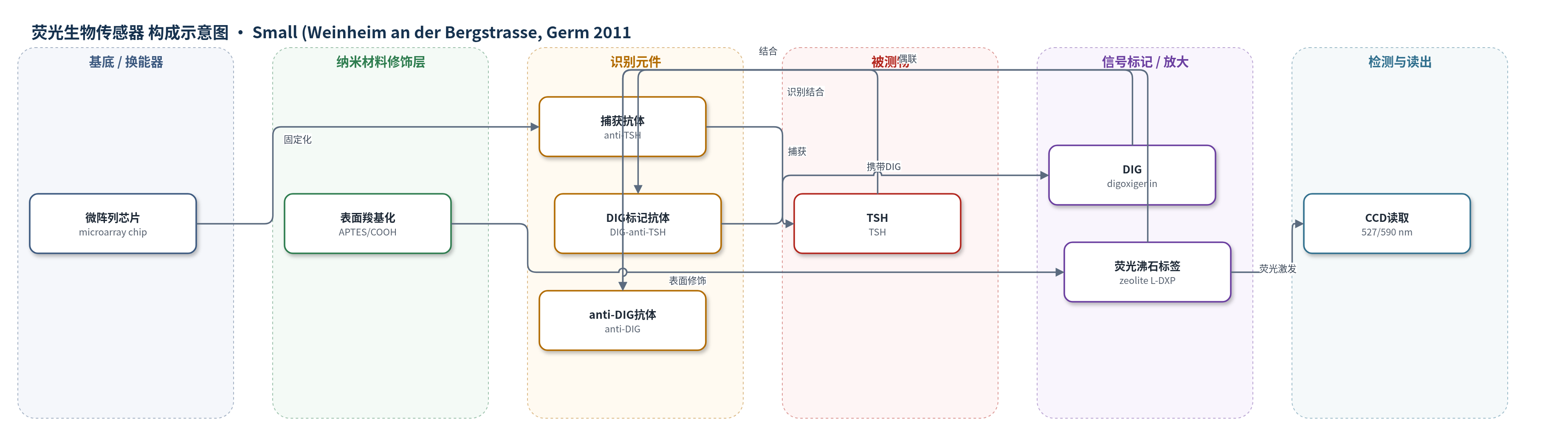
点击图片查看大图 · 依据论文自动绘制
传感器类型
荧光生物传感器
检测对象
促甲状腺激素(thyroid-stimulating hormone, TSH);样品基质:TSH标准溶液/微阵列缓冲液(原文未明确临床血清)
检测原理
蛋白微阵列芯片表面固定anti-TSH捕获抗体,TSH与捕获抗体特异性结合;DIG标记anti-TSH再结合TSH,形成夹心复合物并暴露DIG。anti-DIG偶联的荧光沸石L纳米晶通过DIG–anti-DIG高亲和识别结合到复合物上。沸石L一维通道内负载疏水性DXP染料,在527±35 nm激发下发射590±35 nm荧光。TSH浓度越高,表面结合的荧光标签越多,荧光强度越大。信号放大主要来自单个沸石纳米晶容纳大量DXP染料(约7%单元负载),以及anti-DIG/DIG高亲和低背景识别对;无酶催化或核酸放大。
检测灵敏度
LDL: 0.0033 μUI mL−1(line 3);R^2 = 0.999;乳胶珠对照 LDL: 0.0023 μUI mL−1
效应效果
ELISA校准曲线在2.5–50 ng mL−1线性良好,测得沸石表面活性anti-DIG约357 μg mL−1(约58 μg抗体/mg沸石),上清未结合抗体仅7 μg mL−1,说明偶联充分且游离抗体竞争可忽略。20片微阵列在1.5 μUI mL−1 TSH下重复检测,片间CV<5%,背景低。TSH标准曲线R^2=0.999,LDL约0.0033 μUI mL−1,达飞摩尔级;与荧光乳胶珠对照(LDL=0.0023 μUI mL−1)相比,未经优化即接近其灵敏度。作者认为该荧光沸石标签非特异结合低、信号稳定,适合蛋白微阵列高灵敏免疫分析和体外诊断。
传感器的构成
- 微阵列芯片表面:蛋白微阵列芯片(protein microarray chip)表面,固定化捕获抗体,用于TSH免疫分析
- 捕获识别层:抗TSH抗体(anti-TSH),固定于芯片点阵,特异性捕获TSH
- 信号连接抗体:DIG标记抗TSH抗体(DIG-anti-TSH),结合已捕获TSH并暴露DIG
- 荧光纳米标签:沸石L纳米晶(zeolite L nanocrystals),一维通道负载DXP,提供高亮度荧光信号
- 纳米晶表面修饰层:APTES氨基化后戊二酸酐羧基化,引入-COOH用于抗体偶联
- 识别元件:地高辛抗体(anti-DIG),经EDC/sulfo-NHS酯连接子偶联于沸石L,识别DIG
- 封闭/稳定剂:BSA IV、Tween 20、MIT、氯乙酰胺,封闭非特异位点并稳定共轭物
- 信号读出:CCD相机/自动微阵列系统,527±35 nm激发、590±35 nm发射读取荧光
中文摘要
本文报道将含疏水性荧光染料N,N′-双(2,6-二甲基苯基)芘-3,4,9,10-四羧酸二酰亚胺(DXP)的沸石L纳米晶作为生物传感器系统新型荧光标签。沸石L的一维纳米通道可定向容纳DXP,保护染料并降低聚集;外表面经3-氨基丙基三乙氧基硅烷(APTES)氨基化及戊二酸酐羧基化,引入羧基用于与抗体伯胺偶联。采用EDC/sulfo-NHS酯连接子将地高辛抗体(anti-DIG)固定于沸石L表面,与地高辛(DIG)构成高亲和、低背景通用识别对。动态光散射和酶联免疫吸附测定(ELISA)表征证明抗体成功固定且保留结合活性。基于该纳米晶标签的蛋白微阵列荧光夹心免疫分析用于检测促甲状腺激素(TSH),检出限达飞摩尔级,显示体外诊断潜力。
英文摘要
Zeolite L nanocrystals, as inorganic host material containing hydrophobic fluorophore N,N'-bis(2,6-dimethylphenyl)perylene-3,4,9,10-tetracarboxylic diimide in the unidirectional channels, are developed as new labels for biosensor systems. The external surface of the particles is modified with carboxylic acid groups for conjugation to primary amines of biomolecules such as antibodies. Anti-digoxigenin (anti-DIG) is selected to be immobilized on zeolite L via N-hydroxysulfosuccinimide ester linker. Together with DIG, it serves as a good universal binding pair for diverse analyte detection owing to the high binding affinity and low background noise. The conjugates are characterized by the dynamic light scattering technique for their hydrodynamic diameters and by enzyme-linked immunosorbent assay for antigen-antibody binding behavior. The characterizations prove that anti-DIG antibodies are successfully immobilized on zeolite L with their binding activities maintained. The microarray fluorescent sandwich immunoassay based on such nanocrystalline labels shows high sensitivity in a thyroid-stimulating hormone assay with the lower detection limit down to the femtomolar range. These new fluorescent labels possess great potential for in vitro diagnostics applications.