组成图示
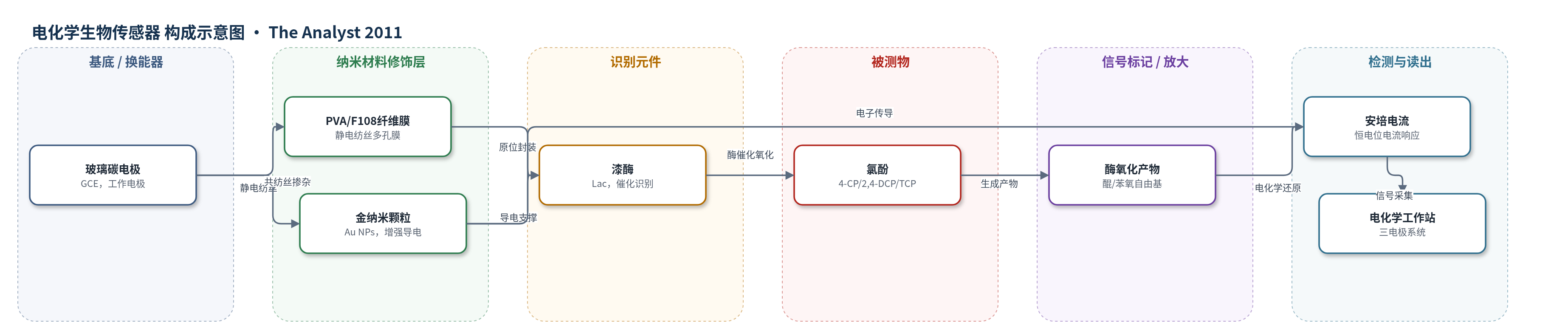
点击图片查看大图 · 依据论文自动绘制
传感器类型
电化学生物传感器
检测对象
氯酚(chlorophenols, CPs),包括4-氯酚(4-CP)、2,4-二氯酚(2,4-DCP)、2,4,6-三氯酚(2,4,6-TCP);样品基质:0.2 mol L−1磷酸盐缓冲液(PBS,pH 5.5,模拟水样)
检测原理
氯酚进入PVA/F108/Au NPs纳米纤维膜后,被原位封装的云芝漆酶(Lac)催化发生单电子氧化,生成苯氧自由基,并进一步转化为醌类等可电化学还原产物。在固定工作电位下,这些产物在玻璃碳电极表面被还原,产生与氯酚浓度相关的阴极安培电流。Au NPs增强纤维膜导电性和界面电子转移,PVA/F108纳米纤维提供高比表面积、多孔传质通道和生物相容微环境,使酶保持活性并促进底物接近活性中心。随着氯酚浓度升高,酶催化产物增多,还原电流线性增大;表观Michaelis–Menten常数反映酶对底物的亲和性,2,4-DCP的Kmapp最低,因此灵敏度最高。
检测灵敏度
LOD: 2.70 mmol L−1 (2,4-DCP)、9.33 mmol L−1 (2,4,6-TCP)、12.09 mmol L−1 (4-CP);摘要另报 0.04 mM (S/N=3, 2,4-DCP) 与 12.10 mM (4-CP);线性范围: 1–25 mmol L−1;R^2 = 0.9889 (2,4-DCP)、0.9891 (2,4,6-TCP)、0.9924 (4-CP)
效应效果
该传感器对三种氯酚的灵敏度顺序为2,4-DCP > 2,4,6-TCP > 4-CP,表明对邻位取代氯酚响应更强;论文未报告实际水样加标回收率及常见干扰物抗干扰实验。重复性RSD分别为4-CP 7.6%、2,4-DCP 2.8%、2,4,6-TCP 9.0%;6个电极间重现性RSD分别为14.9%、10.4%和13.7%。4 ℃ PBS中储存30 d后漆酶保留65.8%初始活性,与化学固定漆酶聚合物基质传感器(约65%)相当。与文献相比,2,4-DCP的Kmapp为9.41 mmol L−1,低于漆酶固定于Cu-OMC/壳聚糖膜检测儿茶酚的40.2 mmol L−1和漆酶修饰石墨电极检测4-CP的22.4 mmol L−1,显示较高催化亲和性。作者认为其简单、低成本、可在线监测,适用于氯酚检测。
传感器的构成
- 基底/换能器电极:玻璃碳电极(GCE,直径3 mm),作为工作电极与电子传导基底
- 静电纺丝纳米纤维膜:聚乙烯醇(PVA,PVA-124)与聚氧乙烯-聚氧丙烯-聚氧乙烯三嵌段共聚物(F108)共纺丝形成多孔纤维膜,提供生物相容性、高比表面积和机械支撑
- 导电纳米添加剂:金纳米颗粒(Au NPs,由氯金酸与柠檬酸钠还原制备),分散于纤维中增强电导和界面电子转移
- 识别/催化元件:云芝漆酶(Lac,Trametes versicolor laccase),原位封装于PVA/F108/Au NPs纳米纤维中,催化氯酚氧化
- 反应介质:0.2 mol L−1磷酸盐缓冲液(PBS,pH 5.5),作为支持电解质和酶反应介质
- 信号读出:三电极电化学系统(GCE工作电极、饱和甘汞电极SCE、铂丝对电极)与恒电位安培检测
中文摘要
本文开发了一种基于云芝漆酶(Lac)的电化学生物传感器,用于酚类化合物检测。该传感器通过原位静电纺丝聚乙烯醇(PVA)、漆酶、聚氧乙烯-聚氧丙烯-聚氧乙烯三嵌段共聚物(F108)和金纳米颗粒(Au NPs)混合液制备,其中F108用作酶稳定添加剂,Au NPs用于增强传感器导电性。激光共聚焦扫描显微镜和电化学阻抗谱证明漆酶被成功封装到静电纺丝纳米纤维中。在最优条件下,2,4-二氯酚(2,4-DCP)的最低检测限为0.04 mM(S/N=3),4-氯酚(4-CP)的最高检测限为12.10 mM。线性范围内氯酚的灵敏度顺序为2,4-DCP > 2,4,6-三氯酚(2,4,6-TCP) > 4-CP。作者将氯酚传感性能归因于PVA/F108/Au NPs/Lac适宜的电化学界面,其来源于生物相容性、高比表面积(10.42 m2 g−1)以及静电纺丝纳米纤维的优良机械性能。该传感器对4-CP、2,4-DCP和2,4,6-TCP的重复性分别为7.6%、2.8%和9.0%(R.S.D.),重现性分别为14.9%、10.4%和13.7%(R.S.D.)。储存30 d后,漆酶保留65.8%初始活性。
英文摘要
A biosensor based on Trametes versicolor laccase (Lac) was developed for the determination of phenolic compounds. The biosensor was prepared by in situ electrospinning of a mixture of polyvinyl alcohol (PVA), Lac, PEO-PPO-PEO (F108) and gold nanoparticles (Au NPs), where F108 was used as an enzyme stabilizing additive and Au NPs was used to enhance the conductivity of the biosensor. Laser confocal scanning microscopy and electrochemical impedance spectroscopy proved that the enzyme was successfully encapsulated into the electrospun nanofibers. Under the optimal conditions, the lowest detection limit was found to be 0.04 μM (S/N = 3) for 2,4-DCP and the highest detection limit was found to be 12.10 μM for 4-CP. The sensitivity of the biosensor obtained in the linear range for chlorophenols followed the sequence 2,4-dichlorophenol (2,4-DCP) > 2,4,6-trichlorophenol (2,4,6-TCP) > 4-chlorophenol (4-CP). The sensing performance for chlorophenols was attributed to the suitable electrochemical interface of PVA/F108/Au NPs/Lac, resulting from biocompatibility, a high surface area-to-volume ratio (10.42 m(2) g(-1)) and superior mechanical properties of the electrospun nanofibers. The biosensor exhibited good repeatabilities of 7.6%, 2.8% and 9.0% (R.S.D.) and reproducibilities of 14.9%, 10.4% and 13.7% (R.S.D.) for 4-CP, 2,4-DCP and 2,4,6-TCP, respectively. Lac retained 65.8% of its initial activity after a 30-day storage period.