组成图示
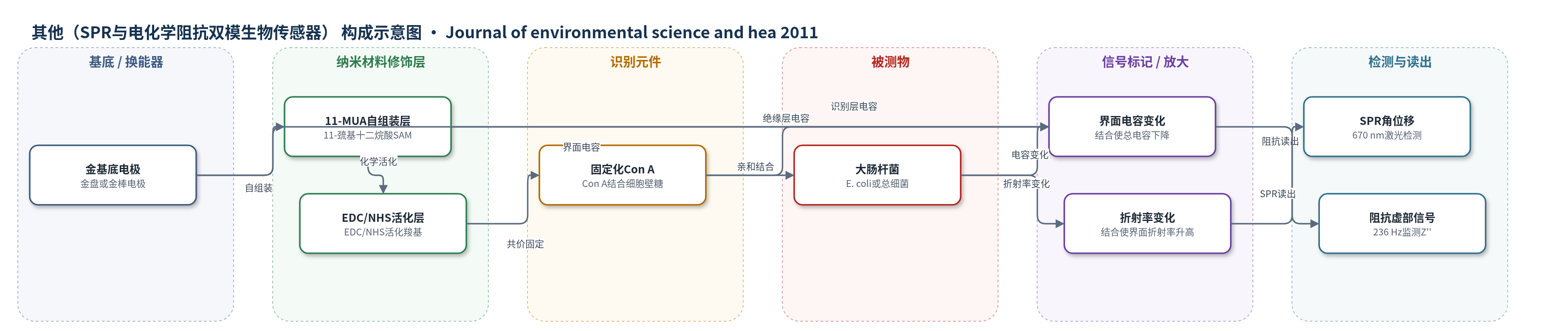
点击图片查看大图 · 依据论文自动绘制
传感器类型
其他(SPR与电化学阻抗双模生物传感器)
检测对象
总细菌(total bacteria,以大肠杆菌 Escherichia coli, E. coli 为模型);样品基质:瓶装饮用水、水库水、废水池水
检测原理
Con A 通过氢键和范德华力与细菌细胞壁上的 α-D-甘露糖/葡萄糖结合,实现无标记亲和识别。在 SPR 系统中,细菌结合使金表面附近质量与折射率增加,导致 SPR 共振角位移 Δθ 增大,Δθ 与细菌浓度相关。在阻抗系统中,11-MUA 绝缘层、Con A 识别层和结合细菌层构成串联电容;细菌结合使总电容下降,在 236 Hz 下虚部阻抗 Z'' 增加,ΔZ'' 与浓度相关。系统使用 200 mM 葡萄糖盐酸液(pH 2.00)通过糖竞争和低 pH 解离细菌,实现再生。方法未使用酶或核酸放大,灵敏度来自低流速流动池、大样品体积和 Z'' 监测。
检测灵敏度
SPR: LOD: 6.1 × 10^7 CFU mL−1;线性范围: 6.1 × 10^7–2.4 × 10^8 CFU mL−1;斜率: (4.7 ± 0.2) × 10^−8 millidegree per CFU mL−1;r = 0.997。阻抗: LOD: 12 CFU mL−1(初始 IUPAC LOD: 55 CFU mL−1);线性范围: 12–1.2 × 10^6 CFU mL−1;校准式: y = (3.27 ± 0.08) log(x) + (8.6 ± 0.8)。
效应效果
该传感器以 Con A 识别多种细菌细胞壁糖,适用于总细菌筛查,但样品中游离糖/淀粉可能竞争干扰,稀释可减轻。阻抗系统经 200 mM 葡萄糖盐酸液(pH 2.00)再生,可重复29–35次;前35次再生平均剩余活性95±3%(RSD=3.2%),之后降至85%。实际水样中,瓶装饮用水直接检测得98±11和67±16 CFU/mL,与平板计数法(100±28、60±28 CFU/mL)接近;水库和废水稀释后结果较PCA低约2–10%。加标回收率为92%–117%,RSD 1.1%–24%。相比直接质量法(LOD 10^3 CFU/mL)更灵敏,虽高于Wan等2 CFU/mL,但单次分析<20 min且实时,可用于水源总细菌快速筛查。
传感器的构成
- 基底/换能器:SPR用50 nm金膜BK-7玻璃金盘,阻抗用直径3 mm金棒电极,活性面积7.1 mm²,作为换能表面。
- 自组装修饰层:150 mM 11-巯基十二烷酸(11-MUA)在金表面形成SAM,提供羧基并绝缘。
- 化学活化层:0.2 M EDC/0.05 M NHS活化11-MUA羧基,形成活性酯用于共价偶联。
- 识别元件:2.0 mg/mL刀豆蛋白A(Con A)在10 mM醋酸钠pH 4.00中共价固定,结合细菌细胞壁α-D-甘露糖/葡萄糖。
- 封闭/绝缘层:SPR用1.0 M乙醇胺pH 8.50和1% BSA封闭非特异结合;阻抗用1.0 M乙醇胺pH 8.50和10 mM十二硫醇乙醇溶液完成绝缘。
- 流动池与读出:10 µL流动池;SPR配棱镜、匹配油、670 nm p偏振激光和光电二极管;阻抗配Ag/AgCl参比、不锈钢辅助电极和阻抗分析仪。
中文摘要
本文报道了基于固定化刀豆蛋白A(Con A)的实时无标记亲和生物传感器,用于检测并计数总细菌。作者分别构建了流动注射表面等离子共振(SPR)和电化学阻抗亲和生物传感器,利用 Con A 与大肠杆菌(E. coli)细胞壁碳水化合物之间的亲和结合实现识别。Con A 通过 11-巯基十二烷酸自组装单分子层固定于金电极表面,结合事件引起 SPR 角位移或电极界面阻抗变化。两种方法单次分析时间均小于20 min,并可用 200 mM 葡萄糖盐酸溶液(pH 2.00)再生,传感器可重复使用29–35次。阻抗检测的检出限显著低于 SPR,分别为12 CFU/mL和6.1×10^7 CFU/mL。利用阻抗系统对实际水样进行分析,并与平板计数琼脂法比较,所得细菌浓度仅略低于传统方法。结果表明,所提出的系统可作为快速筛查和计数水源中总细菌的实用工具。
英文摘要
This work presents the results of the use of flow injection surface plasmon resonance and impedimetric affinity biosensors for detecting and enumerating total bacteria based on the binding between E. coli and Con A, immobilized on a modified gold electrode. The single analysis time for both techniques was less than 20 min. Dissociation between the immobilized Con A and the E. coli using 200 mM of glucose in HCl at pH of 2.00 enabling the sensor to be reused for between 29-35 times. Impedimetric detection provided a much lower limit of detection (12 CFU mL(-1)) than the surface plasmon resonance method (6.1 × 10(7) CFU mL(-1)). Using the impedimetric system, real sample analysis was performed and the results were compared to the plate count agar method. Cell concentrations obtained by the biosensor were only slightly different from the result obtained from the plate count agar. The proposed system offers a rapid and useful tool for screening detection and enumeration of total bacteria.