组成图示
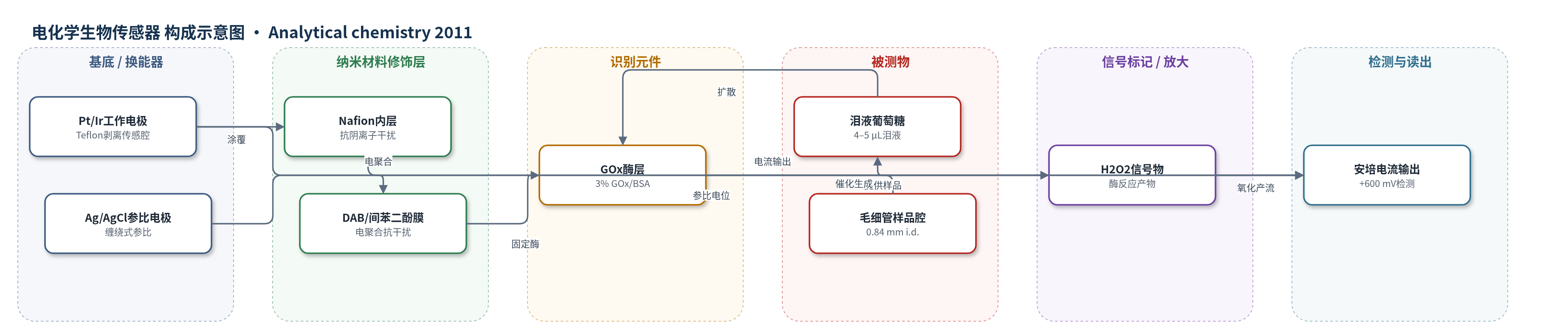
点击图片查看大图 · 依据论文自动绘制
传感器类型
电化学生物传感器
检测对象
泪液葡萄糖(glucose, Glc);对照样品基质为全血(whole blood)
检测原理
泪液中的葡萄糖扩散进入GOx酶层,被葡萄糖氧化酶催化氧化,同时消耗氧气并生成过氧化氢(H2O2)。H2O2在+600 mV(vs Ag/AgCl)工作电极上发生阳极氧化,产生与葡萄糖浓度成正比的安培电流。传感腔内的Nafion层和电聚合1,3-二氨基苯/间苯二酚膜可排斥或阻挡抗坏血酸、尿酸及对乙酰氨基酚等电活性干扰物,提高选择性。由于未设置外层扩散限制膜,葡萄糖可快速到达酶层,从而获得低检出限。传感器插入含4–5 μL泪液的毛细管后,记录插入后2 min的电流,经校准曲线换算为泪液葡萄糖浓度。
检测灵敏度
LOD: 1.5 ± 0.4 μM (S/N = 3);灵敏度: 0.032 ± 0.02 nA/μM (n = 6);线性范围: 至少至800 μM(校准范围5–800 μM);5 wt% GOx版本: LOD 0.62 μM,灵敏度提高近5倍
效应效果
传感器对泪液主要干扰物选择性良好:100 μM抗坏血酸、100 μM尿酸和10 μM对乙酰氨基酚相对100 μM葡萄糖的误差分别为7.56%、11.16%和4.85%。重复性方面,5次测量100 μM葡萄糖得102.5±3.2 μM,20 μM得19.10±0.23 μM。样品量仅需4–5 μL。在12只麻醉兔中连续8 h、每30 min同步检测泪液与血糖,单只兔相关系数r2为0.9126和0.8894;全部数据合并r2=0.4867,按时间平均后线性r2=0.9475,二次多项式r2=0.9835。作者认为泪液葡萄糖可作为血糖无创监测的潜在替代,但需个体化校准。
传感器的构成
- 工作电极/基底:Teflon包覆铂/铱(Pt/Ir)丝,外径约0.2–0.25 mm,剥离Teflon形成1 mm传感腔,作为安培换能器。
- 参比电极:银/氯化银(Ag/AgCl)丝,外径0.1 mm,由Ag丝在FeCl3/HCl中制备并缠绕于Pt/Ir丝4 mm,提供稳定参比电位。
- 绝缘封装层:热缩聚酯套管,覆盖Ag/AgCl上方直段,防止短路并保护导线。
- 抗干扰内层1:Nafion(5 wt%)薄膜,约5 μm,涂覆于传感腔,排斥阴离子干扰物。
- 抗干扰内层2:电聚合1,3-二氨基苯/间苯二酚(DAB/resorcinol)膜,0至+830 mV、2 mV/s循环18 h,增强对尿酸、抗坏血酸选择性。
- 识别/催化层:葡萄糖氧化酶(GOx,3 wt%)与牛血清白蛋白(BSA,3 wt%)混合液1 μL干燥成酶层,催化葡萄糖氧化生成H2O2。
- 交联固定剂:戊二醛(2% v/v)1 μL,交联固定GOx,提高酶层稳定性。
- 样品收集腔:内径约0.84–0.85 mm玻璃毛细管,容纳4–5 μL泪液,远端Critoseal蜡封,使针式传感器插入后溶液覆盖传感区。
中文摘要
本文报道一种用于泪液葡萄糖检测的安培型针式电化学葡萄糖传感器,并与内径0.84 mm的毛细管联用,以收集微升级泪液样品。传感器将葡萄糖氧化酶固定在铂/铱(Pt/Ir)丝上,通过阳极检测酶反应释放的过氧化氢。传感腔内依次构建Nafion层和电聚合1,3-二氨基苯/间苯二酚膜,显著提高对泪液中抗坏血酸、尿酸等电活性干扰物的选择性。优化后的传感器对葡萄糖的检出限为1.5±0.4 μM(S/N=3),灵敏度为0.032±0.02 nA/μM(n=6),插入毛细管时仅需4–5 μL泪液。在麻醉兔模型中连续8 h同步测量泪液葡萄糖和血糖,结果显示泪液与血糖水平存在显著相关,提示泪液葡萄糖检测可作为血糖监测的潜在无创替代方法,该传感器构型有助于进一步开展临床前研究。
英文摘要
An amperometric needle-type electrochemical glucose sensor intended for tear glucose measurements is described and employed in conjunction with a 0.84 mm i.d. capillary tube to collect microliter volumes of tear fluid. The sensor is based on immobilizing glucose oxidase on a 0.25 mm o.d. platinum/iridium (Pt/Ir) wire and anodically detecting the liberated hydrogen peroxide from the enzymatic reaction. Inner layers of Nafion and an electropolymerized film of 1,3-diaminobenzene/resorcinol greatly enhance the selectivity for glucose over potential interferences in tear fluid, including ascorbic acid and uric acid. Further, the new sensor is optimized to achieve very low detection limits of 1.5 ± 0.4 μM of glucose (S/N = 3) that is required to monitor glucose levels in tear fluid with a glucose sensitivity of 0.032 ± 0.02 nA/μM (n = 6). Only 4-5 μL of tear fluid in the capillary tube is required when the needle sensor is inserted into the capillary. The glucose sensor was employed to measure tear glucose levels in anesthetized rabbits over an 8 h period while also measuring the blood glucose values. A strong correlation between tear and blood glucose levels was found, suggesting that measurement of tear glucose is a potential noninvasive substitute for blood glucose measurements, and the new sensor configuration could aid in conducting further research in this direction.