组成图示
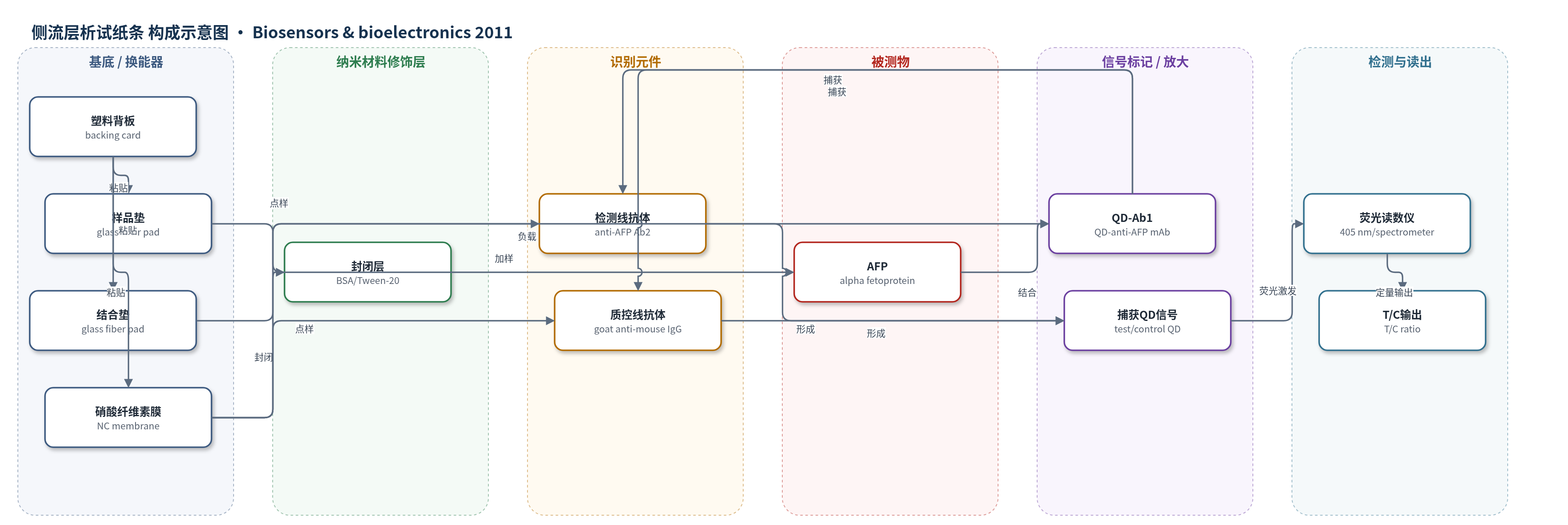
点击图片查看大图 · 依据论文自动绘制
传感器类型
侧流层析试纸条
检测对象
甲胎蛋白(alpha fetoprotein, AFP),样品基质:人血清(human serum)
检测原理
样品加入样品垫后,经毛细作用迁移至结合垫,释放 QD-Ab1。样品中 AFP 与 QD-Ab1 结合形成 QD-Ab1-AFP 复合物,继续迁移至 NC 膜检测线,被固定抗 AFP 抗体 Ab2 捕获,形成 QD-Ab1-AFP-Ab2 三明治复合物;过量 QD-Ab1-AFP 或 QD-Ab1 被质控线抗鼠 IgG 捕获。AFP 浓度越高,检测线捕获 QD 越多,检测线荧光强度越高。自制读数仪用 405 nm 激光激发 QD,光纤光谱仪检测 T 线和 C 线荧光,以 T/C 比值定量,校正试纸条和血清基质差异。
检测灵敏度
LOD: 1 ng/mL;LOD: 3.6 ng/mL;线性范围: 0 < x < 25 ng/mL;灵敏度斜率: 0.01415;R^2 = 0.9956;多项式校准 R^2 = 0.991
效应效果
该传感器在 10 min、50 μL 样品条件下可检测 1 ng/mL AFP,灵敏度与商品化电化学发光免疫分析(ECL)AFP 试剂盒相当(ECL 灵敏度达 pmol 水平)。以 25 ng/mL 为临界值(由 61 份健康人血清确定),1000 份临床人血清样本与商品 ECL 试剂盒同步检测,除 24 例假阳性(3.92%)和 17 例假阴性(4.38%)外高度一致,总错误率 4.10%。相比胶体金试纸条,QD 荧光标记可避免溶血血清颜色干扰,并支持肉眼定性判读和读数仪定量输出。作者认为该平台快速、低成本、易操作,适用于医院定量检测和其他肿瘤标志物即时检测。
传感器的构成
- 基底/支撑层:塑料背板(backing card),用于粘贴各功能垫并支撑试纸条。
- 样品垫:玻璃纤维样品垫(sample pad),预饱和含 20 mM 硼酸钠、2% 蔗糖、2% BSA、0.1% NaN3 的 pH 8.0 缓冲液,用于加样和预处理。
- 结合垫:玻璃纤维结合垫(conjugate pad),负载稀释后的 QD-Ab1 结合物,供样品迁移时释放标记抗体。
- 层析膜:硝酸纤维素膜(NC membrane),作为免疫反应载体,其上点样检测线和质控线。
- 封闭层:3% BSA 和 0.1% Tween-20 的 PBS 封闭液处理 NC 膜,降低非特异性吸附。
- 识别元件:检测线固定抗 AFP 单克隆抗体(Ab2),质控线固定抗鼠 IgG 二抗(goat anti-mouse IgG),用于捕获免疫复合物。
- 信号标记物:CdSe 量子点(QD)经亲水三嵌段共聚物(PBA/PEA/PMA)包覆并偶联抗 AFP 单克隆抗体(Ab1),形成 QD-Ab1 标记物。
- 吸收垫:吸收垫(absorbent pad),吸收多余液体,维持毛细流动。
- 读数仪:405 nm 激光二极管、光纤光谱仪、步进电机控制器、平板电脑和微型打印机,用于激发 QD 荧光并定量 T/C 比值。
中文摘要
肿瘤标志物快速、定量、高灵敏高特异检测对癌症临床诊断与治疗至关重要。本文报道了一种新型便携式荧光生物传感器,将量子点(QD)与免疫层析试纸条(ICTS)及自制试纸条读数仪集成,用于人血清肿瘤标志物检测。以甲胎蛋白(AFP)作为模型肿瘤标志物,验证该免疫传感器性能。该传感器基于在 ICTS 上进行的夹心免疫反应,检测线和质控线上捕获的 QD 标记荧光强度作为信号,由自制读数仪测定。QD 的强发光和良好光稳定性,结合 ICTS 的便捷优势及读数仪的灵敏检测,使传感器表现良好。在最佳条件下,该生物传感器仅需 50 μL 样品、10 min 即可检测低至 1 ng/mL 的 AFP 标准品。此外,1000 份临床人血清样本同时用 QD 基 ICTS 和商品化电化学发光免疫分析 AFP 试剂盒检测,以评估灵敏度、特异性和一致性。结果显示除 24 例假阳性(假阳性率 3.92%)和 17 例假阴性(假阴性率 4.38%)外高度一致,总错误率为 4.10%。这表明 QD 基 ICTS 能实现 AFP 的快速、灵敏、定量检测,并有望用于其他肿瘤标志物的即时检测。
英文摘要
Rapid, quantitative detection of tumor markers with high sensitivity and specificity is critical to clinical diagnosis and treatment of cancer. We describe here a novel portable fluorescent biosensor that integrates quantum dot (QD) with an immunochromatography test strip (ICTS) and a home-made test strip reader for detection of tumor markers in human serum. Alpha fetoprotein (AFP), which is valuable for diagnosis of primary hepatic carcinoma, is used as a model tumor marker to demonstrate the performance of the proposed immunosensor. The principle of this sensor is on the basis of a sandwich immunoreaction that was performed on an ICTS. The fluorescence intensity of captured QD labels on the test line and control line served as signals was determined by the home-made test strip reader. The strong luminescence and robust photostability of QDs combined with the promising advantages of an ICTS and sensitive detection with the test strip reader result in good performance. Under optimal conditions, this biosensor is capable of detecting as low as 1 ng/mL AFP standard analyte in 10 min with only 50 μL sample volume. Furthermore, 1000 clinical human serum samples were tested by both the QD-based ICTS and a commercial electrochemiluminescence immunoassay AFP kit simultaneously to estimate the sensitivity, specificity and concordance of the assays. Results showed high consistency except for 24 false positive cases (false positive rate 3.92%) and 17 false negative cases (false negative rate 4.38%); the error rate was 4.10% in all. This demonstrates that the QD-based ICTS is capable of rapid, sensitive, and quantitative detection of AFP and shows a great promise for point-of-care testing of other tumor markers.