组成图示
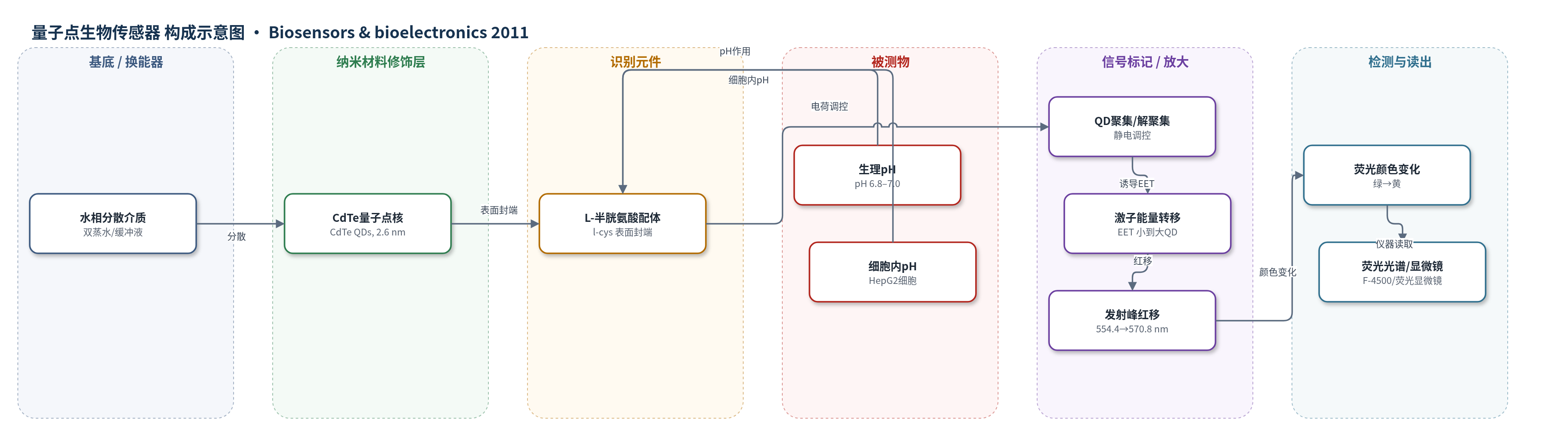
点击图片查看大图 · 依据论文自动绘制
传感器类型
量子点生物传感器
检测对象
细胞内生理pH(intracellular physiological pH, pHi);样品基质:固定HepG2人肝癌细胞、活HepG2细胞、磷酸盐缓冲液/DMEM/PBS
检测原理
L-半胱氨酸封端CdTe QDs在pH 7.0时表面负电荷较强,静电排斥使QDs分散;当pH降至6.8接近等电点时,表面电荷降低,静电排斥减弱,疏水相互作用诱导QDs聚集。由于水相合成QDs尺寸分布较宽,聚集后小尺寸高带隙QDs作为供体,大尺寸低带隙QDs作为受体,发生高效激子能量转移(EET),使发射峰从554.4 nm红移至570.8 nm,荧光强度猝灭,颜色由绿变黄。pH回升时QDs解聚集,EET减弱,发射恢复。荧光光谱或荧光显微镜读取颜色/波长变化,从而指示细胞内生理pH微小变化。
检测灵敏度
原文未报告LOD、线性范围、灵敏度斜率或相关系数。
效应效果
该传感器在pH 7.0至6.8的微小变化下即可产生明显颜色变化,固定HepG2细胞加入pH 6.8缓冲液30 s后由绿变黄,加入pH 7.0缓冲液保持绿色;活细胞加入0.1 M pH 6.8磷酸盐缓冲液后呈黄色,随后加入0.1 mM氯喹10 min后恢复绿色。QD聚集态在给定pH下可稳定数小时,发射波长无明显漂移;pH在7.6与6.6间循环时发射位移至少可逆一个循环,但约20%荧光强度因溶解氧猝灭而损失。QDs对细胞毒性不明显,活细胞孵育后至少可存活6 h,且发射主要位于细胞核边缘溶酶体区域。作者认为该体系可用于快速、直观监测生理和病理状态下的细胞内pH变化。
传感器的构成
- 传感纳米材料:L-半胱氨酸封端CdTe量子点(l-cys-coated CdTe QDs, QDs-1),平均直径2.6±0.4 nm,作为pH响应荧光传感元件
- 表面配体/识别元件:L-半胱氨酸(l-cysteine, l-cys),包覆QD表面,通过pH依赖表面电荷调控QD聚集/解聚集
- 信号标记物:QD自身荧光发射(无外加标记),聚集态通过激子能量转移(EET)产生发射峰红移和颜色变化
- 读出方式:荧光光谱仪(Hitachi F-4500)或荧光显微镜读取发射波长/颜色变化
中文摘要
本文报道了一种基于量子点(QDs)的新型生物传感器,用于通过QDs的pH依赖发射颜色变化监测固定细胞和活细胞中的生理pH变化。作者采用水相合成法制备了名义上单尺寸、但具有本征较宽尺寸分布的L-半胱氨酸封端CdTe QDs。当体系pH从7.0轻微降至6.8时,观察到QDs荧光强度猝灭、发射峰最大红移约16 nm,颜色由绿色变为黄色。该pH依赖发射变化可归因于小尺寸QDs向大尺寸QDs的高效激子能量转移,而该过程受QDs静电调控的聚集/解聚集控制。除高稳定性外,在最优条件下QDs的发射位移至少可逆一个循环。该pH生物传感器有望用于监测生理和病理状态下的细胞内pH变化。
英文摘要
A novel quantum dots (QDs) based biosensor was developed to monitor physiological pH changes in both fixed and living cells by means of pH-dependent emission color of the QDs. In our system, the nominally single-sized colloidal solution samples of the L-cysteine-capped CdTe QDs with intrinsically broadened size distributions were prepared by employing aqueous synthesis technique. The quench of fluorescence intensities of the QDs with a 16 nm red shift of the emission maximum and a color change from green to yellow was observed with a slight pH decrease (from 7.0 to 6.8) in the system. This pH-dependent emission could be attributed to the efficient exciton energy transfer from smaller QDs to larger ones, which was controlled by electrostatic-tuned aggregation/disaggregation (low/high pH values) processes of the QDs. In addition to high stability, the emission shift of the QDs was reversible for at least one cycle under optimal conditions. Our pH biosensor may find potential application for monitoring the intracellular pH changes in both physiological and pathological conditions.