组成图示
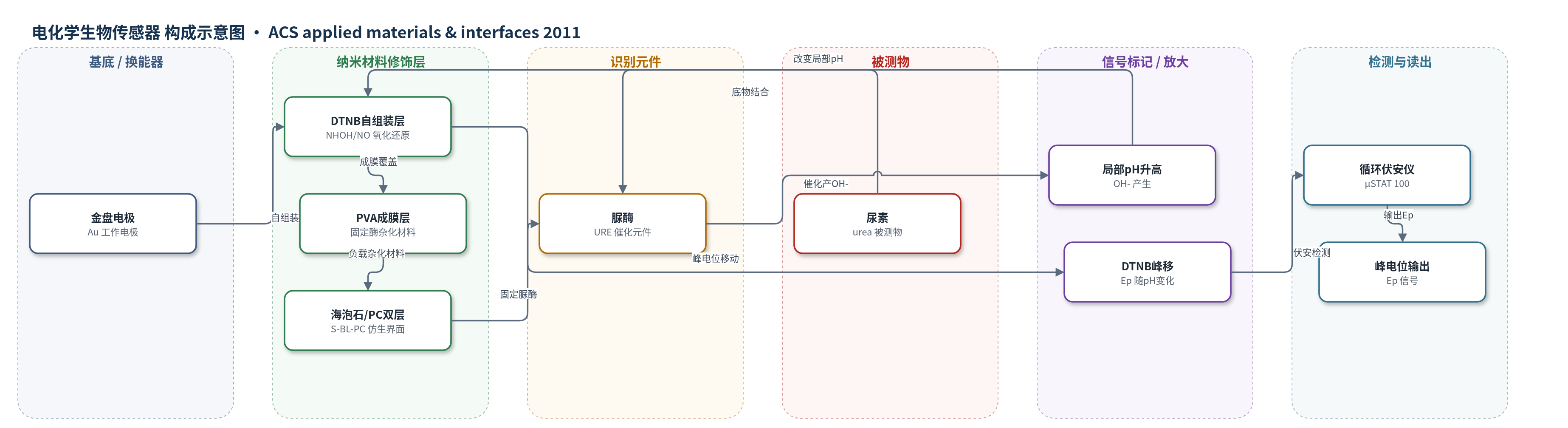
点击图片查看大图 · 依据论文自动绘制
传感器类型
电化学生物传感器
检测对象
尿素(urea),样品基质为磷酸盐缓冲液(PB,pH 7.4),并评估血清/尿液中抗坏血酸干扰;胆固醇(cholesterol),样品基质为含Triton X-100的PB,用于胆固醇氧化酶生物反应器/电化学H2O2检测
检测原理
脲酶传感器中,固定于海泡石/磷脂双层(S-BL-PC)的脲酶(URE)催化尿素水解:(NH2)2CO + 3H2O → 2NH4+ + HCO3- + OH-。尿素浓度越高,酶膜内产生的OH-越多,局部pH升高。金电极表面的DTNB自组装层形成pH敏感氧化还原电对NHOH/NO,其峰电位满足Ep = 0.453 − 0.059 pH,因此pH升高使峰电位负移。循环伏安法读取峰电位变化,信号随尿素浓度增加而增大。PVA膜限制抗坏血酸等干扰物进入,提高选择性;S-BL-PC仿生界面维持脲酶构象与活性,增强响应稳定性。
检测灵敏度
脲酶传感器灵敏度: 30.8 ± 0.7 V M^-1;胆固醇氧化酶(S-ML-PC)线性范围: 0–4.9 μM,灵敏度: 154 mA M^-1;(S-BL-PC)线性范围: 至 3.7 μM,灵敏度: 138 mA M^-1
效应效果
脲酶传感器响应时间60–70 s,干粉末4 ℃保存6个月灵敏度无明显下降;0.1 mM抗坏血酸几乎无干扰,0.25 mM仅使2 mM尿素响应降低2.6%,PVA膜起限域抗干扰作用。胆固醇氧化酶生物反应器在S-ML-PC上10次循环后活性仍为100%,S-BL-PC约60%;第4次后涡旋,S-ML-PC无失活,S-BL-PC活性下降35%,隔夜保存后活性恢复。4周后S-BL-PC的KMapp为15 μM,S-ML-PC为104 μM,表明磷脂双层更稳定。作者认为该仿生界面可稳定酶活性,适用于尿素传感与胆固醇催化反应。
传感器的构成
- 基底/换能器电极:多晶金盘电极(Au),作为工作电极并承载pH敏感氧化还原分子
- 信号标记/换能层:5,5'-二硫代双(2-硝基苯甲酸)(DTNB)自组装单分子层,形成NHOH/NO氧化还原电对,峰电位随pH变化
- 成膜/抗干扰层:聚乙烯醇(PVA)将酶-生物杂化材料分散成膜,覆盖DTNB/Au表面并限制干扰物
- 仿生支撑界面:海泡石(sepiolite, SEP)负载磷脂酰胆碱(PC)支持脂质双层(BL-PC,S-BL-PC),提供类膜环境
- 识别/催化元件:脲酶(URE)固定于S-BL-PC,催化尿素水解产生OH-
- 电极体系:铂辅助电极(Pt)与Ag/AgCl参比电极,用于循环伏安测量
中文摘要
本文报道了基于磷脂酰胆碱(PC)在天然硅酸盐海泡石(sepiolite)表面组装形成的仿生界面,用于脲酶(URE)和胆固醇氧化酶(COx)的稳定固定化。作者制备了支持脂质单层(ML-PC)、支持脂质双层(BL-PC)、PC/辛基-β-D-半乳糖苷混合层(PC-OGal)以及十六烷基三甲基铵(CTA)单层等界面,并与裸海泡石比较。通过水吸附、FTIR、ζ电位等表征层堆积密度、亲疏水性和表面电荷。以胞质酶脲酶和膜结合酶胆固醇氧化酶为模型,考察不同界面对酶固定化及生物活性保持的影响。酶活性通过循环伏安法和紫外-可见光谱评估。脲酶/海泡石-BL-PC杂化材料用作伏安法尿素生物传感器的活性相,胆固醇氧化酶杂化材料用作胆固醇生物反应器。结果表明,BL-PC界面最接近天然膜环境,能长期保持脲酶活性数月,并使胆固醇氧化酶具有较高可重复使用性,说明仿生脂质界面有利于酶活性的保持与稳定。
英文摘要
Biomimetic interfaces based on phosphatidylcholine (PC) assembled to the natural silicate sepiolite were prepared for the stable immobilization of the urease and cholesterol oxidase enzymes. This is an important issue in practical advanced applications such as biocatalysis or biosensing. The supported lipid bilayer (BL-PC), prepared from PC adsorption, was used for immobilization of enzymes and the resulting biomimetic systems were compared to several other supported layers including a lipid monolayer (ML-PC), a mixed phosphatidylcholine/octyl-galactoside layer (PC-OGal), a cetyltrimethylammonium monolayer (CTA), and also to the bare sepiolite surface. Interfacial characteristics of these layers were investigated with a focus on layer packing density, hydrophilicity/hydrophobicity, and surface charge, which are being considered as key points for enzyme immobilization and stabilization of their biological activity. Cytoplasmic urease and membrane-bound cholesterol oxidase, which served as model enzymes, were immobilized on the different PC-based hybrid materials to probe their biomimetic character. Enzymatic activity was assessed by cyclic voltammetry and UV-vis spectrophotometry. The resulting enzyme/bio-organoclay hybrids were applied as active phase of a voltammetric urea biosensor and cholesterol bioreactor, respectively. Urease supported on sepiolite/BL-PC proved to maintain its enzymatic activity over several months while immobilized cholesterol oxidase demonstrated high reusability as biocatalyst. The results emphasize the good preservation of bioactivity due to the accommodation of the enzymatic system within the biomimetic lipid interface on sepiolite.