组成图示
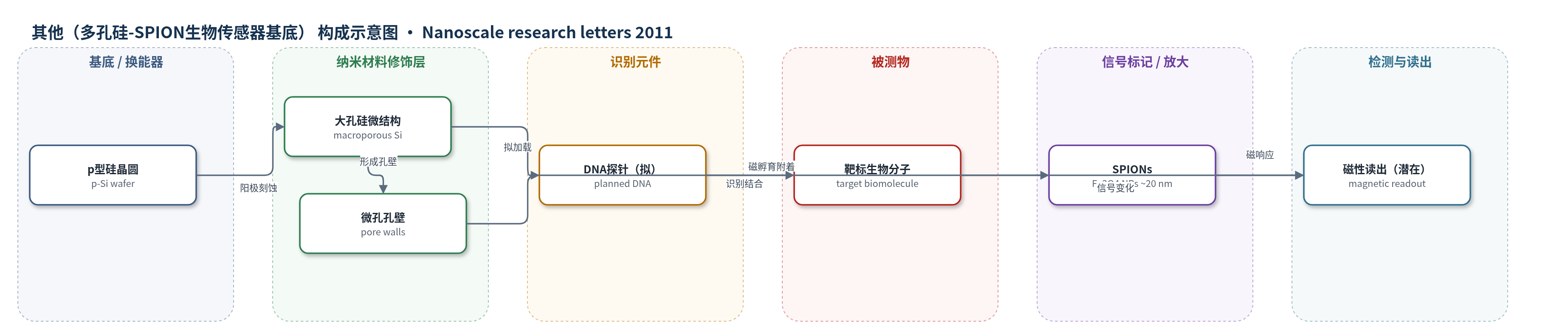
点击图片查看大图 · 依据论文自动绘制
传感器类型
其他(多孔硅-SPION生物传感器基底)
检测对象
未报道具体检测对象;文中仅提出可加载DNA序列用于生物传感,样品基质未说明。
检测原理
论文未建立完整的传感检测流程,也未给出实际被测物浓度与信号定量关系。其潜在原理基于多孔硅界面性质变化:当生物分子吸附或进入大孔硅微试管/微烧杯时,多孔硅的导电性、电容或折射率可能发生改变,从而可通过电学或光学方式读出。SPIONs附着在孔壁和表面,提供超顺磁性响应与生物相容界面;文中还提出未来在特定孔位加载设计DNA序列,使DNA探针与靶标结合后改变界面组成或磁性/光学响应,实现微阵列式生物传感。该工作目前仅完成结构制备、SPION附着与表征,未涉及HCR、RCA、CRISPR-Cas等信号放大策略。
检测灵敏度
未报道。
效应效果
该文未报道生物传感性能,如选择性、抗干扰、RSD、加标回收率或与ELISA/HPLC/qPCR的对比。材料表征显示:SPIONs平均水动力学粒径约20 nm,zeta电位约-50 mV,胶体稳定性较高;室温M-H曲线无磁滞,FC/ZFC曲线显示阻塞温度约100 K,证实超顺磁性。微试管阵列孔径与孔间距约1 μm,长度超过45 μm;微烧杯孔径约1.5 μm,孔壁约100 nm,深度约8.5 μm。SEM与EDX证实Fe存在,水喷淋磁孵育可改善SPIONs向孔内渗透。作者主张该SPION/多孔硅微结构因生物相容而具有生物医学传感潜力。
传感器的构成
- 基底/换能器:p型硅晶圆(p-type Si wafer,(100)取向,电阻率0.01–100 Ω-cm),作为多孔硅模板基底与潜在换能器。
- 多孔硅微结构层:大孔硅(macroporous Si)微试管/微烧杯阵列,由HF/DMF阳极刻蚀形成,提供微孔装载空间与高比表面。
- 纳米材料修饰层:超顺磁性氧化铁纳米颗粒(SPIONs,平均约20 nm,Fe3O4/铁氧化物),通过磁孵育附着于表面和孔壁,提供磁性功能与生物相容界面。
- 识别元件:未报道(文中仅提出未来可加载设计DNA序列,未实际固定)。
中文摘要
本研究在p型硅衬底上,通过N,N-二甲基甲酰胺(DMF)与氢氟酸(HF)阳极刻蚀,制备了横截面和间距可调、均匀分布的微试管与微烧杯阵列,本质上形成大孔硅模板。通过调节形成参数,尤其是晶圆电阻率,可较合理地控制结构尺寸:微试管的孔径及相邻孔间距通常约为1 μm;微烧杯的孔径大于1.5 μm,孔间距可小于100 nm。作者采用化学共沉淀法合成平均粒径约20 nm的超顺磁性氧化铁纳米颗粒(SPIONs),并通过磁孵育将其附着于多孔硅芯片表面及孔壁。由于硅与SPIONs均具有生物相容性,这类SPION包覆的微试管/微烧杯阵列被视为生物传感器的潜在候选。微阵列数据采集是高通量生物传感的重要属性,因此该纳米结构阵列被认为是向高通量生物传感方向迈进的有前景步骤。
英文摘要
A uniformly distributed array of micro test tubes and microbeakers is formed on a p-type silicon substrate with tunable cross-section and distance of separation by anodic etching of the silicon wafer in N, N-dimethylformamide and hydrofluoric acid, which essentially leads to the formation of macroporous silicon templates. A reasonable control over the dimensions of the structures could be achieved by tailoring the formation parameters, primarily the wafer resistivity. For a micro test tube, the cross-section (i.e., the pore size) as well as the distance of separation between two adjacent test tubes (i.e., inter-pore distance) is typically approximately 1 μm, whereas, for a microbeaker the pore size exceeds 1.5 μm and the inter-pore distance could be less than 100 nm. We successfully synthesized superparamagnetic iron oxide nanoparticles (SPIONs), with average particle size approximately 20 nm and attached them on the porous silicon chip surface as well as on the pore walls. Such SPION-coated arrays of micro test tubes and microbeakers are potential candidates for biosensors because of the biocompatibility of both silicon and SPIONs. As acquisition of data via microarray is an essential attribute of high throughput bio-sensing, the proposed nanostructured array may be a promising step in this direction.