组成图示
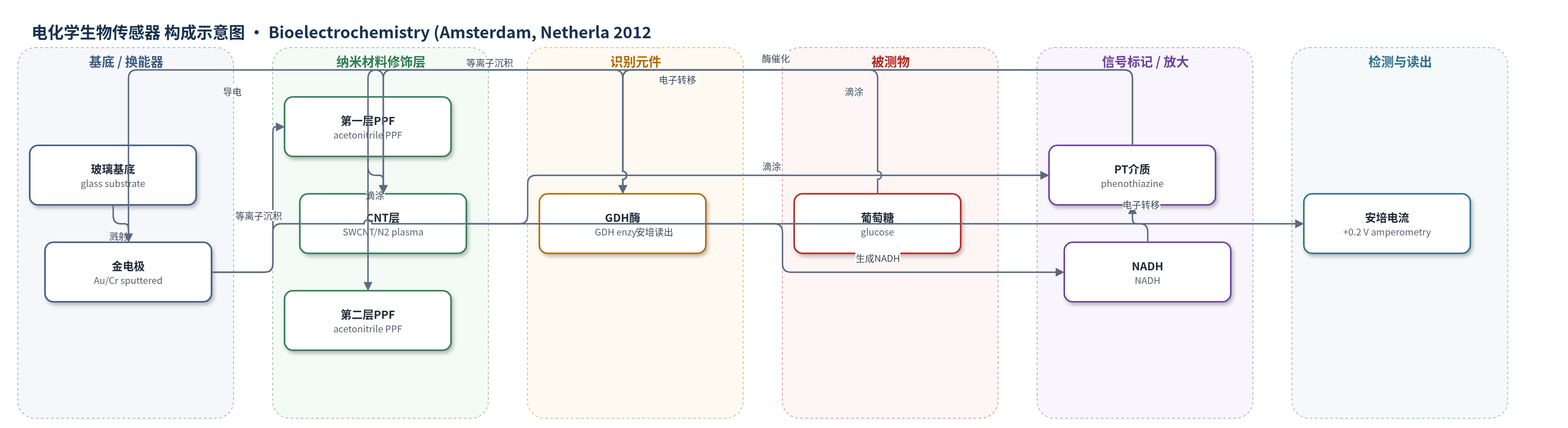
点击图片查看大图 · 依据论文自动绘制
传感器类型
电化学生物传感器
检测对象
葡萄糖(glucose);样品基质:20 mM 磷酸盐缓冲液(pH 7.4,含 0.5 mM NAD+),文中面向生理/糖尿病血糖样品。
检测原理
葡萄糖进入传感器后,被固定于第二层 PPF 下的 GDH 催化氧化,同时 NAD+ 接受氢生成 NADH。NADH 在 SWCNT 表面发生电化学氧化,PT 作为可逆氧化还原介质,将 NADH 的电子传递至 CNT 导电网络,再经 Au 电极收集。CNT 的高导电性和对 NADH 的催化作用降低氧化过电位,PT 进一步将工作电位降至 +0.2 V,减少干扰并提高信噪比。第一层 PPF 通过尺寸筛分阻挡抗坏血酸等干扰物,第二层 PPF 固定酶并防止流失。葡萄糖浓度升高时,NADH 生成量增加,安培电流随之增大,在 4.9–19 mM 范围内呈线性响应。
检测灵敏度
LOD: 0.12 mM (S/N=3);线性范围: 4.9–19 mM;灵敏度: 5.1±0.9 μA mM−1 cm−2 at +0.2 V vs. Ag/AgCl;r = 0.959;响应时间: 5±1 s;Imax: 0.24±0.01 mA cm−2;KMapp: 6.7±0.4 mM (r = 0.998)
效应效果
优化传感器背景电流为 2.7±0.4 μA cm−2,2.5 mM 葡萄糖响应为 66±4 μA cm−2,无需基线校准。0.5 mM 抗坏血酸干扰响应为 5.8±0.7 μA cm−1,相当于 0.22 mM 葡萄糖,生理条件下干扰可忽略。连续极化 10 h 后电流保持初始值的 95% 以上;4 °C 储存 3 d 保持约 90%,7 d 降至约 75%。灵敏度测定 n=4,储存稳定性 n=3。作者认为该干法等离子体工艺兼容半导体层状制备,适合高通量生物电子器件和生物芯片,并可扩展至脱氢酶类传感。
传感器的构成
- 基底/换能器电极:0.15 mm 玻璃基底,40 nm Cr 粘附层与溅射 Au 工作电极,提供导电与信号收集。
- 第一层修饰膜:6 nm 乙腈等离子体聚合膜(acetonitrile PPF),作为选择性扩散膜和 CNT 成膜支架。
- 导电/催化层:单壁碳纳米管(SWCNT)滴涂层,经 N2 等离子体处理,提供导电通路并催化 NADH 氧化。
- 电子转移介质层:吩噻嗪(PT,30 mM 甲醇滴涂),介导 NADH 氧化电子向 CNT/Au 传递。
- 识别/催化元件:葡萄糖脱氢酶(GDH,10 mg/mL 磷酸盐缓冲液滴涂),催化葡萄糖氧化并生成 NADH。
- 第二层修饰膜:6 nm 乙腈 PPF 覆盖层,作为酶固定基质,防止 GDH 和 CNT 流失。
中文摘要
本文报道了一种基于多层膜的安培葡萄糖生物传感器的新型制备方案。该传感器由溅射金电极、乙腈等离子体聚合膜(PPF)、碳纳米管(CNT)、电子转移介质吩噻嗪(PT)和葡萄糖脱氢酶(GDH)依次构成,记为 PPF/GDH/PT/CNT/PPF/Au。第一层 PPF 沉积于金表面,作为选择性扩散膜和 CNT 成膜支架;第二层 PPF 覆盖在 GDH 表面,作为酶固定基质。CNT 经氮等离子体处理后表面引入氨基,提高亲水性与生物相容性,并促进 GDH 与电极间的电子通信。PT 作为电子转移介质,将 GDH 催化葡萄糖氧化产生的 NADH 所携带的电子传递至电极。CNT 与 PT 的协同作用使工作电位降至 +0.2 V(vs. Ag/AgCl)并提高电流响应。优化后的传感器灵敏度为 5.1±0.9 μA mM−1 cm−2,线性范围为 4.9–19 mM,响应时间为 5±1 s。该干法工艺兼容半导体式层状制备,有望用于高通量生物电子器件和生物芯片。
英文摘要
We report on a novel fabrication approach of amperometric biosensor based on multilayer films containing carbon nanotubes (CNT), a nano-thin plasma-polymerized film (PPF), electron transfer mediator phenothiazine (PT), and enzyme glucose dehydrogenase (GDH). The configuration of the electrochemical electrode is sequentially composed of sputtered gold, acetonitrile PPF, PT, GDH, and acetonitrile PPF (denoted as PPF/GDH/PT/CNT/PPF/Au). First PPF deposited on Au acts as a permselective membrane and as a scaffold for CNT layer formation. Second PPF directly deposited on GDH acts as a matrix for enzyme immobilization. To facilitate the electrochemical communication between the CNT layer and GDH, CNT was treated with nitrogen plasma. The electron transfer mediator PT plays a role as the mediator in which the electron caused by enzymatic reaction transports to the electrode. The synergy between the mediator and CNT provides benefits in terms of lowering the operational potential and enhancing the sensitivity (current). The optimized glucose biosensor revealed a sensitivity of 5.1 ± 0.9 μA mM(-1) cm(-2) at + 0.2V vs. Ag/AgCl, linear dynamic range of 4.9-19 mM, and a response time of 5 ± 1 s. Unlike conventional wet-chemical processes that are incompatible with mass production techniques, this dry-chemistry procedure has great potential for enabling high-throughput production of bioelectronic devices. Furthermore, those devices can be applied and expands for the cell biological functional field as a useful, helpful, or indispensable tool.