组成图示
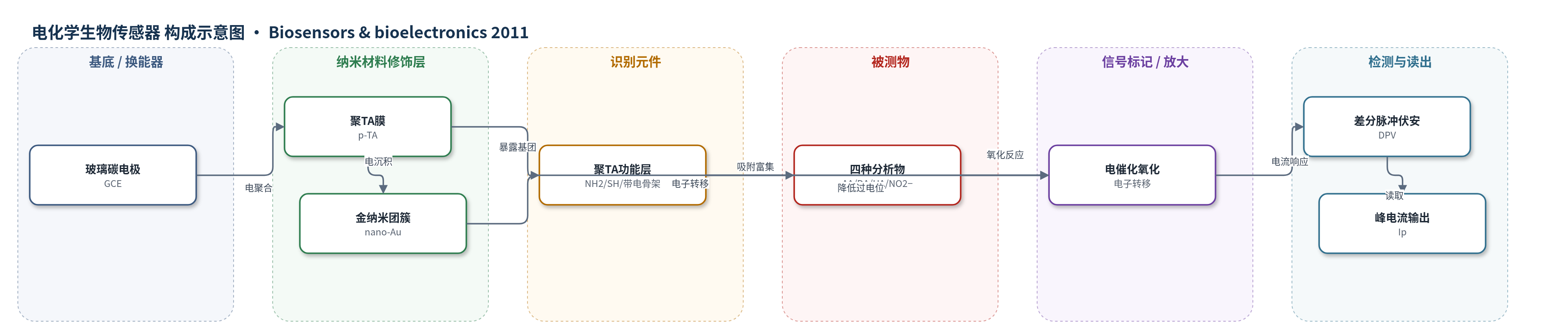
点击图片查看大图 · 依据论文自动绘制
传感器类型
电化学生物传感器
检测对象
抗坏血酸(AA)、多巴胺(DA)、尿酸(UA)、亚硝酸根(NO2−);样品基质:人尿液、人血清。
检测原理
该传感器以GCE为基底,先电聚合TA形成p-TA膜,再在p-TA膜上电沉积nano-Au。在pH 4.0 PBS中,p-TA膜对正负电荷分析物均具有渗透性,其带电骨架可吸引AA、UA和NO2−的阴离子形式,杂原子可吸引DA;nano-Au提供高电子转移速率和电催化活性,与p-TA协同降低过电位并分离AA、DA、UA、NO2−的氧化峰。分析物在各自电位发生氧化,产生差分脉冲伏安峰电流,峰电流随浓度增大而增大,从而实现四组分同时定量。
检测灵敏度
LOD(S/N=3): AA 1.1 × 10⁻⁶ M;DA 5.0 × 10⁻⁸ M;UA 8.0 × 10⁻⁸ M;NO2− 8.9 × 10⁻⁷ M;线性范围: AA 2.1–50.1 μM;DA 0.6–340.0 μM;UA 1.6–110.0 μM;NO2− 15.9–277.0 μM;灵敏度斜率: AA 0.3855 μA/μM;DA 0.1528 μA/μM;UA 0.1196 μA/μM;NO2− 0.05016 μA/μM;R: AA 0.9976;DA 0.9983;UA 0.9976;NO2− 0.9968
效应效果
该传感器选择性良好:在AA 200 μM、DA 10 μM、UA 20 μM、NO2− 40 μM体系中,NaCl、KCl、CaCl2、MgSO4、ZnCl2(各5000 μM)、葡萄糖(1000 μM)和L-半胱氨酸(300 μM)无明显干扰。稳定性方面,4 ℃保存9天后,AA、DA、UA、NO2−峰电流分别仅下降5.6%、6.4%、1.0%和2.4%;测定RSD(n=9)为0.86%、0.97%、1.80%和2.30%,重现性RSD(n=8)小于2.3%。标准加入法测定人尿液和血清样品,回收率为91.0%–109.0%。与nano-Au/GCE和p-TA/GCE相比,能更好分离重叠峰并提高电流响应。
传感器的构成
- 基底/工作电极:玻璃碳电极(GCE),经0.3和0.05 μm氧化铝抛光,提供导电基底与电化学换能界面。
- 聚合物修饰层:聚3-氨基-5-巯基-1,2,4-三唑(p-TA)膜,由TA在0.1 M H2SO4中电聚合15圈形成,含NH2和SH基团,促进Au沉积并降低过电位。
- 纳米材料修饰层:金纳米团簇(nano-Au),在p-TA/GCE上于0.5 M H2SO4和1 mM HAuCl4中施加−0.2 V电沉积80 s,提供大比表面积、高电子转移速率和电催化活性。
- 功能识别/富集层:p-TA膜带电骨架与杂原子,吸附/富集AA、UA、NO2−和DA,并分离各氧化峰。
中文摘要
本文报道了一种新型电化学生物传感器:在玻璃碳电极(GCE)表面电聚合3-氨基-5-巯基-1,2,4-三唑(TA)形成聚TA(p-TA)膜,再于p-TA膜上电沉积金纳米团簇(nano-Au),用于同时测定多巴胺(DA)、抗坏血酸(AA)、尿酸(UA)和亚硝酸根(NO2−)。p-TA层暴露的氨基和巯基有利于nano-Au的电沉积,nano-Au与p-TA协同赋予传感器较大比表面积、良好生物相容性、导电性、稳定性、高选择性和灵敏度,且电沉积过程灵活可控。在四组分共存体系中,AA、DA、UA和NO2−的线性范围分别为2.1–50.1 μM、0.6–340.0 μM、1.6–110.0 μM和15.9–277.0 μM,检出限分别为1.1×10⁻⁶ M、5.0×10⁻⁸ M、8.0×10⁻⁸ M和8.9×10⁻⁷ M。该传感器经标准加入法用于尿液和血清样品中上述物质的测定,结果令人满意。
英文摘要
A novel biosensor has been constructed by the electrodeposition of Au-nanoclusters (nano-Au) on poly(3-amino-5-mercapto-1,2,4-triazole) (p-TA) film modified glassy carbon electrode (GCE) and employed for the simultaneous determination of dopamine (DA), ascorbic acid (AA), uric acid (UA) and nitrite (NO(2)(-)). NH(2) and SH groups exposed to the p-TA layer are helpful for the electrodeposition of nano-Au. The combination of nano-Au and p-TA endow the biosensor with large surface area, good biological compatibility, electricity and stability, high selectivity and sensitivity and flexible and controllable electrodeposition process. In the fourfold co-existence system, the linear calibration plots for AA, DA, UA and NO(2)(-) were obtained over the range of 2.1-50.1 μM, 0.6-340.0 μM, 1.6-110.0 μM and 15.9-277.0 μM with detection limits of 1.1×10(-6) M, 5.0×10(-8) M, 8.0×10(-8) M and 8.9×10(-7) M, respectively. In addition, the modified biosensor was applied to the determination of AA, DA, UA and NO(2)(-) in urine and serum samples by using standard adding method with satisfactory results.