组成图示
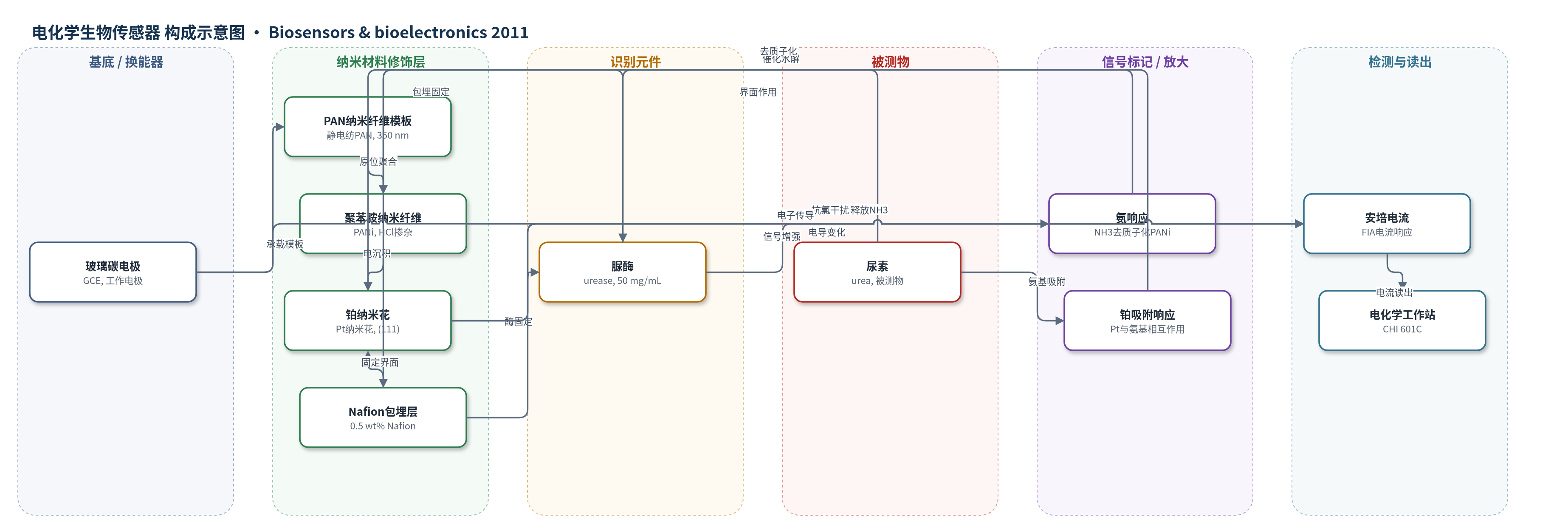
点击图片查看大图 · 依据论文自动绘制
传感器类型
电化学生物传感器
检测对象
尿素(urea),样品基质为10 mM磷酸盐缓冲液(pH 6.0)
检测原理
在FIA系统中,尿素随磷酸盐缓冲液(pH 6.0)注入至脲酶/Pt/PANi/GCE界面。脲酶催化尿素水解,释放NH3;NH3使HCl掺杂的PANi发生去质子化,改变导电聚合物的氧化还原状态和界面电导,在−0.1 V下产生可记录的安培电流。与此同时,Pt纳米花富含(111)晶面,可与尿素中的氨基或酶解产物发生吸附/界面相互作用,增强电子转移或界面响应。Nafion包埋层固定脲酶并排斥Cl−。因此,电流响应随尿素浓度升高而增大,在至20 mM范围内线性,形成酶催化—导电聚合物去质子化—金属纳米界面吸附协同放大的电化学检测机制。
检测灵敏度
LOD: 10 μM (S/N = 3);线性范围: up to 20 mM;灵敏度: 115.6 nA mM−1 cm−2;R^2 = 0.9968
效应效果
与urease/PANi/GCE和Pt/PANi/GCE对照相比,urease/Pt/PANi/GCE对尿素的电流响应显著增强,表明脲酶、Pt纳米花和PANi之间存在协同效应;即使在0 V下,其响应仍明显高于两个对照电极。传感器线性范围可达20 mM,LOD为10 μM(S/N=3),作者认为其灵敏度虽不突出,但检出限和线性范围优于已报道的脲酶尿素传感器。抗干扰方面,注入1 mM NaCl时Pt/PANi/GCE和urease/Pt/PANi/GCE均无明显响应,归因于Nafion的电荷排斥作用。作者提出该合成策略可扩展到其他导电聚合物/金属纳米复合纤维,用于多种传感应用。
传感器的构成
- 基底/换能器电极:玻璃碳电极(GCE,直径3 mm),抛光清洗后作为工作电极,提供电子传导与信号读出界面。
- 模板/支撑层:静电纺聚丙烯腈(PAN)纳米纤维(平均直径约350 nm),作为PANi化学沉积模板,后续用DMF选择性溶解形成中空PANi纳米纤维。
- 导电聚合物修饰层:聚苯胺(PANi)纳米纤维,由苯胺在0.2 M HCl和过硫酸铵(APS)中化学原位聚合,HCl掺杂赋予导电性,并响应氨引起的去质子化。
- 金属纳米结构层:铂纳米花(Pt nanoflowers),由六氯合铂酸六水合物(H2PtCl6·6H2O)在0.1 M H2SO4中循环伏安电沉积,提供(111)晶面吸附/催化位点,增强与尿素氨基或酶产物的相互作用。
- 识别元件:脲酶(urease,50 mg/mL,2.5 μL滴涂),催化尿素水解生成NH3,是生物识别与信号触发元件。
- 封闭/固定剂:Nafion(0.5 wt%,5 μL),包埋固定脲酶,并因负电荷排斥氯离子,降低干扰。
- 检测介质:10 mM磷酸盐缓冲液(pH 6.0),用于FIA系统注入尿素,流速0.2 mL/min,提供稳定电化学环境。
中文摘要
本研究制备了聚苯胺(PANi)纳米纤维负载铂(Pt)纳米花的杂化纳米纤维,并将其用于尿素生物传感器。首先通过静电纺丝获得聚丙烯腈(PAN)纳米纤维模板,随后在含苯胺和过硫酸铵(APS)的酸性溶液中化学原位聚合,得到 HCl 掺杂的 PANi 纳米纤维;再通过循环伏安法将六氯合铂酸电沉积到 PANi 纳米纤维表面,形成 Pt 纳米花,其覆盖度可通过电沉积条件调控。将脲酶固定于 Pt/PANi 杂化纳米纤维上,并以 Nafion 包埋,构建脲酶/Pt/PANi/玻璃碳电极(GCE)传感器,在流注入分析(FIA)系统中检测尿素。尿素酶催化尿素水解释放氨,氨使 PANi 去质子化并改变其电导;同时 Pt 纳米花与尿素氨基或酶产物相互作用,增强界面响应。该传感器线性范围可达 20 mM,检出限为 10 μM(S/N=3),对氯离子干扰具有良好抗扰性。
英文摘要
Hybrid materials with special structures are of great interest because of their superior properties compared with their pure counterparts. Hybrid polyaniline (PANi) nanofibers with integrated Pt nanoflowers are studied in this research. PANi is prepared by in situ polymerization of aniline on an electrospun nanofiber template in an acidic solution with ammonium persulfate (APS) as the oxidant. Pt nanoflowers are further electrodeposited onto the PANi nanofibers backbone by cyclic voltammetry (CV), resulting in novel functionalized hybrid nanofibers. The coverage of Pt nanoflowers on PANi nanofibers can be facilely controlled by adjusting the electrodeposition conditions. The factors affecting Pt nanoflowers formation are further investigated. As a demonstration, urease is immobilized onto the Pt/PANi hybrid nanofibers and the composite was employed as the sensing platform for urea detection in a flow-injection-analysis (FIA) system. The detection of urea shows a wide linear range (up to 20 mM), a good limit of detection of 10 μM (S/N=3), and an excellent anti-interference property against chloride ion. In addition, it was found that the response to urea was attributed not only to the conductivity change of PANi due to the interaction between PANi and ammonia (liberated from the enzymatic reaction), but also to the interaction between Pt nanoflowers and amine groups in urea. The strategy developed in this study can be extended to synthesize other composite nanofibers consisting of conducting polymer and metal nanoparticles for a wide range of sensing applications.