组成图示
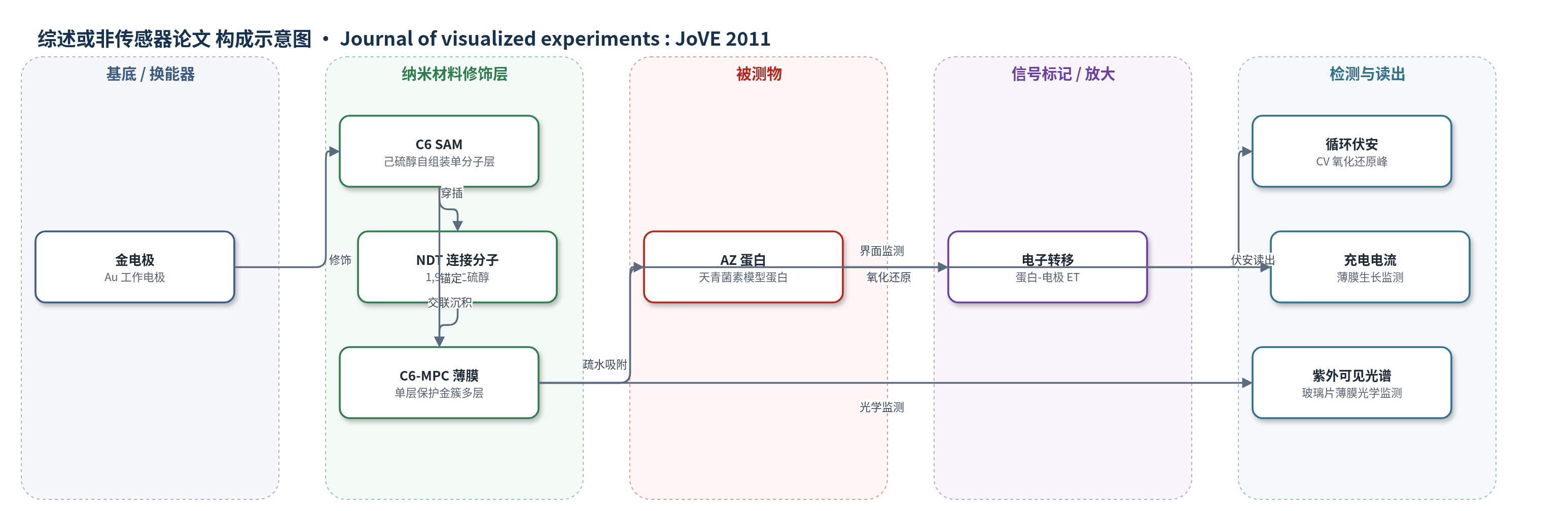
点击图片查看大图 · 依据论文自动绘制
传感器类型
综述或非传感器论文
检测对象
无明确检测对象(非传感检测);模型氧化还原蛋白:铜绿假单胞菌天青菌素(azurin, AZ)、细胞色素 c(cytochrome c, cyt c);样品基质:4.4 mM 磷酸钾缓冲液(KPB, pH 7.0)
检测原理
该体系不是以分析物浓度产生定量传感信号,而是构建用于蛋白单层电化学的界面。金电极先修饰己硫醇自组装单分子层,再引入 1,9-壬二硫醇作为连接分子,通过交替浸渍己硫醇单层保护金簇形成网络状 MPC 薄膜。铜绿假单胞菌天青菌素以疏水作用吸附于薄膜表面。在磷酸钾缓冲液中进行循环伏安时,AZ 的铜中心发生可逆氧化还原,电子经 MPC 网络/界面传递至金电极,形成氧化还原峰;薄膜层数增加使双电层充电电流系统增大,可用于监测组装过程。若用于传感,蛋白或识别元件结合会改变界面电子转移、充电电流或光学吸收,从而实现信号变化。
检测灵敏度
原文未报告 LOD、线性范围、灵敏度斜率或相关系数。
效应效果
MPC 薄膜可通过浸渍循环可控生长,双电层充电电流随浸渍次数系统增加,表明组装过程具有可重复性和可控性。在硅烷修饰玻璃片上,紫外可见吸收随层数增加而增强,表面等离子体吸收带约 520 nm 逐渐清晰;横截面透射电镜显示薄膜结构,己硫醇 MPC 金核平均直径约 2 nm。与传统的烷基硫醇自组装单分子层体系相比,MPC 薄膜可提供更均一的蛋白吸附环境,并促进氧化还原蛋白电子转移,降低距离依赖。AZ 在薄膜上呈现可逆循环伏安峰。该平台还可适配不同蛋白和电极体系,例如细胞色素 c 可通过羧酸修饰 MPC 界面静电固定,也可用于脉冲、阶跃和阻抗等电化学技术。
传感器的构成
- 基底/换能器电极:金电极(Au working electrode),经循环伏安电化学清洗,作为电子转移换能器和薄膜支撑基底。
- 自组装单分子层:己硫醇(C6, 1-hexanethiol)SAM,修饰金表面,提供有序硫醇端基并降低双电层充电电流。
- 连接分子层:1,9-壬二硫醇(NDT, 1,9-nonanedithiol),穿插于 C6 SAM 并连接相邻 MPC 层,形成网络薄膜。
- 纳米材料修饰层:己硫醇配体单层保护金簇(C6-MPCs,平均结构 Au225(C6)75),通过浸渍循环沉积形成多层薄膜,提供蛋白吸附界面。
- 模型蛋白层:铜绿假单胞菌天青菌素(AZ, Pseudomonas aeruginosa azurin),疏水吸附于二硫醇连接 MPC 薄膜,作为氧化还原蛋白模型。
- 缓冲介质:4.4 mM 磷酸钾缓冲液(KPB, pH 7.0, μ=10 mM),维持蛋白稳定与电化学测量环境。
- 电化学测量组件:Ag/AgCl 参比电极、Pt 辅助电极和 Viton O 圈(定义 0.32 cm2 电极面积),用于循环伏安测量。
中文摘要
用烷基硫醇配体保护的胶体金纳米粒子称为单层保护金簇(MPCs)。本文采用改进的 Brust 反应合成己硫醇配体功能化的 MPCs,并通过紫外可见光谱、透射电子显微镜和1H核磁共振进行表征。随后,利用交替浸渍 MPC 溶液和二硫醇连接分子的“浸渍循环”法,在己硫醇自组装单分子层修饰的金电极上组装二硫醇交联 MPC 薄膜。电化学测量通过双电层充电电流的变化追踪薄膜生长;在硅烷修饰玻璃片上组装的类似薄膜可用紫外可见光谱监测,横截面透射电镜可估计厚度。该网络薄膜可通过调节 MPC 配体保护和粒子间连接机制适配不同吸附机制的氧化还原蛋白。例如,铜绿假单胞菌天青菌素(AZ)可疏水吸附于二硫醇连接的己硫醇 MPC 薄膜,细胞色素 c 可静电固定于羧酸修饰 MPC 界面层。本报告聚焦 AZ 系统。此类平台可为蛋白单层电化学研究提供更均一的吸附环境,并有助于生物传感器方案、电子转移模型和生物相容材料开发。
英文摘要
Colloidal gold nanoparticles protected with alkanethiolate ligands called monolayer protected gold clusters (MPCs) are synthesized and subsequently incorporated into film assemblies that serve as adsorption platforms for protein monolayer electrochemistry (PME). PME is utilized as the model system for studying electrochemical properties of redox proteins by confining them to an adsorption platform at a modified electrode, which also serves as a redox partner for electron transfer (ET) reactions. Studies have shown that gold nanoparticle film assemblies of this nature provide for a more homogeneous protein adsorption environment and promote ET without distance dependence compared to the more traditional systems modified with alkanethiol self-assembled monolayers (SAM). In this paper, MPCs functionalized with hexanethiolate ligands are synthesized using a modified Brust reaction and characterized with ultraviolet visible (UV-Vis) spectroscopy, transmission electron microscopy (TEM), and proton (¹H) nuclear magnetic resonance (NMR). MPC films are assembled on SAM modified gold electrode interfaces by using a "dip cycle" method of alternating MPC layers and dithiol linking molecules. Film growth at gold electrode is tracked electrochemically by measuring changes to the double layer charging current of the system. Analogous films assembled on silane modified glass slides allow for optical monitoring of film growth and cross-sectional TEM analysis provides an estimated film thickness. During film assembly, manipulation of the MPC ligand protection as well as the interparticle linkage mechanism allow for networked films, that are readily adaptable, to interface with redox protein having different adsorption mechanism. For example, Pseudomonas aeruginosa azurin (AZ) can be adsorbed hydrophobically to dithiol-linked films of hexanethiolate MPCs and cytochrome c (cyt c) can be immobilized electrostatically at a carboxylic acid modified MPC interfacial layer. In this report, we focus on the film protocol for the AZ system exclusively. Investigations involving the adsorption of proteins on MPC modified synthetic platforms could further the understanding of interactions between biomolecules and man-made materials, and consequently aid the development of biosensor schemes, ET modeling systems, and synthetic biocompatible materials.