组成图示
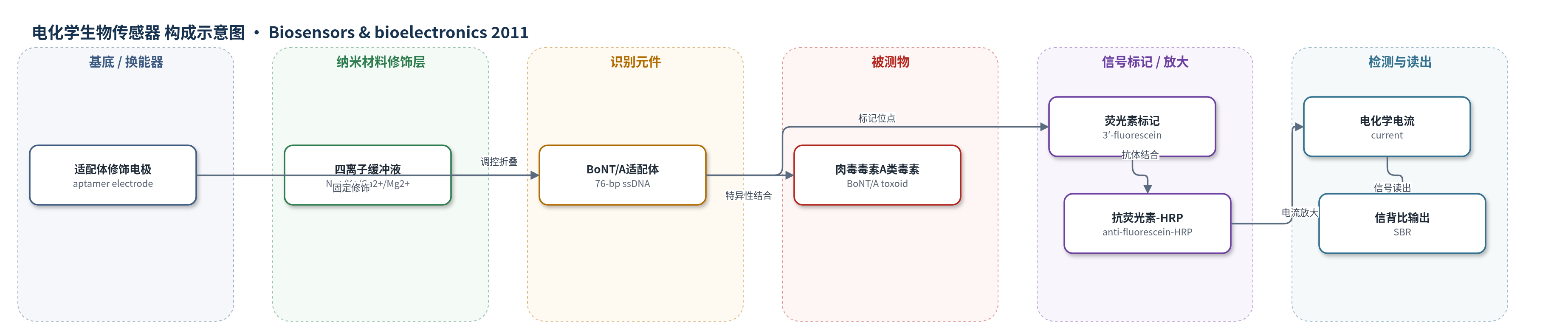
点击图片查看大图 · 依据论文自动绘制
传感器类型
电化学生物传感器
检测对象
A型肉毒神经毒素类毒素(BoNT/A toxoid),样品基质:优化四离子缓冲液中的类毒素溶液
检测原理
传感器以单链 DNA 适配体为识别元件,其正确三级结构依赖 Na+、K+、Ca2+、Mg2+ 的协同作用。FSC 以信背比(SBR)为目标函数,用差分进化算法迭代调整四离子浓度,使适配体折叠为高识别构象。检测时,BoNT/A 类毒素与适配体特异性结合,引起适配体构象或空间位阻变化,使 3′端荧光素标记位点可被抗荧光素-HRP 抗体识别并结合。HRP 作为电化学信号放大元件,在电极界面催化产生电流响应;被测物浓度越高,适配体-毒素复合物越多,HRP 结合量越大,电流越大。空白电流反映非特异结合,样品电流与空白电流之比 SBR 随浓度升高而增大,最终通过电化学电流读出。
检测灵敏度
LOD: 40 pg/ml;动态范围: 1 μg/ml–40 pg/ml
效应效果
在优化四离子缓冲液(Na+ 20 mM、K+ 0.5 mM、Ca2+ 200 mM、Mg2+ 2 mM)下,1 μg/ml BoNT/A 类毒素的信背比 SBR 约 3.8–3.9,而随机非优化组合的 SBR 仅 0.7–1.2,且 0–1 μg/ml 范围内无显著差异,检出限约 1 μg/ml。优化后检出限为 40 pg/ml(2 SD 判读),动态范围覆盖 40 pg/ml–1 μg/ml,检测时间缩短至 5 min,明显快于此前适配体法 24 h、ELISA 约 3 h 和小鼠生物测定约 48 h。论文未报告 RSD、实际样品回收率或与其他方法定量对比,但强调 FSC 可避免大量滴定,适用于多参数体系优化。
传感器的构成
- 换能器电极:适配体修饰电极(aptamer-coated electrode),提供电化学检测界面(原文未说明具体基底材料)
- 识别元件:76 bp 单链 DNA 适配体(BoNT/A aptamer),特异性识别 BoNT/A 类毒素并发生构象/空间位阻变化
- 信号标记物:3′-荧光素标记适配体(fluorescein-labeled aptamer),为抗荧光素抗体提供结合位点
- 信号放大元件:抗荧光素-辣根过氧化物酶抗体(anti-fluorescein-HRP),结合荧光素并催化电化学电流放大
- 识别环境:四离子组合缓冲液(Na+、K+、Ca2+、Mg2+),调控适配体折叠与识别;优化组合为 Na+ 20 mM、K+ 0.5 mM、Ca2+ 200 mM、Mg2+ 2 mM
- 孵育介质:casein/PBS buffer,用于抗荧光素-HRP 孵育
中文摘要
基于适配体的肉毒神经毒素(BoNT)生物传感器的灵敏度和检测时间取决于适配体正确三级结构的形成,而这与缓冲液中多种离子及其浓度的组合效应密切相关。对四种离子在12种浓度下的20736种组合进行穷举优化极为费时费力。本文引入反馈系统控制(FSC)方案,用于快速确定形成最优适配体结构并识别目标分子的最佳组分组合。本研究实现了A型肉毒神经毒素(BoNT/A)电化学适配体传感器离子组合的快速优化。仅需约10次迭代、每次约50次测试,即可从20736种可能中识别最优离子浓度。最显著的结果是,在优化组合离子缓冲液中,适配体法检测BoNT/A仅需5 min,远短于数小时甚至数天,检出限为40 pg/ml。文中方法可推广至其他多参数化学体系,有望显著提高参数优化效率。
英文摘要
The sensitivity and detection time of an aptamer based biosensor for detecting botulinum neurotoxin (BoNT) depend upon the formation of proper tertiary architecture of aptamer, which closely correlates with the combinatorial effects of multiple types of ions and their concentrations presented in the buffer. Finding the optimal conditions for four different ions at 12 different concentrations, 20,736 possible combinations, by brute force is an extremely laborious and time-consuming task. Here, we introduce a feedback system control (FSC) scheme that can rapidly identify the best combination of components to form the optimal aptamer structure binding to a target molecule. In this study, rapid identification of optimized ionic combinations for electrochemical aptasensor of BoNT type A (BoNT/A) detection has been achieved. Only about 10 iterations with about 50 tests in each iteration are needed to identify the optimal ionic concentration out of the 20,736 possibilities. The most exciting finding was that a very short detection time and high sensitivity could be achieved with the optimized combinational ion buffer. Only a 5-min detection time, compared with hours or even days, was needed for aptamer-based BoNT/A detection with a limit of detection of 40 pg/ml. The methodologies described here can be applied to other multi-parameter chemical systems, which should significantly improve the rate of parameter optimization.