组成图示
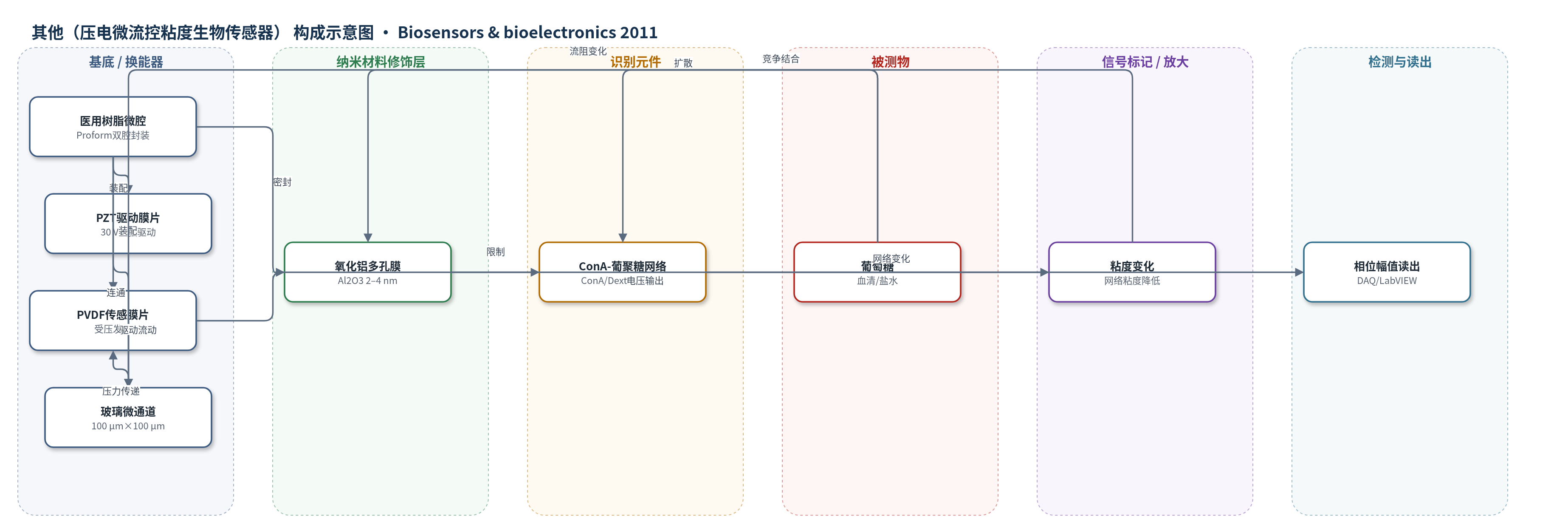
点击图片查看大图 · 依据论文自动绘制
传感器类型
其他(压电微流控粘度生物传感器)
检测对象
葡萄糖(glucose);样品基质:等渗盐水、人血清(human blood serum)
检测原理
敏感流体中,刀豆蛋白A(ConA)与高分子量葡聚糖(Dextran 3200)结合形成交联网络,使溶液粘度升高;葡萄糖与葡聚糖竞争结合ConA,葡萄糖浓度升高时网络被部分破坏,粘度下降。器件中PZT驱动膜片施加正弦电压弯曲,推动敏感流体经玻璃微通道流动;微通道流阻与流体粘度相关,导致传感PVDF膜片偏转幅值和相位随粘度变化。PVDF压电效应将机械偏转转为电压,读出幅值/相位(尤其相位)即可反演粘度,从而得到葡萄糖浓度。温度影响粘度,需校准。
检测灵敏度
灵敏度: 2.64°/mM;范围: 2–20 mM;精度: 0.034 mM
效应效果
等渗盐水中2、4、7、11、16 mM升降切换高度可逆;37°C灵敏度较25°C降低约55%。2与20 mM连续17循环、70 h稳定,400次平均标准差0.045°,95%置信区间0.09°,精度0.034 mM,接近常规血糖仪1 mg/dL(0.056 mM)分辨率;2 mM相对偏差±1.7%。37°C响应时间升糖3.6±0.7 min、降糖12.8±1.4 min,接近10 min医疗目标。人血清5与20 mM测试17 h稳定,无膜污堵;血清灵敏度较盐水降低约20%且部分可逆,提示糖肽/脂质竞争。作者认为适合血液/血浆连续葡萄糖监测。
传感器的构成
- 基底/封装:生物相容医用树脂(Proform)立体光刻结构,形成双微腔并容纳4 μL敏感流体
- 驱动换能器:PZT(钛酸铅锆酸铅)压电膜片(3 mm直径、50 μm厚),粘于10 μm黄铜箔,施加电压弯曲产生压力
- 传感换能器:PVDF(聚偏氟乙烯)压电膜片(3 mm直径、28 μm厚),粘于10 μm黄铜箔,受压偏转产生电压
- 流阻微通道:100 μm×100 μm玻璃毛细管(Vitrocom),提供与粘度相关的流动阻力
- 尺寸选择性界面:50 μm厚氧化铝多孔纳米膜(Al2O3,Synkera Technologies),孔径2–4 nm,限制敏感流体并允许葡萄糖扩散
- 识别元件/敏感流体:2% w/w葡聚糖3200(Dextran 3200, PSS)与0.4% w/w刀豆蛋白A(ConA, Sigma),通过竞争结合改变网络粘度
- 缓冲/激活介质:10 mM Tris base、1 mM CaCl2、1 mM MnCl2、0.05% NaN3、0.15 M NaCl,pH 7.4,Ca2+/Mn2+激活ConA葡萄糖结合
- 样品界面:等渗盐水或人血清(human blood serum),葡萄糖经多孔膜扩散进入敏感流体
中文摘要
本文报道一种基于粘度依赖亲和作用的生物传感器,用于连续监测血液和血浆等生物流体中的葡萄糖。该化学-机械传感器原理基于敏感流体粘度随葡萄糖浓度变化。器件包含驱动压电膜片、传感压电膜片和流阻微通道;并采用自由支撑氧化铝多孔纳米膜作为尺寸选择性界面,以限制敏感流体并允许葡萄糖扩散进入传感器。在25和37°C下测量表明,该传感器拓扑结构在生理血糖浓度范围2–20 mM内具有高分辨率。此外,至少3天内表现出完全可逆性。人血清中的测量证实该传感器满足生物流体连续葡萄糖监测的基本需求。
英文摘要
We present a viscometric affinity biosensor for continuous monitoring of glucose in biological fluids such as blood and plasma. The sensing principle of this chemico-mechanical sensor is based upon the viscosity variation of a sensitive fluid with glucose concentration. Basically, this device includes both an actuating and a sensing piezoelectric diaphragms as well as a flow-resistive microchannel. In order to confine the sensitive fluid and allow glucose diffusion into the sensor, a free-standing alumina nanoporous membrane is also used as size-selective interface. Measurements carried out at nominal temperatures of 25 and 37 °C reveal that this sensor topology exhibits a high resolution in the current range of physiological blood glucose concentrations, i.e. 2-20 mM. In addition, complete reversibility was also demonstrated for at least 3 days. Finally, measurements performed in human blood serum confirm that this sensor fulfils all basic requirements for a use in continuous glucose monitoring of biological fluids.