组成图示
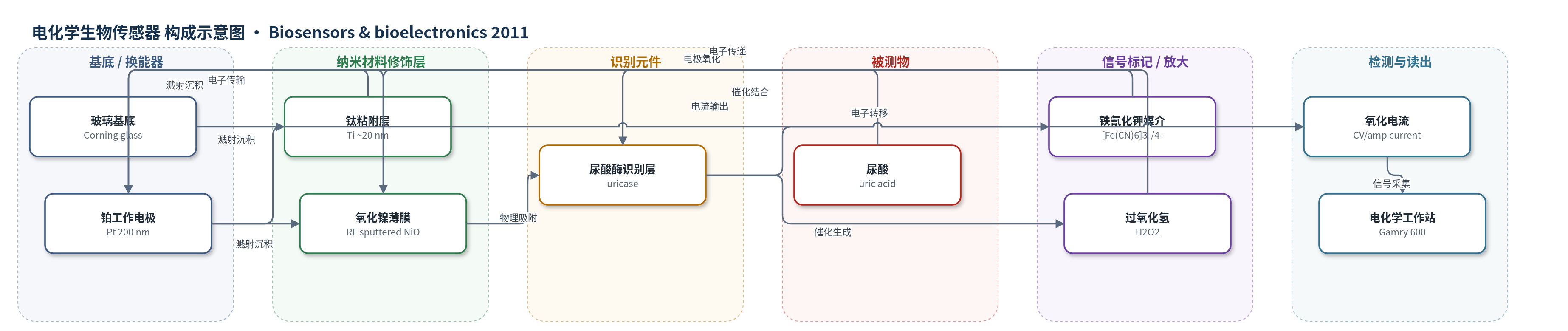
点击图片查看大图 · 依据论文自动绘制
传感器类型
电化学生物传感器
检测对象
尿酸(uric acid, UA);样品基质:血清、尿液等生理体液(文中以 PBS 模拟,干扰实验按人血清正常浓度)
检测原理
尿酸酶催化尿酸在氧气存在下氧化为别嘌呤、CO2 和 H2O2。生成的 H2O2 在电极表面发生氧化:H2O2 → O2 + 2H+ + 2e−,产生安培电流。由于酶活性中心被绝缘外壳包裹,难以直接电子转移,体系中加入 [Fe(CN)6]3−/4− 作为电子媒介,将酶活性中心的电子经 NiO 薄膜传递至 Pt 电极。射频溅射 NiO 的纳米多孔结构提高酶负载量并促进电子传输,使氧化峰电流随尿酸浓度线性增加。
检测灵敏度
LOD: 0.11 mM (1.84 mg/dl);线性范围: 0.05–1.0 mM;灵敏度: 1278.48 µA/mM;R = 0.99;km: 0.17 mM
效应效果
该生物电极响应时间约 5 s,在 0.05–1.0 mM 范围内重现性达 ±2% 精度,可重复使用 25 次,4 个月后仍保留 90% 以上活性。选择性测试中加入葡萄糖 5.6 mM、胆固醇 5 mM、尿素 1 mM、抗坏血酸 0.1 mM 和多巴胺 0.1 mM,在尿酸 0.1 mM 下最大干扰仅 2.5%。检出限约 0.11 mM(1.84 mg/dl),低于生理范围下限,灵敏度高于其他金属氧化物基质尿酸传感器,适合血清和尿液中尿酸的快速稳定检测。
传感器的构成
- 基底:Corning glass 玻璃基底,提供机械支撑
- 粘附层:Ti 钛薄膜(约20 nm),增强 Pt 与玻璃结合
- 工作电极:Pt 铂薄膜(200 nm),导电换能电极
- 纳米修饰层:RF sputtered NiO 氧化镍薄膜,纳米多孔、电子传输并固定酶
- 识别元件:uricase 尿酸酶(1.0 mg/mL,10 µL),物理吸附,催化尿酸氧化
- 电子媒介:[Fe(CN)6]3−/4− 铁氰化钾/亚铁氰化钾(5 mM),电子穿梭放大电流
- 电解液:50 mM PBS(pH 7.0,0.9% NaCl),维持缓冲与离子环境
中文摘要
本研究报道了一种基于射频溅射氧化镍(NiO)薄膜的高灵敏、高选择性尿酸生物传感器。NiO 薄膜沉积于铂/钛/玻璃基底(NiO/Pt/Ti/glass)上,形成具有纳米多孔形貌和良好电子传输特性的传感基质。尿酸酶(uricase)通过物理吸附固定在 NiO 表面,构成尿酸酶/NiO/Pt/Ti/glass 生物电极。采用循环伏安法和紫外-可见光谱法评价其对尿酸的传感性能。该生物电极表现出高灵敏度 1278.48 µA/mM、良好线性范围 0.05–1.0 mM 以及较低的 Michaelis–Menten 常数 0.17 mM,表明尿酸酶对尿酸具有高亲和力。增强响应归因于 NiO 基质良好的电子传输能力、纳米多孔结构对酶的有效负载以及酶的有利取向。
英文摘要
Present study highlights the importance of RF sputtered NiO thin film deposited on platinum coated glass substrate (NiO/Pt/Ti/glass) as a potential matrix for the realization of highly sensitive and selective uric acid biosensor. Uricase has been immobilized successfully onto the surface of NiO matrix by physical adsorption technique. The prepared bioelectrode (uricase/NiO/Pt/Ti/glass) is utilized for sensing uric acid using the cyclic voltammetry and UV visible spectroscopy techniques. The bioelectrode is found to exhibit highly efficient sensing response characteristics with high sensitivity of 1278.48 μA/mM; good linearity of 0.05-1.0 mM, and very low Michaelis-Menten constant (k(m)) of 0.17 mM indicating high affinity of uricase towards the analyte. The enhanced response is due to the development of NiO matrix with good electron transport property and nanoporous morphology for effective loading of enzyme with preferred orientation.