组成图示
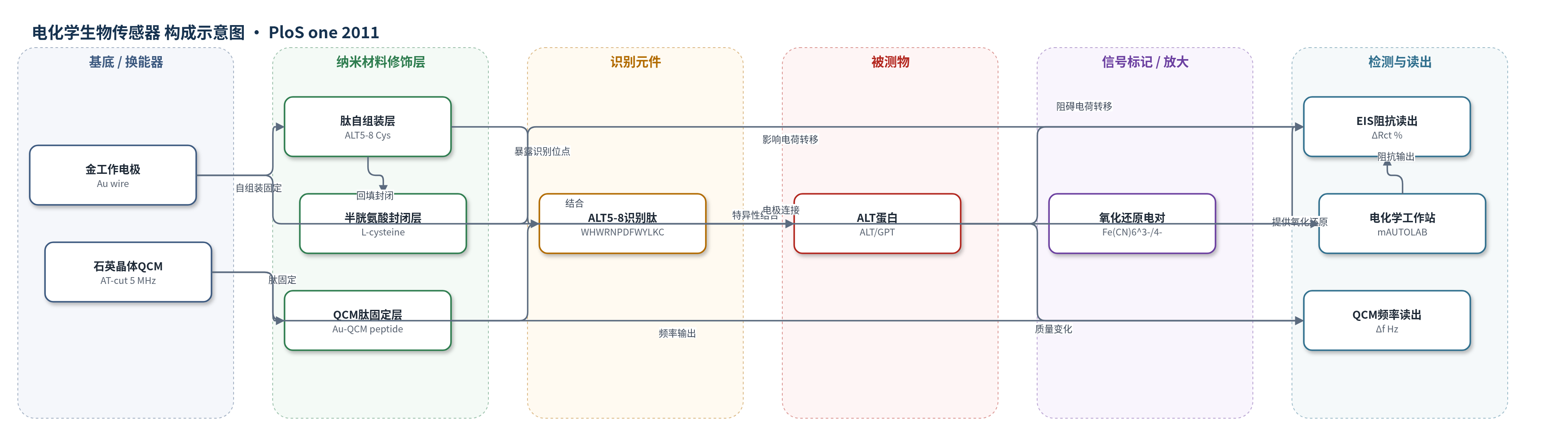
点击图片查看大图 · 依据论文自动绘制
传感器类型
电化学生物传感器
检测对象
丙氨酸氨基转移酶(alanine aminotransferase, ALT);实验样品基质为磷酸盐缓冲液(pH 7.3),目标应用基质为人血清/血浆
检测原理
ALT5-8 肽经 C 端半胱氨酸固定于金电极,游离半胱氨酸回填形成封闭单分子层。当 ALT 与表面肽特异性结合后,蛋白质层阻碍 Fe(CN)6^3-/4- 氧化还原电对接近电极表面,使电荷转移电阻 Rct 增大;EIS 中 Nyquist 半圆直径增加,ΔRct% 随 ALT 浓度升高而增大。QCM 中 ALT 结合导致晶体表面质量增加,共振频率下降,Δf 随浓度增加。CV 中氧化还原电流下降,但定量范围有限。该体系无酶催化或核酸放大,信号直接来自识别事件引起的界面电荷转移/质量变化。
检测灵敏度
LOD: 60 ng/mL(QCM);LOD: 92 ng/mL(EIS);灵敏度: 8.9±0.9 Hz/(mg/mL)(QCM);灵敏度: 142±12 impedance percentage change %/(mg/mL)(EIS)
效应效果
该传感器对 ALT 具有选择性:10 mg/mL 下 ALT 使 QCM 频率变化约 -31 Hz,而 BSA 和链霉亲和素(SA)仅约 -3 Hz,提示非特异结合较低。实验重复三次,结果相似,误差棒为标准差,但未报告 RSD、稳定性或实际样品回收率。作者未与 ELISA/HPLC/qPCR 直接对比,但指出 LOD 低于人血 ALT 正常范围 0.1–0.7 mg/mL,且 EIS 相比 QCM 具有更大线性动态范围、对环境扰动更稳健。固定肽与 ALT 的 Kd 为 20.1±0.6 nM,ALT5-8 为竞争性抑制剂,KI=71±17 nM。作者认为该平台可低成本、快速开发多种蛋白靶标传感器,但临床前仍需复杂基质验证。
传感器的构成
- 基底/换能器电极:金线工作电极(Au wire, dia. 1 mm,封于环氧),提供电子转导与肽固定表面
- 识别元件:ALT5-8 肽(WHWRNPDFWYLKC,C 端半胱氨酸),经 Cys 端固定于金表面并特异性结合 ALT
- 封闭剂:游离半胱氨酸(L-cysteine, 1 mM),回填未结合位点,形成短链自组装单分子层(SAM),降低非特异结合
- 信号标记/氧化还原探针:铁氰化钾/亚铁氰化钾(Fe(CN)6^3-/4-,1 mM in 0.1 M NaClO4),用于 CV/EIS 电荷转移读出
- 辅助换能器:AT 切 5 MHz 石英晶体微天平(QCM, Au-coated quartz crystal),原位监测肽固定与 ALT 结合的质量变化
- 电化学池组件:Ag/AgCl 参比电极与 Pt 网对电极,用于 CV/EIS 测量
中文摘要
本文提出一种快速开发蛋白生物传感器的平台:利用 M13 噬菌体展示筛选能结合目标蛋白的短无序肽,化学合成后固定于金表面,采用电化学阻抗谱(EIS)检测目标;石英晶体微天平(QCM)用于开发过程中的诊断。作者以肝毒性标志物丙氨酸氨基转移酶(ALT)为例,经生物筛选获得新肽 ALT5-8(WHWRNPDFWYLK),表达该肽的噬菌体对固定 ALT 的表观解离常数为 85±20 nM。合成 C 端半胱氨酸修饰肽并固定于金电极,用循环伏安(CV)、QCM 和 EIS 表征。QCM 检测 ALT 的灵敏度为 8.9±0.9 Hz/(mg/mL),检出限 60 ng/mL;EIS 灵敏度为 142±12 阻抗百分比变化 %/(mg/mL),检出限 92 ng/mL,均低于人血 ALT 典型浓度。EIS 因线性动态范围更大而更优,QCM 测得固定肽与 ALT 的 Kd 为 20.1±0.6 nM。该平台可低成本、快速开发针对新蛋白靶标的肽基生物传感器。
英文摘要
There is a consistent demand for new biosensors for the detection of protein targets, and a systematic method for the rapid development of new sensors is needed. Here we present a platform where short unstructured peptides that bind to a desired target are selected using M13 phage display. The selected peptides are then chemically synthesized and immobilized on gold, allowing for detection of the target using electrochemical techniques such as electrochemical impedance spectroscopy (EIS). A quartz crystal microbalance (QCM) is also used as a diagnostic tool during biosensor development. We demonstrate the utility of this approach by creating a novel peptide-based electrochemical biosensor for the enzyme alanine aminotransferase (ALT), a well-known biomarker of hepatotoxicity. Biopanning of the M13 phage display library over immobilized ALT, led to the rapid identification of a new peptide (ALT5-8) with an amino acid sequence of WHWRNPDFWYLK. Phage particles expressing this peptide exhibited nanomolar affinity for immobilized ALT (K(d,app) = 85±20 nM). The newly identified ALT5-8 peptide was then chemically synthesized with a C-terminal cysteine for gold immobilization. The performance of the gold-immobilized peptides was studied with cyclic voltammetry (CV), QCM, and EIS. Using QCM, the sensitivity for ALT detection was 8.9±0.9 Hz/(µg/mL) and the limit of detection (LOD) was 60 ng/mL. Using EIS measurements, the sensitivity was 142±12 impedance percentage change %/(µg/mL) and the LOD was 92 ng/mL. In both cases, the LOD was below the typical concentration of ALT in human blood. Although both QCM and EIS produced similar LODs, EIS is preferable due to a larger linear dynamic range. Using QCM, the immobilized peptide exhibited a nanomolar dissociation constant for ALT (K(d) = 20.1±0.6 nM). These results demonstrate a simple and rapid platform for developing and assessing the performance of sensitive, peptide-based biosensors for new protein targets.