组成图示
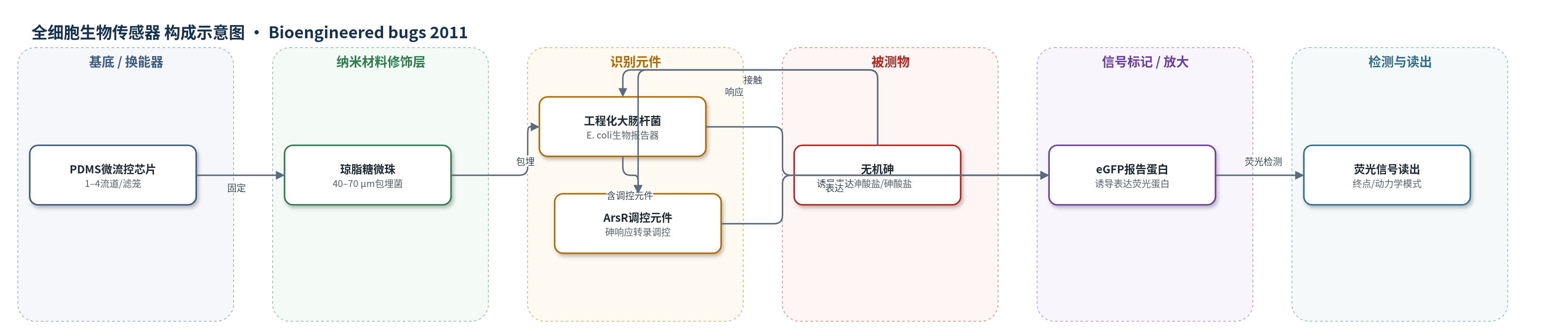
点击图片查看大图 · 依据论文自动绘制
传感器类型
全细胞生物传感器
检测对象
无机砷(inorganic arsenic, As)、亚砷酸盐(arsenite, As(III))、砷酸盐(arsenate, As(V));样品基质:水样/饮用水/地下水
检测原理
工程化大肠杆菌携带砷响应调控元件(如 ArsR 系统),当水样中的亚砷酸盐或砷酸盐扩散进入琼脂糖微珠并与细胞接触时,砷离子激活/解除 ArsR 对报告基因启动子的调控,诱导 eGFP 基因转录和翻译。eGFP 在细胞内积累后发出绿色荧光,荧光强度随砷浓度和诱导时间增加。微流控滤笼将约 1000 个含菌微珠集中,提高总荧光输出,使低成本光学检测可行。检测可采用固定时间终点读数或积分信号上升速率的动力学模式,从而区分 0、10、50 μg/L 亚砷酸盐。保存后细胞诱导能力下降,LB 预孵育补充营养可恢复表达,缩短信号起始延迟。
检测灵敏度
原文未报告明确 LOD、线性范围、灵敏度斜率或相关系数;仅报告可区分 0、10、50 μg/L 亚砷酸盐。
效应效果
器件在 -20°C 保存的细胞珠可维持诱导性约 1 个月;无预孵育时,50 μg/L 亚砷酸盐可靠检测时间从第 1 天 60 min 延长至 1 个月 140 min,10 μg/L 从 60 min 延长至 200 min,寿命约 2–4 周。经 LB 预孵育 30 min 后,28 d 保存芯片可完全恢复对 0、10、50 μg/L 的区分,并缩短 eGFP 信号起始延迟,至少使冻结芯片寿命翻倍。芯片含 1–4 条平行流道,提高测量准确性;单批 0.2 mL 菌液可制备超过 20 个芯片,成本较低。作者认为该微型化、封闭、可现场操作的细菌生物传感器有望成为昂贵化学分析仪器的低成本替代,适用于饮用水/地下水砷污染的大规模现场筛查。
传感器的构成
- 微流控基底:PDMS 微流控芯片,含 1–4 条平行流道和 500×500 μm² 滤笼,用于固定细胞珠并引导水样流动。
- 细胞固定层:40–70 μm 琼脂糖微珠(agarose beads),包埋工程化大肠杆菌,维持细胞活性并集中荧光信号。
- 识别元件:工程化大肠杆菌(Escherichia coli)全细胞生物报告器,含 ArsR 砷响应调控元件,识别亚砷酸盐/砷酸盐。
- 信号报告元件:增强型绿色荧光蛋白(eGFP),在砷诱导下表达,产生可光学检测的荧光。
- 保存介质:15% 甘油(glycerol)矿物盐缓冲培养基,含葡萄糖,用于 -20°C 保存细胞珠并维持细胞能量。
- 恢复介质:LB 培养基(Luria-Bertani medium),预孵育 30 min 补充有机微量营养,恢复细胞诱导能力。
- 读出方式:光学荧光检测(optical fluorescence detection),监测 eGFP 荧光随时间变化。
中文摘要
细菌生物报告器与微流控系统结合有望实现化学或毒性目标的现场检测。作者将工程化大肠杆菌细胞封装于琼脂糖微珠并集成到 PDMS 微流控芯片中,用于检测饮用水中的无机砷。该菌株在接触亚砷酸盐或砷酸盐后,通过 ArsR 调控系统诱导表达增强型绿色荧光蛋白 eGFP。约 1000 个含菌琼脂糖微珠被捕获在芯片 500×500 μm² 滤笼中,样品流经后 eGFP 荧光随时间增强,可采用终点或动力学模式读取。芯片可在 -20°C 保存,细胞珠诱导性可维持约 1 个月,并能可重复区分 0、10 和 50 μg/L 亚砷酸盐,检测时间少于 200 min。研究发现随保存时间延长,信号起始延迟增加、上升速率下降;用 LB 培养基预孵育 30 min 可恢复细胞诱导能力,使 28 d 保存芯片仍能区分三种浓度,并缩短检测时间,从而延长器件寿命。
英文摘要
Combining bacterial bioreporters with microfluidics systems holds great promise for in-field detection of chemical or toxicity targets. Recently we showed how Escherichia coli cells engineered to produce a variant of green fluorescent protein after contact to arsenite and arsenate can be encapsulated in agarose beads and incorporated into a microfluidic chip to create a device for in-field detection of arsenic, a contaminant of well known toxicity and carcinogenicity in potable water both in industrialized and developing countries. Cell-beads stored in the microfluidics chip at -20°C retained inducibility up to one month and we were able to reproducibly discriminate concentrations of 10 and 50 μg arsenite per L (the drinking water standards for European countries and the United States, and for the developing countries, respectively) from the blank in less than 200 minutes. We discuss here the reasons for decreasing bioreporter signal development upon increased storage of cell beads but also show how this decrease can be reduced, leading to a faster detection and a longer lifetime of the device.