组成图示
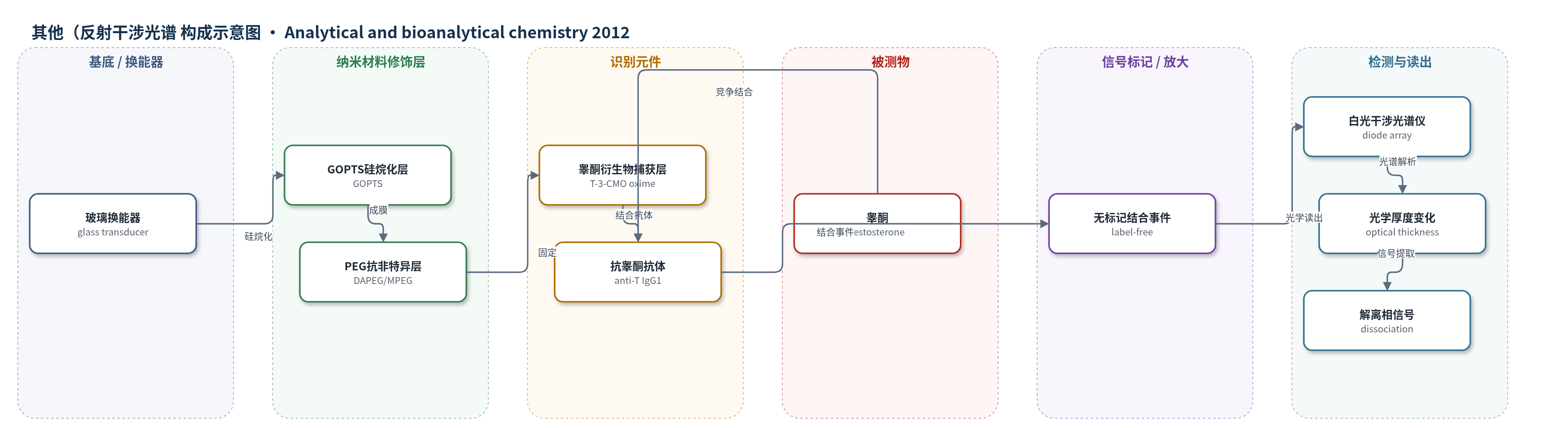
点击图片查看大图 · 依据论文自动绘制
传感器类型
其他(反射干涉光谱(RIfS)生物传感器)
检测对象
睾酮(testosterone);样品基质:缓冲液、全脂巴氏牛乳(whole pasteurized bovine milk,3.5%脂肪)
检测原理
该传感器采用竞争抑制免疫分析与RIfS无标记光学检测。样品中的睾酮先与抗睾酮单克隆IgG1抗体孵育,睾酮占据抗体结合位点;随后混合物流过传感表面,未被占据的抗体与表面过量固定的睾酮衍生物结合,且结合过程处于质量传输限制状态。抗体结合使敏感层光学厚度增加,改变白光在薄膜界面的干涉光谱。牛奶中因丁达尔散射和非特异结合,采用解离相特定时间信号高度,并扣除无抗体牛奶空白,以相对信号定量。睾酮浓度越高,表面结合抗体越少,信号越低,经四参数logistic拟合得到浓度。未使用酶催化或核酸放大。
检测灵敏度
LOD: 70.2 ng L−1(缓冲液,DAPEG表面);LOD: 75.2 ng L−1(缓冲液,AMD表面);LOD: 94.4 ng L−1(牛奶);LOQ: 130.0 ng L−1(缓冲液,DAPEG表面);LOQ: 142.1 ng L−1(缓冲液,AMD表面);LOQ: 229.3 ng L−1(牛奶);工作范围: 0.29–2.75 μg L−1(缓冲液,DAPEG表面);工作范围: 0.33–3.40 μg L−1(缓冲液,AMD表面);工作范围: 0.38–8.86 μg L−1(牛奶)
效应效果
该RIfS免疫分析对孕酮交叉反应仅为4.68%,选择性良好。通过5% DAPEG/95% MPEG表面和解离相评价,显著降低牛奶丁达尔散射与非特异结合,牛奶非特异信号仅0.3 nm,且无需封闭剂。传感表面可再生,同一芯片可完成超过100次测量。牛奶加标回收率为117.7±3.1%、98.4±2.2%和85.5±2.1%(0.4、3、6 μg/L),符合AOAC 70%–120%要求。相比GC-MS无需样品前处理或预浓缩,相比先前水样RIfS方法(LOD 405.5 ng L−1)改善约5倍。作者认为该方法可推广至牛奶中激素、肠毒素和PCBs等污染物检测。
传感器的构成
- 基底/换能器:玻璃换能器(glass transducer),作为RIfS光学换能层,通过薄膜干涉检测光学厚度变化
- 硅烷化层:3-环氧丙氧基丙基三甲氧基硅烷(GOPTS),用于玻璃表面活化与硅烷化,提供反应位点
- 抗非特异聚合物层:双氨基聚乙二醇(DAPEG)、甲氧基聚乙二醇(MPEG)混合PEG层或氨基葡聚糖(AMD),抑制抗体和牛奶成分非特异吸附
- 捕获层:睾酮-3-(O-羧甲基)肟(testosterone-3-(O-carboxymethyl)oxime),通过活性酯化学固定,作为过量抗原衍生物捕获抗体
- 识别元件:抗睾酮单克隆IgG1抗体(anti-testosterone IgG1),与样品中睾酮竞争结合,再结合到表面睾酮衍生物
- 信号标记物:无标记(label-free),不添加酶、荧光或电化学标记物,直接检测结合引起的光学厚度变化
- 再生液:0.5%十二烷基硫酸钠(SDS,pH 2),用于表面再生,使同一芯片可重复校准
中文摘要
复杂基质如牛奶仍是生物传感器开发中的难题,尤其在使用无标记检测或测量低浓度分析物时。本文采用直接光学方法反射干涉光谱(RIfS)研究免疫分析中的基质效应,并建立降低这些效应的方法。以激素睾酮为模型体系,因为该免疫分析在缓冲液中已得到充分表征。首先,作者优化了缓冲液中睾酮检测的传感表面,使检出限降至70.2 ng/L,定量限为130.0 ng/L,并将检测时间缩短至15 min。随后,利用改进方法研究全脂巴氏牛乳的基质效应。通过调整表面化学并建立合适的数据评价方法,降低了丁达尔散射和牛奶成分非特异性结合的影响,使牛奶中可进行可靠定量。该方法无需样品前处理,传感表面可再生,可在同一芯片上完成校准。在3.5%脂肪牛奶中校准得到检出限94.4 ng/L、定量限229.3 ng/L,回收率为70%–120%。因此,首次实现了RIfS在牛奶基质中对低浓度分析物的成功定量。
英文摘要
Measurements in complex matrices like milk still present a challenge in biosensor development. This is especially important when using a label-free detection method or when measuring low analyte concentrations. The direct optical method reflectometric interference spectroscopy (RIfS) was used for investigating matrix effects in immunoassay development. Furthermore, approaches to reduce these effects have been established. As a model system, the hormone testosterone has been chosen because this immunoassay has been well characterized in buffer. In a first step, the immunoassay for the detection of testosterone in buffer was improved beyond former published results. Therefore, the sensor surface was optimized, resulting in a fivefold lower limit of detection (70.2 ng L(-1)) and limit of quantification (130.0 ng L(-1)). Additionally, the assay time could be reduced to 15 min. Consequently, we used this improved assay to investigate matrix effects of whole pasteurized bovine milk. To minimize these effects, the surface chemistry was adapted and a suitable evaluation method was established, reducing the effects of Tyndall scattering and nonspecific binding to the sensor surface. These improvements allow for very reliable quantitative measurements in milk. The assay developed required no sample pretreatment and allowed for the regeneration of the sensor surface so that calibration could be performed on one chip. The calibration in milk (3.5% fat) resulted in a limit of detection of 94.4 ng L(-1) and a limit of quantification of 229.3 ng L(-1). Furthermore, recovery rates between 70% and 120% could be obtained. Thus, for the first time, an analyte in the matrix milk was successfully quantified with RIfS at low concentrations.