组成图示
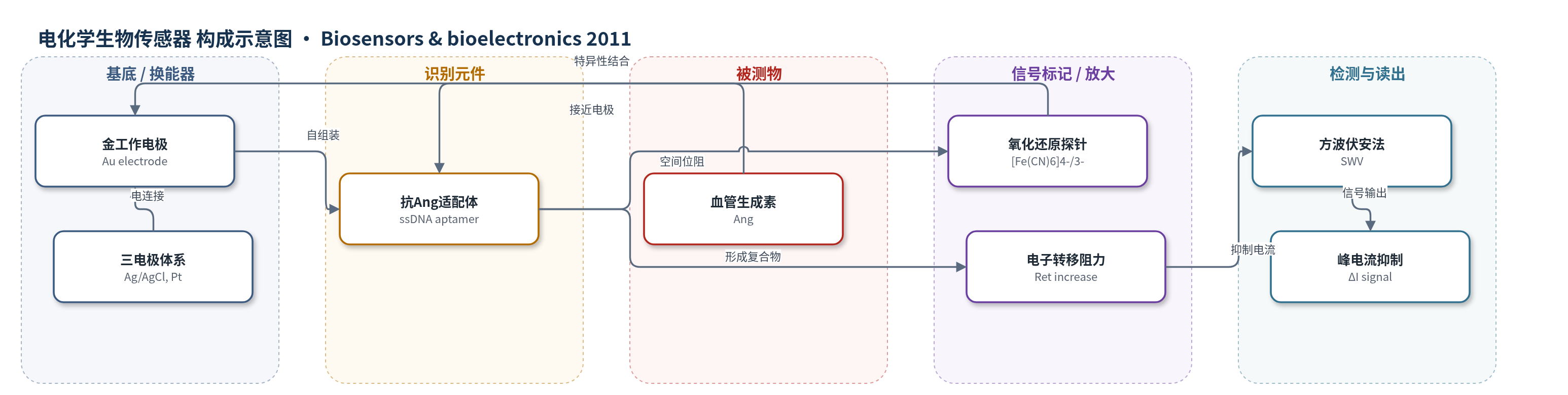
点击图片查看大图 · 依据论文自动绘制
传感器类型
电化学生物传感器
检测对象
血管生成素(angiogenin, Ang);样品基质:血清(serum,稀释50倍)
检测原理
抗Ang单链DNA适配体通过3′端巯基自组装在金电极表面,其磷酸骨架负电荷对[Fe(CN)6]4−/3−形成一定动力学屏障。加入Ang后,适配体与Ang特异性结合,形成适配体–Ang复合物,在电极界面产生空间位阻和绝缘效应,阻碍氧化还原探针接近金表面,使电子转移阻力增加,方波伏安法(SWV)峰电流下降。该过程为无标记signal-off检测,无需酶或荧光标记。随着Ang浓度升高,更多适配体被占据,探针可及性进一步降低,SWV电流抑制增大,且电流抑制与Ang浓度对数呈线性关系。
检测灵敏度
LOD: 1 pM;线性范围: 0.01 nM–30 nM;回归方程: ΔI = 12.09 + 1.675 log c (c, nM);R = 0.9974
效应效果
该传感器对 Ang 选择性良好:100 nM 溶菌酶、凝血酶和血红蛋白的相对信号抑制均低于2%,而1 nM Ang 引起明显电流下降。SWV 四次连续测量标准偏差为0.15%,优于CV和EIS,单次测量约180 s。血清加标回收率为92.1%(0.01 nM)和116%(1 nM),RSD分别为3.52%和4.87%(n=5)。与商业免疫分析比较,4例肺癌患者血清结果准确性为92%–104%(n=5)。作者认为该方法快速、灵敏、低成本,适用于复杂生物样品中 Ang 检测,并可为其他蛋白和小分子适配体检测提供策略。
传感器的构成
- 工作电极:金电极(Au electrode,直径2 mm),经piranha清洗、氧化铝抛光和电化学循环,作为换能器
- 识别元件:抗血管生成素单链DNA适配体(anti-angiogenin ssDNA aptamer,3′-SH-(CH2)6修饰),通过巯基自组装于Au表面,特异性结合Ang
- 氧化还原探针:铁氰化钾/亚铁氰化钾(K4[Fe(CN)6]/K3[Fe(CN)6],[Fe(CN)6]4−/3−),在PBS中提供SWV法拉第电流
- 固定化缓冲液:I-B(20 mM Tris-HCl/140 mM NaCl/5 mM KCl/1 mM MgCl2/1 mM CaCl2,pH 7.41)与TCEP,用于还原二硫键并促进适配体自组装
- 支撑电解质:0.2 M PBS(pH 7.0)含1 mM K4[Fe(CN)6]/K3[Fe(CN)6],用于电化学测量
中文摘要
血管生成素(angiogenin, Ang)是最强促血管生成因子之一,与多种肿瘤的生长和转移密切相关。本文报道了一种简单、无标记的方波伏安法(SWV)适配体生物传感器用于检测 Ang。该传感器以抗 Ang 单链 DNA 适配体作为分子识别元件,以铁氰化钾/亚铁氰化钾(K4[Fe(CN)6]/K3[Fe(CN)6])氧化还原电对作为探针。在裸金电极上,氧化还原电对可轻易接近电极表面并产生强 SWV 信号;在抗 Ang 适配体修饰的金电极上,加入 Ang 后,适配体与目标物结合形成空间位阻,降低氧化还原探针接近电极的可用性,使 SWV 峰电流下降。通过监测峰电流抑制可定量 Ang。信号抑制与 Ang 浓度对数在 0.01–30 nM 范围内线性,检出限为 1 pM。该传感器对 Ang 具有良好选择性,不受血清中其他蛋白质干扰,为 Ang 及其他蛋白检测提供了快速、灵敏、低成本的策略。
英文摘要
Angiogenin (Ang), one of the most potent angiogenic factor, is related with the growth and metastasis of numerous tumors. This paper presents a very simple and label-free square-wave voltammetry (SWV) aptasensor to detect angiogenin, in which an anti-angiogenin-aptamer was used as a molecular recognition element, and the couple ferro/ferricyanide as a redox probe. At the bare gold electrode, the redox couple (K(4)[Fe(CN)(6)]/K(3)[Fe(CN)(6)]) can be very easily accessed to the electrode surface to give a very strong SWV signal. At the anti-angiogenin/Au electrode surface, when angiogenin was added to the electrochemical cell, the binding of the analyte results in less availability for a redox reaction, which led to smaller SWV current. To quantify the amount of angiogenin, current suppressions of SWV peak were monitored using the redox couple of an [Fe(CN)(6)](4-/3-) probe. The plot of signal suppression against the logarithm of angiogenin concentration is linear with over the range from 0.01 nM to 30 nM with a detection limit of 1 pM. The aptasensor also showed very good selectivity for angiogenin without being affected by the presence of other proteins in serum. It is the first time to use a very simple method to detect the cancer marker. Such an aptasensor opens a rapid, selective and sensitive route for angiogenin detection and provides a promising strategy for other protein detections.