组成图示
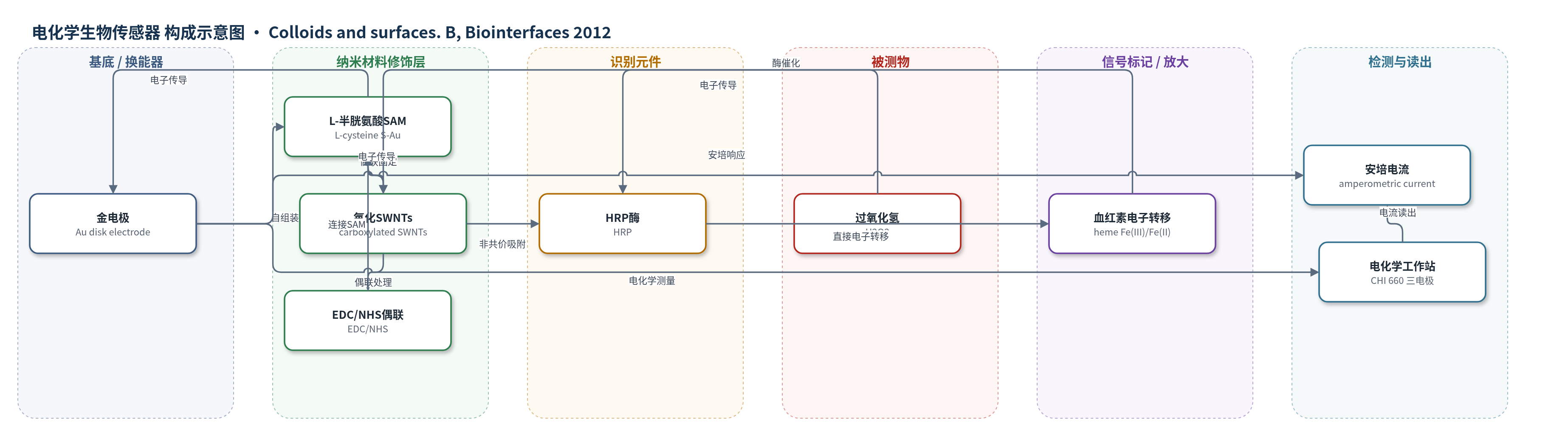
点击图片查看大图 · 依据论文自动绘制
传感器类型
电化学生物传感器
检测对象
过氧化氢(hydrogen peroxide, H2O2);样品基质为 PBS 缓冲液(0.01 M, pH 7.5),文中未报告实际生物/环境样品基质。
检测原理
该传感器以 HRP 为催化识别元件,以 SWNTs 为导电桥梁。HRP 通过胆酸钠悬浮-透析法非共价吸附于氧化 SWNTs,再经 EDC/NHS 偶联固定到 L-半胱氨酸自组装金电极上。检测时,H2O2 扩散至 HRP 血红素活性中心,被酶催化还原为 H2O;同时电极电子经 L-cysteine SAM 和 SWNTs 直接传递至 HRP 的 Fe(III)/Fe(II) 中心,实现无介质直接电子转移并再生酶活性中心。H2O2 浓度升高使电催化还原电流增大,最终由电化学工作站以安培电流读出。SWNTs 的高导电性和三维网络结构增强了电子传递与电流放大。
检测灵敏度
LOD: 2.1 × 10⁻¹³ M;线性范围: 1.0 × 10⁻¹²–1.0 × 10⁻¹¹ M;R^2 = 0.9986
效应效果
该传感器在 0.01 M PBS(pH 7.5)中对 H2O2 的安培线性范围为 1.0×10⁻¹²–1.0×10⁻¹¹ M,相关系数 0.9986,检测限 2.1×10⁻¹³ M(S/N=3),低于文献中 HRP 固定于 ZrO2 接枝胶原/DMSO 膜(2.5×10⁻⁷ M)、HRP-CPE(1×10⁻⁷ M)和 HRP-Chi-BMIM·BF4/GC(2.5×10−7 M)等体系。pH 7.5 附近响应最佳,pH 小于 7.0 或大于 8.0 时响应明显下降。文中报告其具有良好的操作稳定性和储存稳定性,但未给出 RSD、选择性、抗干扰或实际样品回收率数据。作者认为该集成组装可用于低浓度 H2O2 检测及生物燃料电池等应用。
传感器的构成
- 基底/换能器电极:金圆盘电极(Au disk electrode,直径3.0 mm),经抛光和电化学预处理,作为工作电极与电子换能器。
- 自组装单分子层:L-半胱氨酸(L-cysteine)通过 S–Au 共价键在金表面形成 SAM,提供氨基端点并作为固定化基底。
- 纳米导电修饰层:氧化单壁碳纳米管(SWNTs,经 H2O2/HCl 氧化引入羧基,胆酸钠分散去束),作为导电通道和酶载体。
- 识别/催化元件:辣根过氧化物酶(HRP),通过胆酸钠悬浮-透析法非共价吸附于 SWNTs,保留血红素活性并催化 H2O2。
- 偶联固定层:EDC 和 NHS 偶联剂,用于 HRP–SWNTs 与 L-cysteine SAM 之间的氨基/羧基偶联固定。
- 信号元件:HRP 血红素中心(heme),作为电活性中心实现 Fe(III)/Fe(II) 直接电子转移并电催化 H2O2。
- 检测介质:磷酸盐缓冲液(PBS,0.01 M,pH 7.5),维持酶活性与离子环境。
中文摘要
本文报道了一种基于辣根过氧化物酶(HRP)与单壁碳纳米管(SWNTs)集成组装的高灵敏纳米结构电化学生物传感器。作者采用胆酸钠悬浮-透析法将 HRP 非共价吸附到 SWNTs 表面,形成 HRP–SWNTs 共轭物;随后利用 L-半胱氨酸在金电极表面通过 S–Au 键形成自组装单分子层,并将 HRP–SWNTs 固定于该界面。HRP 在 SWNTs 上实现直接电子转移,使修饰金电极在电催化过程中阳极和阴极电流均得到放大。实验结果表明,HRP 能稳定固定在 SWNTs 上,并保持对过氧化氢的固有酶活性。该传感器对 H2O2 具有安培响应,线性范围为 1.0×10⁻¹² 至 1.0×10⁻¹¹ M,检测限为 2.1×10⁻¹³ M,且具有良好的操作稳定性和储存稳定性,可作为新型过氧化氢安培生物传感器的传感元件。
英文摘要
Development of a highly sensitive nanostructured electrochemical biosensor based on the integrated assembly of horseradish peroxidase (HRP) and single-walled carbon nanotubes (SWNTs) is described. In this study, we describe the use of a sodium cholate suspension-dialysis method to adsorb the horseradish peroxidase (HRP) onto single-walled carbon nanotubes (SWNTs). We demonstrate that HRP-SWNTs conjugates can be assembled into amperometric biosensors which L-cysteine were assembled on a gold electrode through the covalent bond of S-Au and was used as a substrate for the immobilization of enzymes. Direct electron transfer of HRP is realized at SWNTs, and both anodic and cathodic currents of the redox reaction at the l-cysteine-HRP-SWNTs-modified gold film upon electrocatalysis are amplified. Meanwhile, experimental results reveal that HRP is stably immobilized onto the SWNTs and maintains inherent enzymatic activity toward H(2)O(2). The modified electrode shows high sensitivity toward H(2)O(2). A linear response to hydrogen peroxide measurement is obtained over the range from 1.0×10(-12) to 1.0×10(-11)M and an amperometric detection limit of 2.1×10(-13)M due to its bioelectrocatalytic reduction based on direct electron transfer between gold electrode and the active site of the HRP. The biosensor displays excellent operational, storage stability and highly sensitive. The excellent performance validates the integrated assembly as an attractive sensing element for the development of a new hydrogen peroxide amperometric biosensor.