组成图示
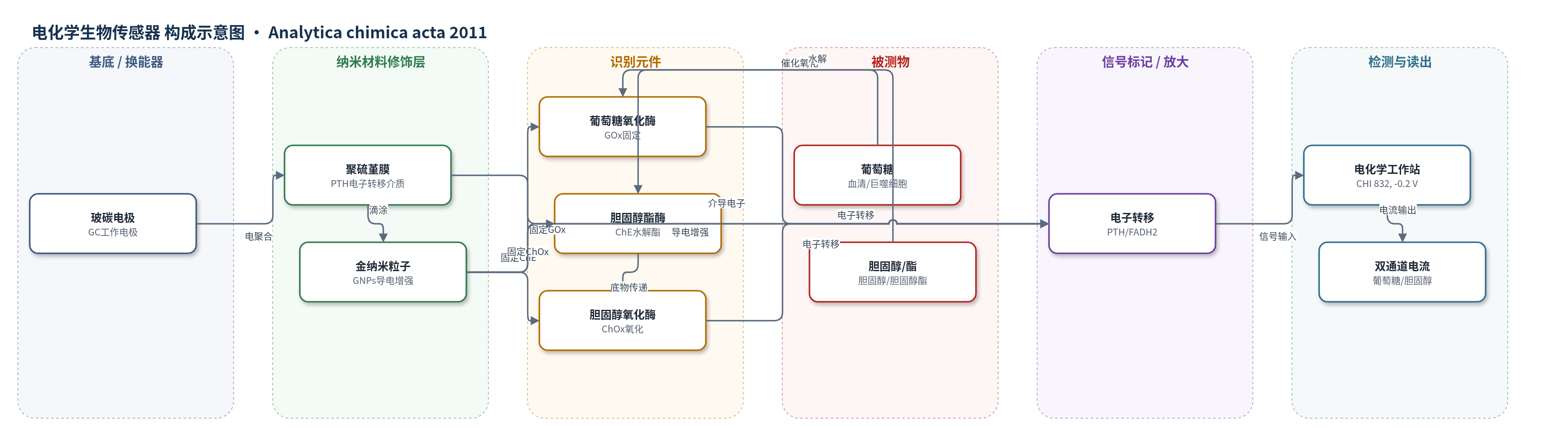
点击图片查看大图 · 依据论文自动绘制
传感器类型
电化学生物传感器
检测对象
葡萄糖(glucose)、胆固醇(cholesterol);样品基质:糖尿病小鼠血清、腹膜巨噬细胞(PMs)裂解上清
检测原理
该双酶传感器基于酶催化与介导电子转移的电化学换能机制。葡萄糖通道中,GOx催化葡萄糖氧化,其FAD辅基发生氧化还原;胆固醇通道中,ChE先将胆固醇酯水解为胆固醇,ChOx再催化胆固醇氧化,FAD同样发生氧化还原。酶反应产生的电子经GNPs和PTH膜的可逆两电子/两质子氧化还原过程传递至GC电极。在-0.2 V恒电位安培检测下,电流响应随葡萄糖或胆固醇浓度升高而增大。GNPs增大催化活性面积并降低电子转移阻力,PTH在负电位工作可抑制尿酸、抗坏血酸等干扰,双通道分别固定不同酶组合,因而对两种分析物具有低串扰。
检测灵敏度
LOD: 2.0 μM(葡萄糖);线性范围: 0.008–6.0 mM(葡萄糖);R^2 = 0.9987;LOD: 0.6 μM(胆固醇);线性范围: 0.002–1.0 mM(胆固醇);R^2 = 0.9983;KappM: 0.8689 mM(葡萄糖)、0.0886 mM(胆固醇)
效应效果
传感器抗干扰性良好:20 μM尿酸(UA)和20 μM抗坏血酸(AA)对0.5 mM葡萄糖及胆固醇响应偏差小于4%;60 μM UA/AA下双通道串扰低。重现性RSD为葡萄糖4.3%、胆固醇3.6%。4 ℃ PBS保存3周后分别保留89.2%和88.7%电流。实际样品中,非糖尿病小鼠血清葡萄糖6.54±0.29 mM、胆固醇1.92±0.04 mM;糖尿病小鼠血清葡萄糖21.5±0.93 mM(约3.3倍),胆固醇无显著变化;PMs葡萄糖139.31±18.14 mM mg−1细胞蛋白(约3.58倍),胆固醇24.55±1.31 mM mg−1(约2.14倍),支持糖尿病加速动脉粥样硬化风险评价。
传感器的构成
- 基底/换能器电极:玻碳电极(GC, glassy carbon electrode),作为工作电极基底
- 电子转移介质层:聚硫堇(PTH, poly-thionine)膜,由硫堇(thionine)电聚合形成,作为电子转移介质(ETM)
- 纳米材料修饰层:金纳米粒子(GNPs, gold nanoparticles),滴涂于PTH表面,增强导电性并促进酶与电极间电子转移
- 葡萄糖识别/催化元件:葡萄糖氧化酶(GOx, glucose oxidase),通过壳聚糖(CH)固定,催化葡萄糖氧化
- 胆固醇识别/催化元件:胆固醇酯酶(ChE, cholesterol esterase)与胆固醇氧化酶(ChOx, cholesterol oxidase),通过CH固定,ChE水解胆固醇酯为胆固醇,ChOx催化胆固醇氧化
- 连接/固定层:壳聚糖(CH, chitosan),作为连接子将酶固定于GNPs/PTH/GC表面
- 检测介质:0.1 M PBS(pH 6.5),维持酶活性并提供电化学检测环境
中文摘要
本文报道了一种新型双酶生物传感器,用于同时测定糖尿病小鼠血清和腹膜巨噬细胞(PMs)中的葡萄糖和胆固醇,以评估糖尿病加速动脉粥样硬化的风险。该传感器采用三步法构建:首先通过循环伏安电聚合在玻碳电极表面组装聚硫堇(PTH)膜,作为电子转移介质(ETM);其次在PTH表面滴涂金纳米粒子(GNPs),促进葡萄糖氧化酶(GOx)、胆固醇氧化酶(ChOx)与电极之间的电子转移;最后通过壳聚糖(CH)连接子将GOx、胆固醇酯酶(ChE)和ChOx固定于PTH层。PTH与GNPs的结合赋予传感器良好选择性、高灵敏度和低串扰。该传感器对葡萄糖和胆固醇氧化具有良好电催化活性,葡萄糖线性范围为0.008–6.0 mM,检出限为2.0 μM;胆固醇线性范围为0.002–1.0 mM,检出限为0.6 μM。糖尿病小鼠结果显示,血清胆固醇水平随葡萄糖升高无明显变化,而PMs中胆固醇水平随葡萄糖升高而升高。巨噬细胞胆固醇大量积累可诱导泡沫细胞形成,是早期动脉粥样硬化的标志,本研究为糖尿病加速动脉粥样硬化提供了进一步证据。
英文摘要
In this paper, a novel dual enzymatic-biosensor is described for simultaneous determination of glucose and cholesterol in serum and peritoneal macrophages (PMs) of diabetic mice to evaluate the risk of diabetes-accelerated atherosclerosis. The biosensor was constructed by a three-step method. First, a poly-thionine (PTH) film was assembled on the surface of glassy carbon electrode by cyclic voltammetric electropolymerization of thionine, which serves as an electron transfer mediator (ETM). Second, gold nanoparticles (GNPs) were covered on the surface of PTH facilitating the electron transfer between glucose oxidase (GOx), cholesterol oxidase (ChOx) and electrode. Finally, the enzymes, GOx, cholesterol esterase (ChE), and ChOx, were covalently attached to the PTH layer through a chitosan (CH) linker. The PTH coupled with GNPs provides good selectivity, high sensitivity and little crosstalk for the dual enzymatic-biosensor. The developed biosensor had good electrocatalytic activity toward the oxidations of glucose and cholesterol, exhibiting a linear range from 0.008 mM to 6.0 mM for glucose with a detection limit of 2.0 μM, and a linear range from 0.002 mM to 1.0 mM for cholesterol with a detection limit of 0.6 μM. The results of the diabetic mice demonstrated that the cholesterol level did not change obviously with the increase of glucose level in serum, while the cholesterol level was induced with the increase of the glucose level in PMs. Previous studies have shown that the large accumulation of cholesterol in macrophage could lead to macrophage foam cell formation, which is the hallmark of early atherosclerosis. This study provides useful further evidences for the development of diabetes-accelerated atherosclerosis.