组成图示
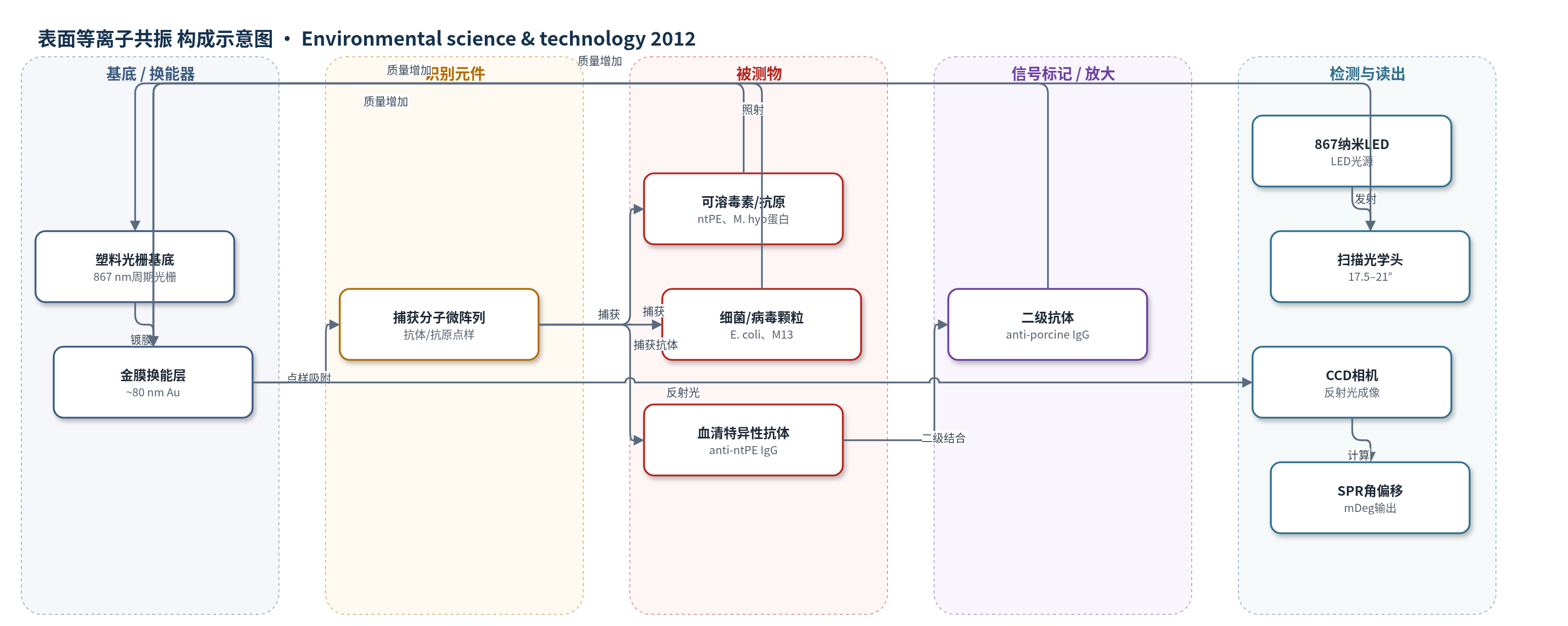
点击图片查看大图 · 依据论文自动绘制
传感器类型
表面等离子共振(SPR)生物传感器
检测对象
检测对象:非毒性铜绿假单胞菌外毒素A(ntPE)、鸡卵白蛋白(ovalbumin, Ova)、猪肺炎支原体(Mycoplasma hyopneumoniae)抗原/抗体、大肠杆菌(Escherichia coli)、单核细胞增生李斯特菌(Listeria monocytogenes)、巨大芽孢杆菌(Bacillus globigii,作为炭疽杆菌替代物)、M13噬菌体(M13 bacteriophage);样品基质包括PBS/PBST缓冲液、猪血清、淡水鱼缸水(模拟环境水样)。
检测原理
GCSPRI芯片在塑料衍射光栅上镀约80 nm金膜,867 nm LED经扫描光学头以17.5–21°连续照射,光栅将入射光耦合为金表面表面等离子体,反射光强度在共振角出现最小值。芯片表面以微阵列形式被动吸附抗体或抗原作为识别元件,被测毒素、细菌、病毒或血清抗体结合后,界面局部折射率/质量增加,使SPR共振角发生偏移。CCD相机逐角度采集反射光图像,算法计算SPR角偏移(mDeg),并与邻近裸金参考ROI比较以扣除整体折射率和非特异结合。可选二级抗体结合已捕获抗体,进一步增加界面质量,实现信号放大。
检测灵敏度
LOD: M13 bacteriophage 10^5 PFU/mL(10^4 PFU/mL无信号;10^5 PFU/mL产生2.54 mDeg,1 mg/mL capture spots);定量评估: 1.1 × 10^5 PFU/mL;LOD: live B. globigii 3.2 × 10^6 cells/mL;LOD: paraformaldehyde-fixed B. globigii 1.6 × 10^5 cells/mL;约90个捕获B. globigii细胞产生2 SD背景以上信号(X-int = 30.92 cells;=89.29 cells);线性响应: anti-Listeria LZF7 125–500 μg/mL ROIs(31、59、115 mDeg);R^2 = 0.5988(Pearson R = 0.7738,P = 0.0052)。
效应效果
该传感器在1 cm²芯片上可并行检测1000余个ROI,较多数棱镜SPR提高约100倍。ntPE仅结合免疫猪IgG;M. hyopneumoniae裂解液仅使anti-M. hyo IgG ROI产生62.7 mDeg;E. coli、Listeria、M13均只在对应抗体ROI响应。不同芯片、活菌/固定菌、PBS与鱼缸水样品中相同浓度信号可重复。M13可定量至1.1×10^5 PFU/mL,优于Love波(10^9 PFU/mL)和QCM(10^6 PFU/mL);固定B. globigii检测至1.6×10^5 cells/mL。二级抗体使ntPE信号约加倍,M. hyo二级结合达72–82 mDeg。作者认为适合快速、无标记、高多路环境病原与毒素监测。
传感器的构成
- 基底/换能器:塑料光学衍射光栅(plastic optical diffraction grating,周期867 nm、沟深40 nm)与约80 nm金膜(Au),用于耦合入射光并激发表面等离子体。
- 识别元件:微阵列点样的抗体或抗原捕获分子(如anti-ntPE porcine IgG、anti-M13 mouse IgG、anti-E. coli goat IgG、anti-Listeria mAbs LZF7/LZH1、anti-B. globigii rabbit IgG、ntPE、M. hyopneumoniae lysate),被动吸附于金表面并特异性捕获被测物。
- 封闭层:2% BSA、10% Superblock或5% cold-water teleostean gelatin,用于阻断非特异吸附;部分抗原点样使用1% Stabilcoat稀释/稳定。
- 流池:带垫圈窗口(gasketed window)贴合芯片形成约40 μL样品流路,使样品流过微阵列。
- 信号放大元件:可选二级抗体(anti-porcine IgG、goat anti-mouse IgG)结合已捕获抗体,增加界面质量与SPR角偏移。
- 读出系统:867 nm LED、扫描光学头(angle encoder,17.5–21°)和CCD相机,记录反射光强度最小值对应的SPR角偏移(mDeg)。
中文摘要
光栅耦合表面等离子共振成像(GCSPRI)利用镀金传感芯片上的光学衍射光栅,将准直入射光耦合为表面等离子体。该耦合角度对芯片表面分析物捕获敏感,因此可采用低成本批量生产的可抛弃芯片,并以微阵列形式点样,大幅提高多重检测能力。当前GCSPRI仪器可同时测量超过1000个独立感兴趣区(ROI),通过芯片上固定抗体或其他特异性捕获分子实现。本文报道利用GCSPRI在近实时条件下直接检测多种分析物,覆盖较大动态范围,包括可溶性蛋白毒素、细菌细胞和病毒。所检测对象包括大分子抗原、非毒性铜绿假单胞菌外毒素A(ntPE)、巨大芽孢杆菌、猪肺炎支原体、单核细胞增生李斯特菌、大肠杆菌和M13噬菌体。结果表明,GCSPRI可在快速、无标记、高多重检测中同时评估毒素与病原体的存在,并定量环境因子特异性抗体,仅需纳升级捕获试剂。
英文摘要
Grating-coupled surface plasmon resonance imaging (GCSPRI) utilizes an optical diffraction grating embossed on a gold-coated sensor chip to couple collimated incident light into surface plasmons. The angle at which this coupling occurs is sensitive to the capture of analyte at the chip surface. This approach permits the use of disposable biosensor chips that can be mass-produced at low cost and spotted in microarray format to greatly increase multiplexing capabilities. The current GCSPRI instrument has the capacity to simultaneously measure binding at over 1000 unique, discrete regions of interest (ROIs) by utilizing a compact microarray of antibodies or other specific capture molecules immobilized on the sensor chip. In this report, we describe the use of GCSPRI to directly detect multiple analytes over a large dynamic range, including soluble protein toxins, bacterial cells, and viruses, in near real-time. GCSPRI was used to detect a variety of agents that would be useful for diagnostic and environmental sensing purposes, including macromolecular antigens, a nontoxic form of Pseudomonas aeruginosa exotoxin A (ntPE), Bacillus globigii, Mycoplasma hyopneumoniae, Listeria monocytogenes, Escherichia coli, and M13 bacteriophage. These studies indicate that GCSPRI can be used to simultaneously assess the presence of toxins and pathogens, as well as quantify specific antibodies to environmental agents, in a rapid, label-free, and highly multiplexed assay requiring nanoliter amounts of capture reagents.