组成图示
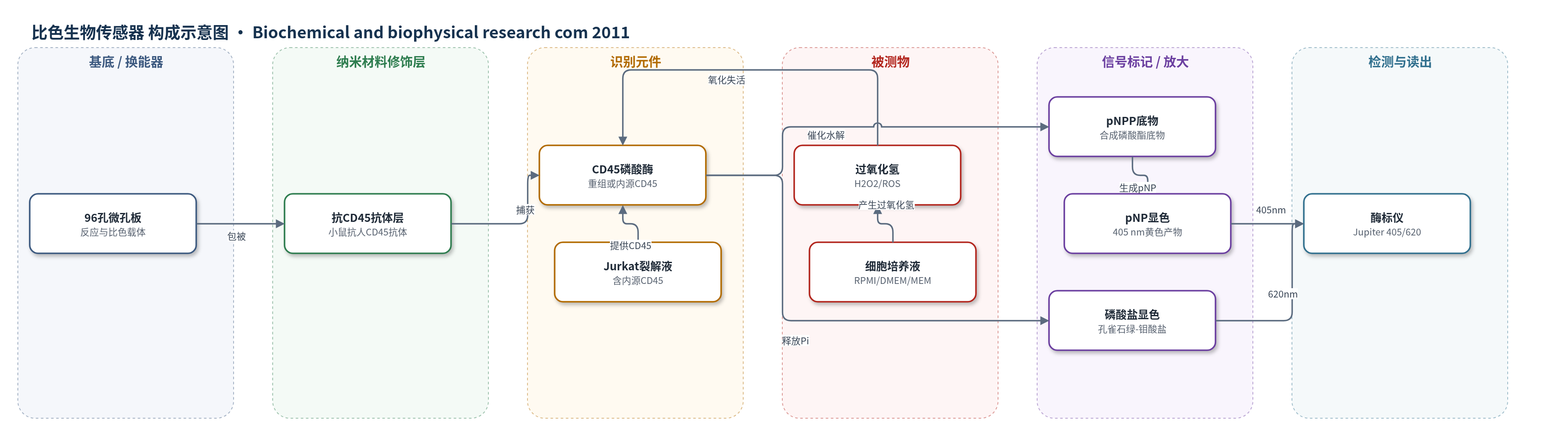
点击图片查看大图 · 依据论文自动绘制
传感器类型
比色生物传感器
检测对象
过氧化氢(hydrogen peroxide, H2O2)、活性氧(reactive oxygen species, ROS);样品基质:细胞培养液(RPMI 1640、DMEM、含丙酮酸 DMEM、MEM)及 Jurkat 细胞培养体系/细胞裂解液
检测原理
CD45 是含催化半胱氨酸的蛋白酪氨酸磷酸酶,其催化中心半胱氨酸以硫醇盐形式存在。当细胞培养液或细胞体系中产生过氧化氢(H2O2)时,H2O2 将 CD45 催化半胱氨酸氧化为次磺酸,使磷酸酶活性下降;H2O2 浓度越高,CD45 剩余活性越低。检测时,将 CD45 与底物 pNPP 孵育,剩余活性 CD45 水解 pNPP 生成黄色 p-nitrophenol,405 nm 吸光度随 H2O2 增加而降低。对于 Jurkat 细胞裂解液,CD45 先被抗 CD45 抗体捕获,再用 DADEY(PO3)LIPQQG 底物反应,释放无机磷酸盐,经 malachite green-molybdate 显色后于 620 nm 读出。DTT 可还原次磺酸恢复活性,catalase 清除 H2O2 可阻止失活,从而验证 H2O2 介导机制。
检测灵敏度
原文未报告LOD、线性范围、灵敏度斜率、相关系数。
效应效果
该方法以 CD45 活性变化反映培养液中 H2O2/ROS 水平,机制选择性明确:900 μg/mL catalase 几乎完全消除培养基抑制,10 mM sodium pyruvate 也能消除抑制,1 mM 仅部分缓解;DTT 处理后酶活性几乎完全恢复,说明失活为可逆氧化。RPMI 1640 失活最强,含丙酮酸培养基抑制最弱。Jurkat 细胞中,catalase 预处理使 CD45 活性比未处理高约40%;1 mM 和 10 mM sodium pyruvate 分别提高约15%和超过30%。光照组 CD45 活性比避光组低约22%,提示光依赖 H2O2 产生。实验重复至少三次,mean ± SEM,ANOVA/Tukey p<0.05。作者认为该方法可评估培养液氧化应激,并通过避光或抗氧化补充减少假象。
传感器的构成
- 载体/反应容器:96-well microplate,提供反应与比色读出
- 捕获/固定层:小鼠抗人 CD45 抗体(R&D Systems)包被微孔板,用于捕获 Jurkat 裂解液中的 CD45
- 识别/传感元件:重组人蛋白酪氨酸磷酸酶 CD45(PTP CD45)或 Jurkat 细胞内源 CD45,催化中心半胱氨酸被 H2O2 氧化失活
- 样品基质:RPMI 1640、DMEM、含 1 mM 丙酮酸 DMEM、含 1 mM 丙酮酸 MEM 或 Jurkat 细胞裂解液,提供待测 H2O2/ROS
- 底物/信号转换:pNPP(对硝基苯基磷酸二酯)作为合成底物,被 CD45 水解生成 p-nitrophenol 和无机磷酸盐
- 磷酸盐显色体系:malachite green-molybdate 反应检测无机磷酸盐,用于 620 nm 比色
- 还原/恢复试剂:DTT(二硫苏糖醇)还原 CD45 催化半胱氨酸,验证可逆氧化失活
- 对照/清除剂:catalase(过氧化氢酶,900 μg/mL)和 sodium pyruvate(丙酮酸钠,1/10 mM)清除 H2O2,用于机制对照
- 检测仪器:microplate reader Jupiter(Biogenet)配 DigiRead 软件,405 nm 或 620 nm 吸光度读出
中文摘要
本研究设计了一种评估生物流体中活性氧(ROS)生成的方法,利用蛋白酪氨酸磷酸酶 CD45 作为氧化应激生物传感器。作者应用该方法检测 RPMI 1640、DMEM、含丙酮酸的 DMEM 和 MEM 等细胞培养液中的氧物种生成。结果显示,这些培养基(尤其 RPMI 1640)显著降低蛋白酪氨酸磷酸酶活性;培养基导致的 CD45 失活在二硫苏糖醇(DTT)处理后几乎完全恢复,表明为可逆氧化。加入过氧化氢酶的培养基对 CD45 活性无抑制,提示酶失活由过氧化氢介导。此外,在 RPMI 1640 中培养 Jurkat 细胞,比较暴露于层流柜荧光灯与避光条件,发现暴露光线的细胞 CD45 活性较避光细胞低约20%。结果表明,培养基中过氧化氢产生并抑制 CD45 具有光依赖性,培养液避光可避免细胞研究中的假象;过氧化氢可能由培养基中光反应氨基酸在光照下产生。
英文摘要
We have designed a useful method of assessing reactive oxygen species generation in biological fluids. The novel assay utilizes tyrosine phosphatase CD45 as a biosensor of oxidative stress. Applying this new method, we examined oxygen species generation in the following cell culture media: RPMI 1640, DMEM, DMEM enriched with pyruvate and MEM. We discovered that the media (especially RPMI 1640) significantly reduced the activity of protein tyrosine phosphatase. The media-caused inactivation of CD45 was reversible after treatment with dithiothreitol being a powerful reducing agent. Interestingly, the media supplemented with catalase did not exhibit any inhibitory effect on CD45 activity which suggests a hydrogen peroxide-mediated mechanism of the enzyme inactivation. In addition to that, we assessed the impact of oxidative stress level on the activity of CD45 as measured in Jurkat cells cultured in RPMI 1640 either exposed or not exposed to the light of laminar flow cabinet fluorescent lamp. We found that Jurkat cells that were exposed to light displayed ca. 20% lower activity of CD45 than the cells protected against the light. The obtained results indicate that production of hydrogen peroxide in the medium leading to inhibition of CD45 was light-dependent, and that careful protection of cell culture media from the light may help to prevent the artifact in cell studies. Hydrogen peroxide, responsible for CD45 inactivation, can be generated in cell culture media after exposition to light due to photoreactive amino acids present in the media.