组成图示
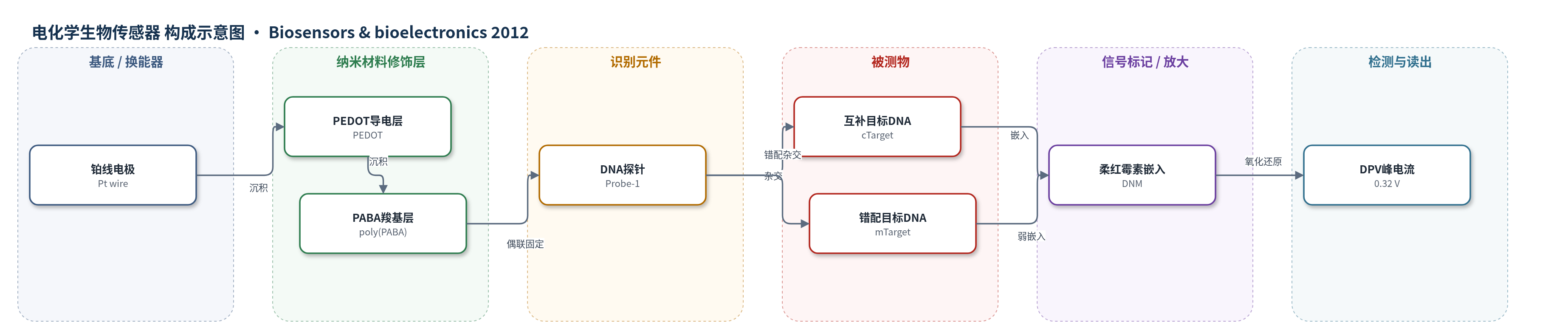
点击图片查看大图 · 依据论文自动绘制
传感器类型
电化学生物传感器
检测对象
互补目标 DNA(cTarget)、错配目标 DNA(mTarget-1、mTarget-3、mTarget-5)、PCR 双链 DNA 产物;样品基质为 PBS 缓冲液中的 DNA 寡核苷酸或 PCR 产物
检测原理
该传感器以PEDOT/Pt为导电基底,poly(PABA)提供羧基,通过EDC/Sulfo-NHS将3′氨基DNA探针共价固定。目标DNA在PBS中杂交后形成双链结构,柔红霉素DNM嵌入双链碱基对之间。DPV扫描时,DNM发生氧化还原反应,在约0.32 V处产生峰电流。互补目标DNA浓度越高,形成的双链越多,嵌入DNM越多,峰电流越大;错配碱基降低杂交稳定性,减少DNM嵌入,使峰电流下降。PEDOT提供电子传导并降低背景,poly(PABA)的晶体突起可减轻空间位阻,提高杂交效率。
检测灵敏度
灵敏度: 1.39 μA nM−1 cm−2;R^2 = 0.9909
效应效果
传感器对互补目标DNA呈线性响应,灵敏度为1.39 μA nM−1 cm−2,相关系数0.9909。选择性方面,1、3、5个错配碱基使DPV峰电流依次降低;在100 nM cTarget存在下,加入6.67、20、22.67 nM mTarget-1(55 ℃杂交)也导致峰电流明显下降,表明可识别混合中的错配DNA。作者提出PCR双链DNA分析流程,用56-mer探针检测64-mer目标及64 bp PCR产物,经加热–冷却和竞争寡核苷酸处理后信号增强。与PPy、PANI修饰电极相比,PEDOT表面更均匀,后两者未检测到明显信号。文中未报告RSD、实际样品回收率或与ELISA/qPCR的定量对比,但作者认为其可用于DNA定量和突变检测。
传感器的构成
- 基底/换能器电极:铂线(Pt wire,直径0.6 mm),抛光后作为工作电极
- 导电聚合物修饰层:聚(3,4-乙烯二氧噻吩)(PEDOT),电化学聚合于Pt表面,提供导电通道并降低背景
- 羧基功能化修饰层:聚(对氨基苯甲酸)(poly(PABA)),电化学沉积于PEDOT上,提供羧基用于探针固定
- 交联活化试剂:EDC与Sulfo-NHS,活化poly(PABA)羧基,使探针3′氨基共价偶联
- 识别元件:单链DNA探针(Probe-1,19-mer,3′氨基C6修饰),与目标DNA杂交
- 信号标记物:柔红霉素盐酸盐(DNM),嵌入双链DNA并作为氧化还原指示剂
- 检测介质:PBS缓冲液(pH 7.4),用于杂交、洗涤和DPV测量
中文摘要
本研究通过电化学合成聚(3,4-乙烯二氧噻吩)(PEDOT)和聚(对氨基苯甲酸)(poly(PABA))修饰铂线,构建了一种无标记 DNA 生物传感器。设计好的单链 DNA 寡核苷酸通过 poly(PABA) 的羧基固定于电极表面作为探针,在适当条件下与目标 DNA 杂交。采用差分脉冲伏安法(DPV)在柔红霉素盐酸盐存在下表征杂交效率;柔红霉素可嵌入杂交形成的双链 DNA 并具有氧化还原活性。结果显示 DPV 峰电流与互补目标 DNA 浓度呈良好线性关系。另一方面,目标 DNA 与探针 DNA 之间的错配导致电化学响应显著降低,且降低程度与错配碱基数相关。因此,该 DNA 生物传感器不仅可用于 DNA 定量,还具有在临床诊断和实验室应用中检测突变的潜力。
英文摘要
In this study, we have fabricated a label free DNA biosensor by modifying the platinum wire with electrochemically synthesized poly(3,4-ethylenedioxythiopene) and poly(p-aminobenzoic acid). A designed single-strand DNA oligo was immobilized with the carboxyl group of poly(p-aminobenzoic acid) and served as the probe, a target DNA was then hybridized with the probe under a proper condition. Differential pulse voltammetry was performed to characterize the hybridization efficiency in the presence of daunorubicin hydrochloride that was able to be intercalated into the hybridized double-strand DNA and possessed the redox activity. Our results revealed a satisfied linear correlation between the peak current of differential pulse voltammetry and the concentration of complementary target DNA. On the other hand, the mismatches between the target- and probe-DNA caused a significant reduction of electrochemical response, in which was correlated with the amount of mismatched base pairs, therefore the current DNA biosensor had potential applications not only in DNA quantification but also in mutation detection for clinical diagnostics and laboratory applications.