组成图示
点击图片查看大图 · 依据论文自动绘制
传感器类型
电化学生物传感器
检测对象
PML/RARA 融合基因目标 DNA 序列(PML/RARA fusion gene target sequences / cDNA),样品基质为 2× SSC 杂交缓冲液(pH 7.5);面向急性早幼粒细胞白血病(APL)样本。
检测原理
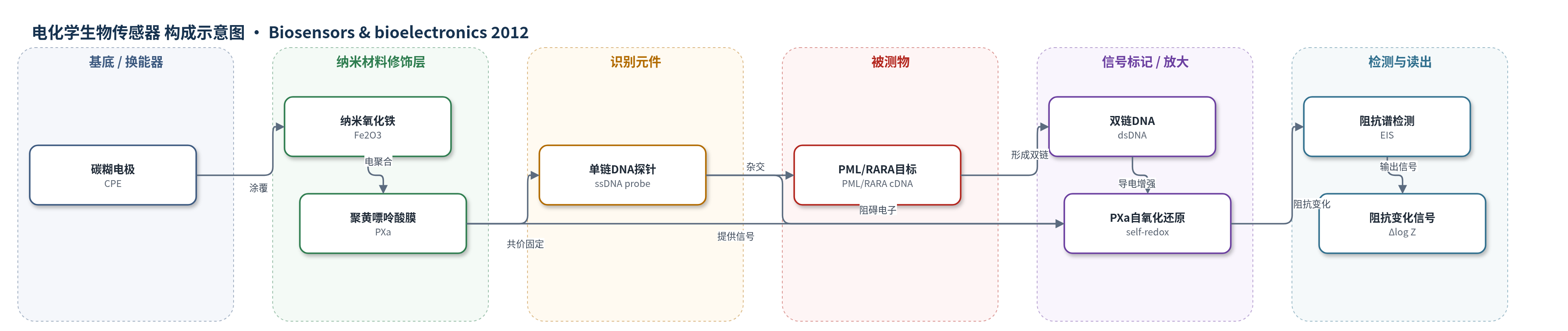
传感器以 PXa/Fe2O3 纳米菱形膜为无标记信号平台。ssDNA 探针经 EDC/NHS 共价固定于 PXa 羧基末端。固定 ssDNA 后,柔性单链 DNA 及负电荷磷酸骨架阻碍电子沿 PXa 链转移,使 PXa 自氧化还原电流降低、界面阻抗升高。当 PML/RARA 目标 DNA 与探针杂交形成 dsDNA 后,双链结构更刚性有序,导电性高于 ssDNA,反离子扩散更自由,界面阻抗下降,PXa 自氧化还原电流增强。通过 EIS 无指示剂监测 Δlog Z 随目标 DNA 浓度变化,实现无标记检测。Fe2O3 提高 PXa 电聚合效率和膜导电性,PXa 提供自信号,构成信号放大。
检测灵敏度
LOD: 2.8 fmol/L;线性范围: 1.0 × 10⁻¹⁴ mol/L–1.0 × 10−7 mol/L;R = 0.9972;斜率: 0.1102(Δlog Z/log C);回归方程: Δlog Z = 0.1102 log C + 1.7025;动态范围: 8 orders of magnitude。
效应效果
该传感器无需对目标 DNA 进行标记,即可通过 EIS 直接监测杂交事件。选择性方面,与完全互补目标 DNA 相比,单碱基错配序列引起的阻抗下降明显较小,非互补 DNA 序列未引起显著阻抗变化,表明其能区分单碱基错配和非互补序列。稳定性、可重复性和重现性在正文中仅说明详见补充材料,未给出具体 RSD 或寿命数值;未报告实际临床样品加标回收率及与 ELISA、qPCR 等方法的定量对比。作者认为该无标记阻抗平台具有超灵敏、宽线性范围(8 个数量级)和良好选择性,可用于其他 DNA 生物识别事件及疾病诊断。
传感器的构成
- 基底/换能器电极:碳糊电极(CPE),提供导电基底与电化学换能界面。
- 纳米材料修饰层:纳米氧化铁(Fe2O3)涂覆于 CPE 表面,提高导电性、增大比表面积并作为 PXa 成核生长基底。
- 电活性聚合物膜:聚黄嘌呤酸(PXa)通过脉冲恒电位法在 Fe2O3 上电聚合形成纳米菱形膜,提供丰富羧基和自氧化还原信号。
- 交联活化层:EDC/NHS 活化 PXa 末端羧基,用于与 DNA 末端氨基形成酰胺键共价连接。
- 识别元件:18-mer 单链 DNA 捕获探针(ssDNA probe),特异性识别 PML/RARA 融合基因目标序列。
- 信号读出层:无标记 PXa 自氧化还原/界面阻抗变化,通过 EIS 监测杂交事件。
中文摘要
本文报道了一种新型电化学 DNA 生物传感器,利用 18 聚单链脱氧核糖核酸作为捕获探针,用于急性早幼粒细胞白血病中 PML/RARA 融合基因的简便、快速和特异性检测。首先将纳米 Fe2O3 固定在碳糊电极(CPE)表面;随后在 Fe2O3 基底上采用脉冲恒电位法电生聚黄嘌呤酸(PXa),形成独特且均匀的纳米菱形结构。由于黄嘌呤酸(Xa)与 Fe2O3 具有独特结合能力,Xa 单体倾向于吸附在纳米 Fe2O3 周围,电聚合效率显著提高。由于 PXa/Fe2O3 纳米菱形膜富含羧基,捕获探针通过 DNA 序列游离氨基与羧基末端之间经 EDC/NHS 交联反应共价固定。共价固定的捕获探针可选择性与其目标 DNA 杂交,在 PXa/Fe2O3/CPE 表面形成双链 DNA。采用电化学阻抗谱对探针捕获电极上的杂交反应进行无指示剂监测。高效探针固定平台与超灵敏无指示剂阻抗测量相结合,使检测限达 2.8 fmol/L,动态范围跨越 8 个数量级。该传感器优异的分析性能为其他生物识别事件的超灵敏检测和疾病诊断提供了广阔前景。
英文摘要
This paper describes a novel electrochemical DNA biosensor for simple, rapid, and specific detection of PML/RARA fusion gene in acute promyelocytic leukemia by using 18-mer single-stranded deoxyribonucleic acid as the capture probe. Nanosized Fe(2)O(3) was first immobilized on the surface of a carbon paste electrode (CPE). Then poly-xanthurenic acid (PXa), a new electroactive material, was electrogenerated by using the pulse potentiostatic method on the Fe(2)O(3) substrate to form a unique and uniform nanorhombus structure. Due to the unique binding ability of xanthurenic acid (Xa) with Fe(2)O(3), Xa monomers tended to be adsorbed around nanosized Fe(2)O(3), and the electropolymerization efficiency was greatly improved. Owing to the presence of abundant carboxyl groups, the capture probe was covalently attached on the carboxyl-terminated PXa/Fe(2)O(3) nanorhombus membranes through the free amines of DNA sequences based on the 1-ethyl-3-(3-dimethylaminopropyl) carbodiimide and N-hydrosulfosuccinimide cross-linking reaction. The covalently immobilized capture probe could selectively hybridize with its target DNA to form double-stranded DNA on the PXa/Fe(2)O(3)/CPE surface. Electrochemical impedance spectroscopy was adopted for indicator-free monitoring of the hybridization reaction on the probe-captured electrode. As a result, the efficient probe immobilization platform, coupled with the ultrasensitive indicator-free impedance measurement, gave rise to a detection limit of 2.8 fmol/L and a dynamic range spanning 8 orders of magnitude. The excellent analytical properties of the proposed biosensor developed here holds great promise for ultrasensitive detection of other biorecognition events and diagnosis of diseases in practice.