组成图示
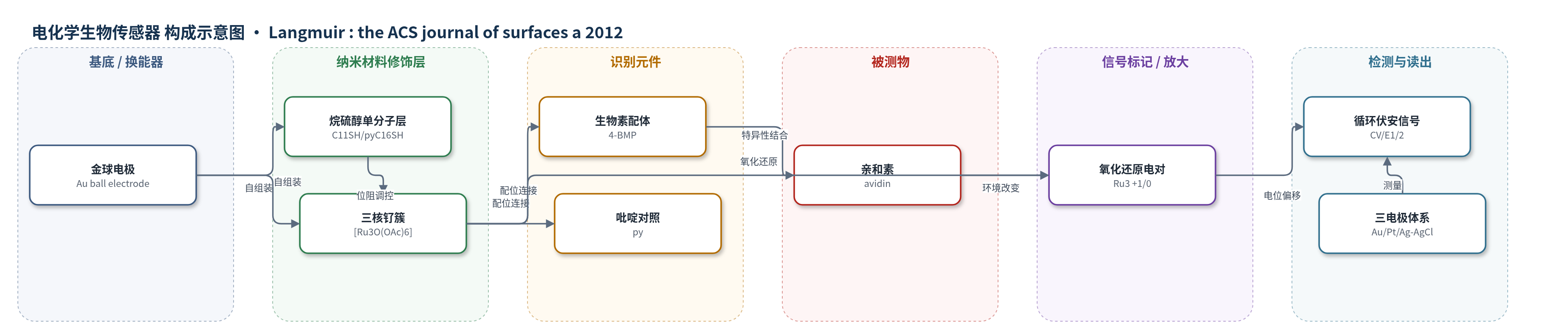
点击图片查看大图 · 依据论文自动绘制
传感器类型
电化学生物传感器
检测对象
亲和素(avidin),pH 7.0 PBS 含 100 mM NaCl 缓冲液
检测原理
该传感器以金球电极为基底,通过烷硫醇自组装单分子层将三核钌簇固定于电极表面。簇上的生物素氨基甲基吡啶(4-BMP)作为识别元件,与样品中的亲和素(avidin)特异性结合;双价 4-BMP 可桥接亲和素相邻亚基,提高界面结合概率。avidin 结合后,非极性蛋白取代簇周围水分子,降低局部介电常数并稳定氧化态,使三核钌簇 +1/0 氧化还原电对的 E1/2 向负方向移动,结合越多负移越大。循环伏安法读取 E1/2 偏移,偏移幅度反映结合事件。表面固定消除了蛋白扩散限制,三核钌簇尺寸维持电极电子耦合,避免电流完全消失。Tafel/Laviron 分析显示 kET 和重组能 λ 基本不变,E1/2 变化主要来自结合后 Gibbs 自由能变化。
检测灵敏度
未报告 LOD、线性范围、灵敏度斜率或相关系数。
效应效果
选择性由吡啶对照 10 验证:avidin 加入后 E1/2 不变,仅电流下降,说明偏移源于特异结合。ITC 结合常数:4-BMP 1.1×10^8、3 8.0×10^6、4 6.5×10^6 M^-1。溶液中 3a/4a 的 E1/2 负移 58/53 mV,保持可逆。单分子层 C11 20:1 下双价 9 负移 43 mV,单价 8 仅 6 mV,双价增强信号;C11 kET 约 75 s^-1,C16 约 0.5 s^-1。未报告 RSD、回收率或实际样品。作者认为多价相互作用可提升电化学蛋白传感器灵敏度。
传感器的构成
- 基底/换能器电极:金球电极(Au ball electrode),提供电子转移动态界面与电化学信号读出
- 自组装单分子层:烷硫醇稀释剂 HO(CH2)11SH 或 HO(CH2)16SH 与含 pyC16SH 的三核钌簇 6/7 共组装,控制表面覆盖密度和空间位阻
- 氧化还原探针/信号标记:三核钌簇 [Ru3O(OAc)6](化合物 8/9/10),提供可逆 +1/0 氧化还原电对,avidin 结合改变 E1/2
- 识别元件:生物素氨基甲基吡啶(4-BMP),单价(8)或双价(9)配体,特异性结合 avidin
- 对照识别元件:吡啶(py)配体(10),不含生物素,用于排除非特异结合
- 电化学介质:pH 7.0 PBS 含 100 mM NaCl,提供离子导电环境
- 检测系统:三电极体系(Au 工作电极、Pt 对电极、Ag/AgCl 参比电极)与循环伏安(CV)/Tafel 分析,读出 E1/2 和 kET
中文摘要
电化学生物传感器常受灵敏度不足限制,利用多价配体–受体相互作用并控制表面配体空间排布是改进策略。作者合成并表征了五种生物素化三核钌簇作为潜在生物传感器平台:3、4、8、9、10,其中 4-BMP 为生物素氨基甲基吡啶,py 为吡啶,L 为 pyC16SH。HABA/avidin 实验和等温滴定量热法显示 3 和 4 可结合亲和素,结合常数为 (6.5–8.0)×10^6 M^-1。天然凝胶电泳表明 4 在溶液中发生分子间蛋白结合;QM、MM 和 MD 计算显示双价簇 4 可分子内结合亲和素。溶液中 3a 和 4a 加入亲和素后 E1/2 分别负移 58 和 53 mV。由 8–10 构建的自组装单分子层作为模型生物传感器,稀释剂/簇比例和组成显著影响亲和素结合;8 和 10 的 E1/2 变化可忽略,9 加入亲和素后 E1/2 负移 43 mV。结果表明多价相互作用可提升电化学蛋白生物传感器灵敏度。
英文摘要
Despite their popularity, electrochemical biosensors often suffer from low sensitivity. One possible approach to overcome low sensitivity in protein biosensors is to utilize multivalent ligand-receptor interactions. Controlling the spatial arrangement of ligands on surfaces is another crucial aspect of electrochemical biosensor design. We have synthesized and characterized five biotinylated trinuclear ruthenium clusters as potential new biosensor platforms: [Ru(3)O(OAc)(6)CO(4-BMP)(py)](0) (3), [Ru(3)O(OAc)(6)CO(4-BMP)(2)](0) (4), [Ru(3)O(OAc)(6)L(4-BMP)(py)](+) (8), [Ru(3)O(OAc)(6)L(4-BMP)(2)](+) (9), and [Ru(3)O(OAc)(6)L(py)(2)](+) (10) (OAc = acetate, 4-BMP = biotin aminomethylpyridine, py = pyridine, L = pyC16SH). HABA/avidin assays and isothermal titration calorimetry were used to evaluate the avidin binding properties of 3 and 4. The binding constants were found to range from (6.5-8.0) × 10(6) M(-1). Intermolecular protein binding of 4 in solution was determined by native gel electrophoresis. QM, MM, and MD calculations show the capability for the bivalent cluster, 4, to intramolecularly bind to avidin. Electrochemical measurements in solution of 3a and 4a show shifts in E(1/2) of -58 and -53 mV in the presence of avidin, respectively. Self-assembled monolayers formed with 8-10 were investigated as a model biosensor system. Diluent/cluster ratio and composition were found to have a significant effect on the ability of avidin to adequately bind to the cluster. Complexes 8 and 10 showed negligible changes in E(1/2), while complex 9 showed a shift in E(1/2) of -43 mV upon avidin addition. These results suggest that multivalent interactions can have a positive impact on the sensitivity of electrochemical protein biosensors.