组成图示
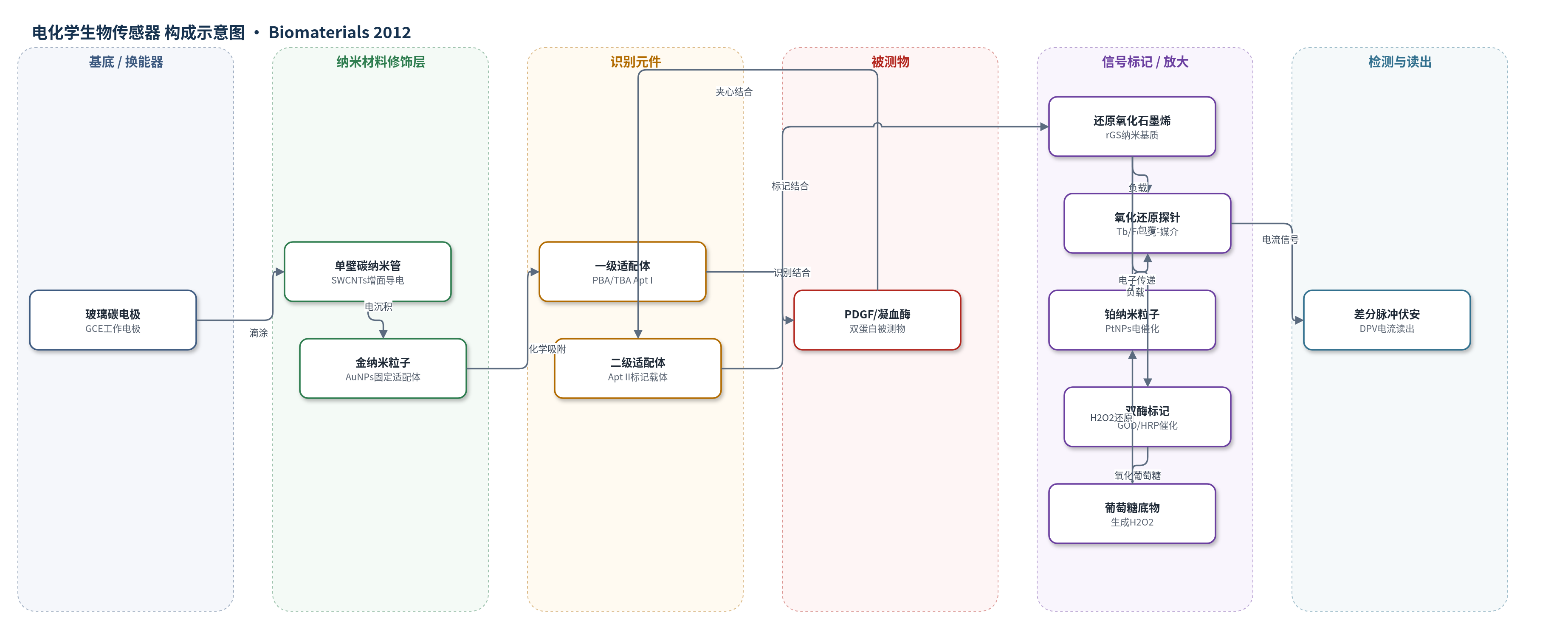
点击图片查看大图 · 依据论文自动绘制
传感器类型
电化学生物传感器
检测对象
血小板衍生生长因子(PDGF)、凝血酶(thrombin);样品基质:标准溶液(PBS缓冲液,含葡萄糖)
检测原理
传感器以AuNPs@SWCNTs/GCE为平台,PBA和TBA作为Apt I固定于AuNPs表面。样品中PDGF或凝血酶与Apt I特异性结合后,再与标记在PtNPs-氧化还原探针-rGS复合材料上的Apt II形成夹心结构。该复合材料同时负载Tb/Fc、PtNPs、GOD和HRP。检测时,GOD催化葡萄糖生成H2O2,HRP与PtNPs协同电催化还原H2O2,电子经Tb或Fc传递至电极,DPV还原峰电流随靶标浓度升高而增大。Tb和Fc在不同电位响应,实现双靶标区分;SWCNTs/AuNPs增大面积并促进电子转移,rGS多探针与PtNPs/双酶催化实现信号放大。
检测灵敏度
LOD: 8 pM (PDGF);线性范围: 0.01–35 nM (PDGF);LOD: 11 pM (thrombin);线性范围: 0.02–45 nM (thrombin)
效应效果
交叉反应低:0.1 nM PDGF/凝血酶分别产生-5.4/-0.1和-0.1/-4.1 mA;15 nM为-18.4/-0.2和-0.3/-15.6 mA;混合0.1+0.1与15+15 nM为-5.6/-3.9和-18.1/-15.8 mA,接近单标。5个电极RSD 6.8%。未报告稳定性与回收率。作者称LOD与RCA法PDGF 63 pM、AuNPs法凝血酶20 pM相当或更优,可拓展其他靶标。
传感器的构成
- 基底电极:玻璃碳电极(GCE),作为工作电极承载修饰层并传导电子。
- 纳米修饰层:单壁碳纳米管(SWCNTs)滴涂于GCE,增大有效面积并促进电子转移;随后电化学沉积HAuCl4形成金纳米粒子(AuNPs),构成AuNPs@SWCNTs平台。
- 识别元件:一级适配体Apt I,包括PDGF结合适配体PBA和凝血酶结合适配体TBA,5′端氨基通过AuNPs与-NH2化学吸附固定。
- 封闭剂:0.1 M PBS含1.0 mM己硫醇(HT),封闭非特异结合位点。
- 信号标记层:多标记PtNPs-氧化还原探针-rGS纳米复合材料,rGS负载Tb或Fc氧化还原探针,经L-半胱氨酸支化壳聚糖(CBC)包覆后用NaBH4还原H2PtCl6形成PtNPs,并负载GOD、HRP及二级适配体Apt II。
- 电子供体/底物:葡萄糖(glucose,3.6 mM PBS)作为GOD底物,催化生成H2O2,供HRP和PtNPs电催化还原。
- 信号读出:电化学工作站(CHI 660D)采用差分脉冲伏安法(DPV)在PBS(pH 7.4)含葡萄糖体系中记录还原峰电流。
中文摘要
本文构建了一种夹心型电化学适配体传感器,用于同时灵敏检测血小板衍生生长因子(PDGF)和凝血酶。还原氧化石墨烯片(rGS)作为基质负载氧化还原探针,并包覆铂纳米粒子(PtNPs),形成PtNPs-氧化还原探针-rGS纳米复合材料。该复合材料进一步负载葡萄糖氧化酶(GOD)和辣根过氧化物酶(HRP)双酶以及二级适配体(Apt II),作为夹心检测中的信号标记物。以金纳米粒子功能化单壁碳纳米管(AuNPs@SWCNTs)为传感器平台,可增大电极表面积并促进电子转移,从而捕获大量一级适配体(Apt I),放大检测响应。实验结果表明,多标记PtNPs-氧化还原探针-rGS复合材料具有良好的电化学氧化还原活性和PtNPs及双酶的电催化活性,对蛋白检测具有高灵敏度。PDGF线性范围为0.01–35 nM,检出限为8 pM;凝血酶线性范围为0.02–45 nM,检出限为11 pM。
英文摘要
In this work, a sandwich-type electrochemical aptasensor for simultaneous sensitive detection of platelet-derived growth factor (PDGF) and thrombin is fabricated. Reduced graphene oxide sheets (rGS) are used as matrices to immobilize the redox probes, which are subsequently coated with platinum nanoparticles (PtNPs) to form the PtNPs-redox probes-rGS nanocomposites. With the employment of the as prepared nanocomposites, a signal amplification strategy was described based on bienzyme (glucose oxidase and horseradish peroxidase) modified PtNPs-redox probes-rGS nanocomposites as the tracer labels for secondary aptamers (Apt II) through sandwiched assay. Gold nanoparticles functionalized single-walled carbon nanotubes (AuNPs@SWCNTs) as the biosensor platform enhance the surface area to capture a large amount of primary aptamers (Apt I), thus amplifying the detection response. The experiment results show that the multi-labeled PtNPs-redox probes-rGS nanocomposites display satisfying electrochemical redox activity and highly electrocatalytic activity of PtNPs and bienzyme, which exhibit high sensitivity for detection of proteins. The linear range of PDGF is 0.01-35 nM with a detection limit of 8 pM, while the linear ranges from 0.02 to 45 nM and a detection limit of 11 pM for thrombin are obtained.