组成图示
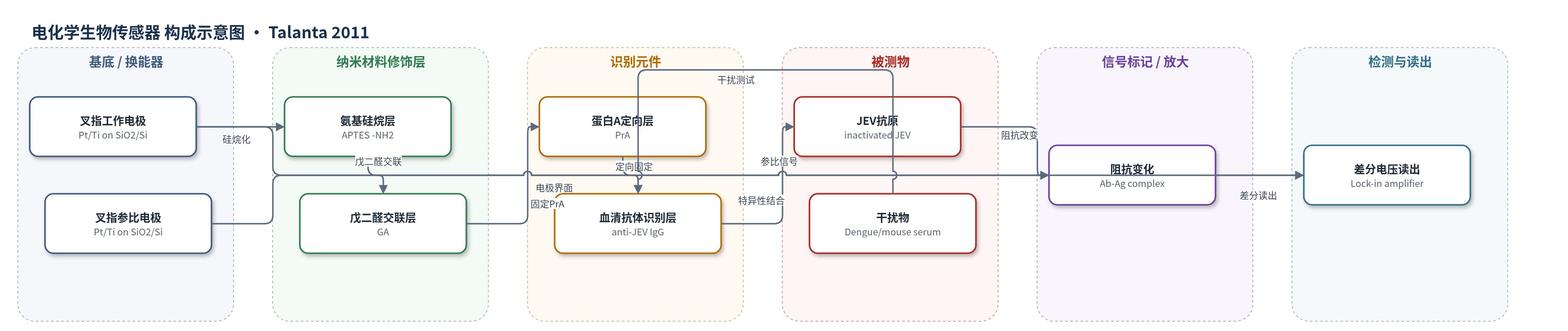
点击图片查看大图 · 依据论文自动绘制
传感器类型
电化学生物传感器
检测对象
日本脑炎病毒抗原(Japanese encephalitis virus antigens, JEV antigens);样品基质:PBS 稀释的灭活 JEV 抗原(文中亦提出可用于血液、脑脊液、鼻咽洗液等临床样品)
检测原理
该传感器采用无标记非法拉第阻抗机制。含抗 JEV 特异性 IgG 的人血清经蛋白A(PrA)和戊二醛(GA)定向固定于 APTES 硅烷化叉指工作电极区,抗体抗原结合位点朝外。当 JEV 抗原加入 PBS 样品时,抗原与表面抗体特异性结合,在工作电极表面形成抗原-抗体/PrA/GA/APTES 复合物,改变电极-溶液界面的双电层电容(Cdl)和生物分子复合物界面电阻(Rcs),从而引起非法拉第阻抗变化。参比电极区未固定抗体,主要发生非特异吸附,作为对照。在 100 mV、1 kHz 下,通过锁相放大器测量工作电极与参比电极间差分电压;随着 JEV 抗原浓度增加,结合量增加,差分电压增大,低频率下信号更明显,无需氧化还原探针或信号放大。
检测灵敏度
LOD: 0.75 µg/ml;线性范围: 1–10 µg/ml
效应效果
该传感器对 JEV 抗原选择性较高。以登革热病毒抗原和健康小鼠血清作为干扰物,50 倍稀释小鼠血清仅引起轻微变化并快速饱和;但在 0.75 µg/ml 低浓度下,JEV 信号高于登革热抗原干扰信号的程度有限,提示低浓度抗干扰能力仍需提高。响应约 5 min 出现,20 min 达到稳定,文中以 n=5 误差棒表示重复性,但未报告 RSD。未进行实际临床样品加标回收。与表 1 所列方法相比,本传感器 LOD 为 0.75 µg/ml、检测时间 20 min,操作简便且无需纯化抗体,作者认为其适合疫情暴发时血液、脑脊液或鼻咽洗液等临床样品中病毒抗原的快速直接初筛。
传感器的构成
- 基底/换能器电极:硅片上热生长 100 nm SiO2,溅射 10 nm Ti 和 200 nm Pt 形成叉指工作/参比电极,用于阻抗测量
- 硅烷化修饰层:5% APTES/MeOH 处理,引入氨基(-NH2),提供共价连接位点
- 交联层:5% 戊二醛(GA)处理,交联固定蛋白A
- 识别元件连接层:蛋白A(PrA,1 mg/ml PBS)结合 IgG Fc 区,定向固定血清抗体
- 识别元件:含抗 JEV 特异性抗体的人血清(1 mg/ml),捕获 JEV 抗原
- 封闭剂:2% BSA/PBS,封闭未饱和和非特异结合位点
- 信号标记物/电子供体:无(label-free,non-Faradic impedance,不使用氧化还原探针)
中文摘要
本文报道了一种基于血清抗体固定化的无标记生物传感器,用于快速检测病毒抗原。将含有抗日本脑炎病毒(JEV)特异性抗体的人血清,通过蛋白A/戊二醛体系固定于硅烷化叉指传感器表面,用于电学检测 JEV 抗原。傅里叶变换红外光谱和荧光显微镜证实血清抗体在传感器表面有效固定。传感器信号由 JEV 抗原与表面抗体特异性结合引起的非法拉第阻抗变化转换为差分电压获得。检测分析表明,该传感器对 JEV 抗原的检测范围为 1–10 µg/ml,检出限为 0.75 µg/ml,约 20 min 可获得稳定信号。该研究提出了一种具有高选择性的生物传感器,可快速、简便地检测 JEV 抗原,并有望作为未来诊断工具,用于临床样品中病毒抗原的快速直接检测,以在疫情暴发时进行病原初筛。
英文摘要
In this paper, we represent a label-free biosensor based on immobilization of serum antibodies for rapid detection of viral antigens. Human serum containing specific antibodies against Japanese encephalitis virus (JEV) was immobilized on a silanized surface of an interdigitated sensor via protein A/glutaraldehyde for electrical detection of JEV antigens. The effective immobilization of serum antibodies on the sensor surface was verified by Fourier transform infrared spectrometry and fluorescence microscopy. The signal of the biosensor obtained by the differential voltage converted from the change into non-Faradic impedance resulting from the specific binding of JEV antigens on the surface of the sensor. The detection analyzed indicates that the detection range of this biosensor is 1-10 μg/ml JEV antigens, with a detection limit of 0.75 μg/ml and that stable signals are measured in about 20 min. This study presents a useful biosensor with a high selectivity for rapid and simple detection of JEV antigens, and it also proposes the biosensor as a future diagnostic tool for rapid and direct detection of viral antigens in clinical samples for preliminary pathogenic screenings in the case of possible outbreaks.