组成图示
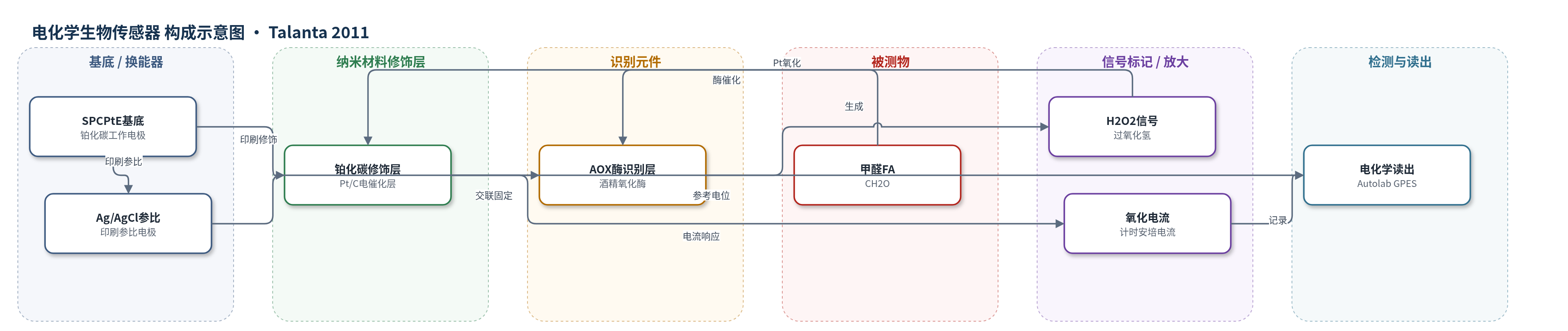
点击图片查看大图 · 依据论文自动绘制
传感器类型
电化学生物传感器
检测对象
甲醛(formaldehyde, FA/CH2O);样品基质:磷酸盐缓冲液标准样品、商业组织学样品HISTOGEN(含甲醛固定液)
检测原理
AOX-SPCPtE生物传感器以丝网印刷铂化碳电极为换能器,AOX作为识别元件。样品中的甲醛(FA)在AOX催化下发生氧化:CH2O + H2O → HCOO− + H+ + H2O2。生成的H2O2扩散至铂化碳工作电极表面,在−100 mV(vs 印刷Ag/AgCl)发生氧化:H2O2 → O2 + 2H+ + 2e−,产生计时安培氧化电流。由于H2O2生成速率与FA浓度成正比,稳态或瞬时电流随FA浓度增加而增大。铂化碳层催化H2O2氧化,避免直接在高电位下氧化FA形成CO吸附层导致Pt钝化;酶催化提供选择性并降低检测过电位。方法通过中心复合设计优化pH 7.5和−100 mV,实现低浓度FA的安培检测。
检测灵敏度
LOD(原文称capability of detection): 60 μmol L−1(α=β=0.05);线性范围: 60–460 μmol L−1;灵敏度: 6.96、6.76、6.58、6.48 nA mmol−1 L;R^2 = 0.994、0.994、0.995、0.994。直接SPCPtE: 线性范围: 0.99–9.09 mmol L−1;检测能力: [1.07±0.06] mmol L−1(α=β=0.05)
效应效果
AOX提供选择性,未报告长期稳定性。AOX-SPCPtE校准曲线斜率重复性和重现性为3%(n=4)和6%(n=4),优于直接SPCPtE的9%(n=6)和4%(n=6)。检测能力60 μmol L−1(α=β=0.05),符合欧洲法规0.5–2.0 ppm限值,优于此前SPE方法并避免FDH辅因子复杂性。HISTOGEN样品标准加入法测得FA [10.05±0.69]%(n=6,RSD=6%);加标总FA 9.39 mmol L−1,测得[9.15±0.15] mmol L−1(n=6,RSD=2%),回收率97.46±1.60%。作者认为适合组织学样品FA检测。
传感器的构成
- 基底/换能器电极:丝网印刷铂化碳电极(SPCPtE),工作区9 mm2,铂化碳墨水C2050804D9提供Pt电催化活性,并印刷Ag/AgCl参比电极(Electrodag 6037 SS)与Ag辅助电极(Electrodag 418)
- 修饰层:铂化碳层(platinised carbon layer),催化H2O2氧化并降低电子传递阻力
- 识别元件:酒精氧化酶(AOX,Pichia pastoris来源),催化CH2O氧化生成HCOO−、H+和H2O2
- 交联固定层:戊二醛(GA)与牛血清白蛋白(BSA)交联固定AOX,提高酶层稳定性
- 信号分子:过氧化氢(H2O2),酶反应产物,在−100 mV下于Pt表面氧化产生电流
- 支持电解质:50 mmol L−1磷酸盐缓冲液含100 mmol L−1 KCl(pH 7.5),提供离子导电与酶反应环境
- 读出系统:Autolab type II电化学工作站(GPES软件),计时安普法记录氧化电流
中文摘要
本文报道了用于甲醛(FA)检测的一次性丝网印刷电极与酶生物传感器。作者对电化学铂化丝网印刷碳电极(Pt-SPCE)和丝网印刷铂化碳电极(SPCPtE)进行了计时安普法表征。在600 mV下,FA浓度0.99–9.09 mmol L−1范围内,SPCPtE在重复性和重现性方面表现出更高的精度。SPCPtE还用于酒精氧化酶(AOX)的交联固定化,以构建FA酶生物传感器。酶促反应产生过氧化氢(H2O2),通过计时安普法监测H2O2并将其与不同样品中的FA浓度相关联。采用实验设计方法优化pH和施加电位。该方法在60–460 μmol L−1范围内校准曲线斜率的重复性和重现性分别为3%(n=4)和6%(n=4)。该生物传感器在假阳性和假阴性概率均为0.05时具有60 μmol L−1的检测能力,并已用于商业组织学样品中FA的测定。
英文摘要
Screen-printed carbon electrodes (SPCEs) electrochemically platinised (Pt-SPCEs) and screen-printed platinised carbon electrodes (SPC(Pt)Es) have been chronoamperometrically characterized for the determination of formaldehyde (FA). The oxidation current registered at 600 mV in the FA concentration range from 0.99 to 9.09 mmol L(-1), led to higher precision values in terms of repeatability and reproducibility when using SPC(Pt)Es. SPC(Pt)Es have been also used for alcohol oxidase (AOX) cross-linked immobilization in the development of enzymatic biosensors for FA. The enzymatic reaction produces hydrogen peroxide, which has been chronoamperometrically monitored and related to FA concentration in different kinds of samples. Experimental design methodology has been performed to optimize the pH and the applied potential. This method has shown a repeatability and reproducibility of 3% (n=4) and 6% (n=4) respectively, related to the slopes of the calibration curves performed in the range from 60 to 460 μmol L(-1). The use of this kind of biosensor, which has a detection capability of 60 μmol L(-1) for a given probability of false positive and negative equal to 0.05, has been probed in the determination of FA in commercial samples for histology.