组成图示
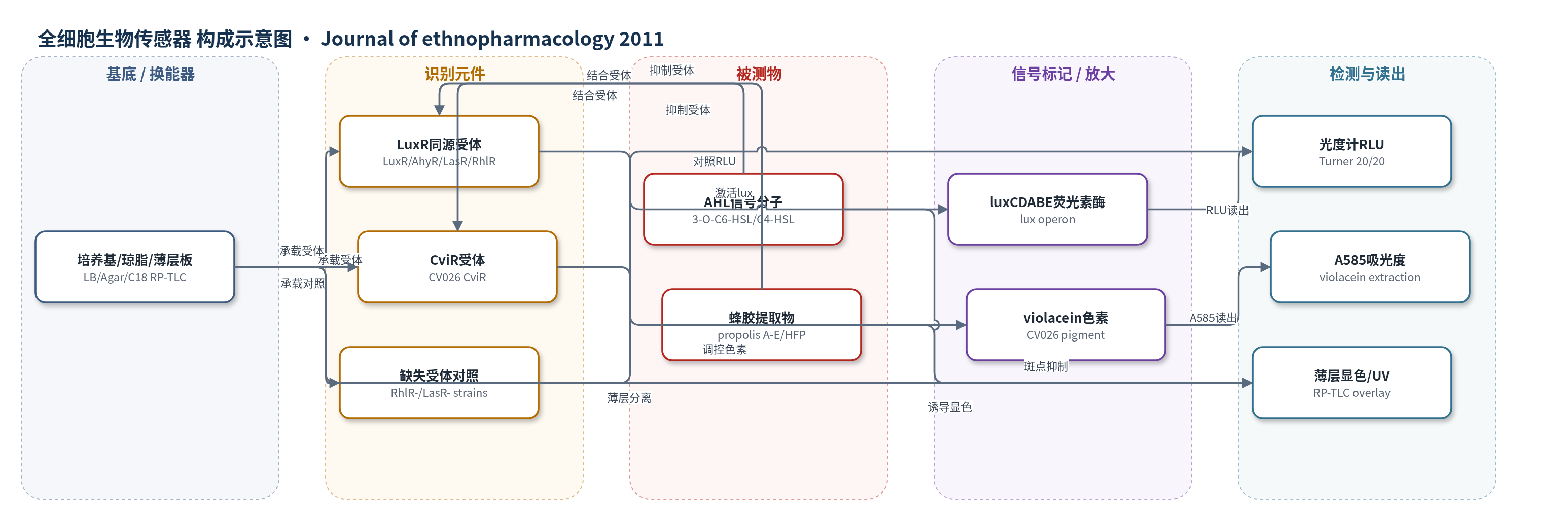
点击图片查看大图 · 依据论文自动绘制
传感器类型
全细胞生物传感器
检测对象
N-酰基高丝氨酸内酯(AHL,3-oxo-C6-HSL、C4-HSL、3-oxo-C12-HSL)及蜂胶(propolis)中群体感应抑制活性成分;样品基质:70%乙醇蜂胶酊剂、LB培养基、琼脂、C18反相薄层板。
检测原理
细菌生物报告菌携带 LuxR 同源受体和 luxCDABE 或 violacein 报告基因。AHL 信号分子扩散进入培养体系并与 LuxR/AhyR/LasR/RhlR/CviR 结合,引起受体构象变化与二聚化,启动 luxCDABE 表达或 violacein 合成,产生可用光度计或 A585 吸光度读出的光/色信号。蜂胶酊剂中的成分在反向实验中与 AHL 共同作用,干扰 AHL-LuxR 识别或下游 QS 调控,使报告信号随蜂胶浓度增加而下降。C18 反相薄层分离后覆盖 CV026,可定位抑制 C4-HSL 诱导 violacein 的斑点。
检测灵敏度
原文未报告 LOD、线性范围、灵敏度斜率或相关系数;原文仅称 JM109(pSB401) detects picomolar amounts of the cognate acyl-HSL, 3-oxo-C6-HSL。
效应效果
0.0005%(v/v)蜂胶不影响生物报告菌生长和荧光素酶系统;正向实验未检出 AHL 模拟物。反向实验中,蜂胶 E 使 LuxR 报告活性最高降低 62%,AhyR 最高降低 38%,LasR 降低 19–42%;CV026 的 violacein 呈剂量依赖抑制,长链 C10-HSL 正对照降低 87%。PAO1 群游运动降至对照 35–59%;HFP 使 RhlR 最高降低 49%、LasR 最高降低 57%、群游降低 61%(P<0.001)。近等基因缺失受体对照无显著变化,提示受体依赖;不同样品与受体响应不同,作者认为可用于抗致病/QS 抑制剂开发。
传感器的构成
- 培养基底/换能介质:LB 培养基、Bacto Agar、纤维素纸盘、圆底管、C18 反相薄层板(RP-TLC),承载细菌并允许 AHL 与蜂胶成分扩散。
- 识别元件:LuxR、AhyR、LasR、RhlR、CviR 等 LuxR 同源受体,识别 AHL 并调控报告基因。
- 报告基因/信号标记物:luxCDABE 荧光素酶操纵子或 violacein 色素合成途径,将识别事件转为光或紫色色素。
- 对照元件:近等基因缺失受体菌株 JLD271(pAL102)、JLD271(pAL106) 及无 AHL 阴性对照,排除生长抑制和非特异干扰。
- 读出系统:Turner Design TD 20/20 luminometer 测 RLU,分光光度计 A585 nm 测 violacein,UV 成像与薄层显色比较。
中文摘要
开发抗致病剂以控制细菌毒力基因是替代抗生素的策略之一,群体感应(QS)是重要靶标。本研究使用六种依赖 N-酰基高丝氨酸内酯(AHL)的细菌生物报告菌株,评估蜂胶是否含有能抑制 QS 控制的 AHL 信号成分,并检测蜂胶对机会致病菌铜绿假单胞菌 PAO1 的 QS 依赖群游运动的影响。不同来源蜂胶酊剂在理化谱和吸收光谱上存在差异。在 0.0005%(v/v)且不影响细菌生物传感器生长或报告系统的条件下,蜂胶酊剂本身未表现出 AHL 信号模拟物活性;但当蜂胶与诱导性 AHL 共同暴露于五种大肠杆菌和一种紫罗兰色杆菌生物传感器时,蜂胶在液体和琼脂生物测定以及 C18 反相薄层板测定中破坏细菌 QS 信号系统。蜂胶还抑制 PAO1 的群游运动及其 LasR 和 RhlR 依赖的 QS 行为。结果表明蜂胶含有可抑制 QS 反应的化合物,可为开发破坏细菌 QS 信号、降低毒力的治疗剂提供候选物质。
英文摘要
ETHNOPHARMACOLOGICAL RELEVANCE: An alternative approach to antibiotics is the development of anti-pathogenic agents to control the bacterial virulome. Such anti-pathogenic agents could target a phenomena known as quorum sensing (QS).
MATERIALS AND METHODS: Six bacterial N-acyl-homoserine lactone (AHL)-dependent bioreporter strains were used to evaluate if bee hive glue also known as propolis contains constituents capable of inhibiting QS-controlled AHL signaling. In addition, the effect of propolis on the QS-dependent swarming motility was evaluated with the opportunisitic pathogen, Pseudomonas aeruginosa.
RESULTS: Differences in the propolis tincture samples were identified by physiochemical profiles and absorption spectra. Propolis tinctures at 0.0005% (v/v) that do not affect bacteria biosensor growth or the reporter system monitored were exposed to biosensors with and without the addition an AHL. No AHL signal mimics were found to be present in the propolis tinctures. However, when propolis and an inducer AHL signal were together exposed to five Escherichia coli and a Chromobacterium violaceum biosensor, propolis disrupted the QS bacterial signaling system in liquid- and agar-based bioassays and in C(18) reverse-phase thin-layer plate assays. Swarming motility in the opportunistic pathogen, Pseudomonas aeruginosa PAO1 and its AHL-dependent LasR- and RhlR-based QS behaviors were also inhibited by propolis.
CONCLUSIONS: Together, we present evidence that propolis contain compounds that suppress QS responses. In this regard, anti-pathogenic compounds from bee harvested propolis could be identified and isolated and thus will be valuable for the further development of therapeutics to disrupt QS signaling systems which regulate the virulome in many pathogenic bacteria.