组成图示
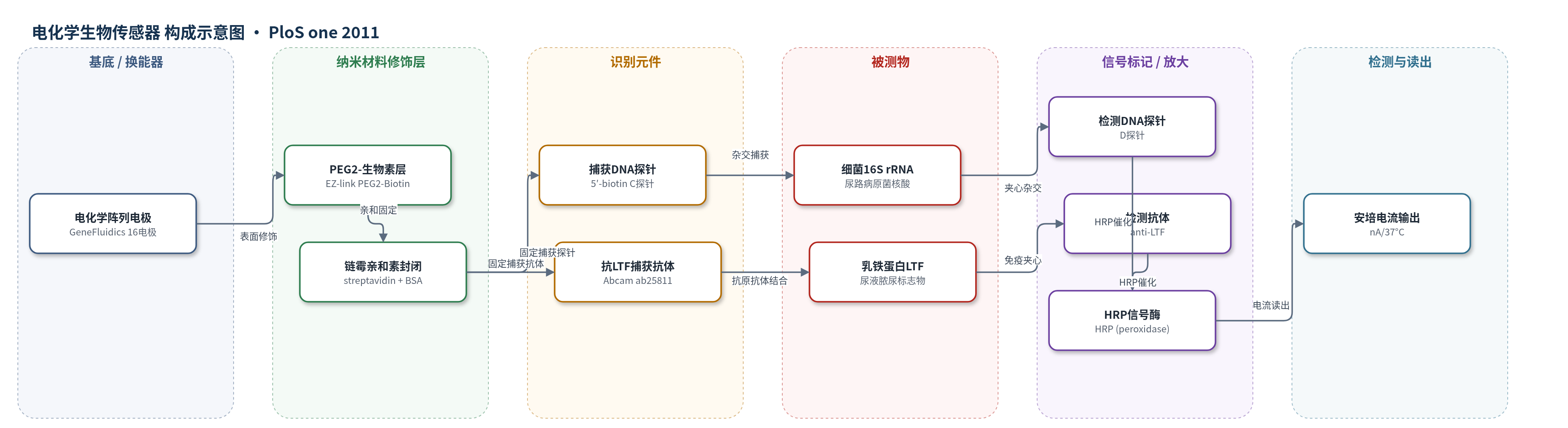
点击图片查看大图 · 依据论文自动绘制
传感器类型
电化学生物传感器
检测对象
细菌16S rRNA(bacterial 16S rRNA,含大肠杆菌E. coli、奇异变形杆菌P. mirabilis、铜绿假单胞菌P. aeruginosa、肠球菌属Enterococcus spp.等尿路病原菌)、乳铁蛋白(lactoferrin, LTF);样品基质:临床尿液(urine,含自排尿、导尿及回肠膀胱造口样本)
检测原理
传感器表面经PEG2-生物素和链霉亲和素固定生物素化捕获探针或抗LTF抗体。尿液裂解液中的细菌16S rRNA与互补捕获探针杂交后,再与检测探针形成夹心复合物;尿液LTF则被捕获抗体和检测抗体夹心捕获。两种检测均在37°C进行,使核酸杂交与免疫反应兼容。夹心复合物携带HRP信号酶,在电化学体系中催化氧化还原反应,产生与目标物量成正比的电流。病原菌按探针特异性给出定性/半定量信号,LTF通过标准曲线定量,从而同时反映病原菌存在和脓尿程度。
检测灵敏度
LOD: 104 cfu/ml(原文排版为104 cfu/ml,结合上下文为10^4 cfu/ml);估计摩尔LOD: 2–20 pM
效应效果
在113例临床尿液中,病原检测特异性97%、敏感性89%。34例培养阴性中仅1例不一致;79例培养阳性中检出70例,漏检样本菌量在103–104 cfu/ml或低于LOD。22例单菌尿全部检出,其中16例鉴定到种、6例到科;44例混合菌尿中37例由UNI探针阳性;13例多菌尿中4例全部物种正确、6例至少一种正确。LTF与WBC(r=0.56)、白细胞酯酶(r=0.76)显著相关(p<0.001),菌量与LTF、WBC、酯酶亦相关。作者认为该平台可快速多重检测病原核酸与宿主免疫标志物,辅助UTI诊断并减少经验性抗生素。
传感器的构成
- 基底/换能器:GeneFluidics电化学传感器阵列(16个可独立寻址电极),提供安培电流读出。
- 表面修饰层:EZ-link Amine-PEG2-Biotin(PEG2-生物素,Pierce)0.5 mg/mL,在电极表面引入生物素结合位点。
- 亲和固定/封闭层:链霉亲和素(streptavidin, SA)0.05 mg/mL,结合生物素化捕获探针/抗体;磷酸盐缓冲液含2.5% BSA用于封闭。
- 核酸识别元件:5′-生物素化捕获寡核苷酸探针(UNI、EB、PM、EC、PA、EF、SM、PS、SA、MM、KE),固定于电极并捕获细菌16S rRNA。
- 蛋白识别元件:兔源生物素化多克隆抗乳铁蛋白捕获抗体(rabbit biotinylated polyclonal anti-LTF, Abcam ab25811),固定于电极并捕获尿液LTF。
- 信号标记物:检测寡核苷酸探针(D探针,表1注明3′-fluorescein)与检测抗体-LTF复合物;HRP作为信号酶参与夹心复合物的电化学信号转换。
- 信号转换:辣根过氧化物酶(HRP)催化氧化还原反应,产生可定量电流。
中文摘要
尿路感染(UTI)常见且诊断困难,需要快速、敏感、可靠的检测方法以实现早期诊断并减少不必要的抗生素使用。病原菌鉴定联合乳铁蛋白(lactoferrin, LTF)定量检测(反映脓尿)可为UTI整体诊断提供有用信息。本文报道一种整合生物传感器平台,可在同一电化学传感器阵列上同时完成病原菌鉴定和尿液生物标志物检测。研究对113例来自复杂UTI风险患者的临床尿液样本进行了病原菌16S rRNA和宿主LTF的整合检测。病原菌检测采用捕获探针与检测探针同细菌16S rRNA的夹心杂交;蛋白检测采用基于捕获抗体和检测抗体的类似电化学夹心免疫分析。为与免疫分析兼容,作者开发了在37°C下杂交优化的寡核苷酸探针组,靶向常见尿路病原菌如大肠杆菌(E. coli)、奇异变形杆菌(P. mirabilis)、铜绿假单胞菌(P. aeruginosa)、肠球菌属(Enterococcus spp.)以及较少见的产碱杆菌属(Serratia)、普罗威登斯菌属(Providencia)、摩根菌属(Morganella)和葡萄球菌属(Staphylococcus spp.)。病原菌检测特异性为97%,敏感性为89%。生物传感器测得的LTF浓度与白细胞计数(WBC)及白细胞酯酶均呈显著相关(p<0.001)。结果表明,该平台可在临床样本中同时检测核酸和宿主免疫标志物,可作为下一代UTI多重诊断工具。
英文摘要
BACKGROUND: Urinary tract infection (UTI) is a common infection that poses a substantial healthcare burden, yet its definitive diagnosis can be challenging. There is a need for a rapid, sensitive and reliable analytical method that could allow early detection of UTI and reduce unnecessary antibiotics. Pathogen identification along with quantitative detection of lactoferrin, a measure of pyuria, may provide useful information towards the overall diagnosis of UTI. Here, we report an integrated biosensor platform capable of simultaneous pathogen identification and detection of urinary biomarker that could aid the effectiveness of the treatment and clinical management.
METHODOLOGY/PRINCIPAL FINDINGS: The integrated pathogen 16S rRNA and host lactoferrin detection using the biosensor array was performed on 113 clinical urine samples collected from patients at risk for complicated UTI. For pathogen detection, the biosensor used sandwich hybridization of capture and detector oligonucleotides to the target analyte, bacterial 16S rRNA. For detection of the protein biomarker, the biosensor used an analogous electrochemical sandwich assay based on capture and detector antibodies. For this assay, a set of oligonucleotide probes optimized for hybridization at 37°C to facilitate integration with the immunoassay was developed. This probe set targeted common uropathogens including E. coli, P. mirabilis, P. aeruginosa and Enterococcus spp. as well as less common uropathogens including Serratia, Providencia, Morganella and Staphylococcus spp. The biosensor assay for pathogen detection had a specificity of 97% and a sensitivity of 89%. A significant correlation was found between LTF concentration measured by the biosensor and WBC and leukocyte esterase (p<0.001 for both).
CONCLUSION/SIGNIFICANCE: We successfully demonstrate simultaneous detection of nucleic acid and host immune marker on a single biosensor array in clinical samples. This platform can be used for multiplexed detection of nucleic acid and protein as the next generation of urinary tract infection diagnostics.