组成图示
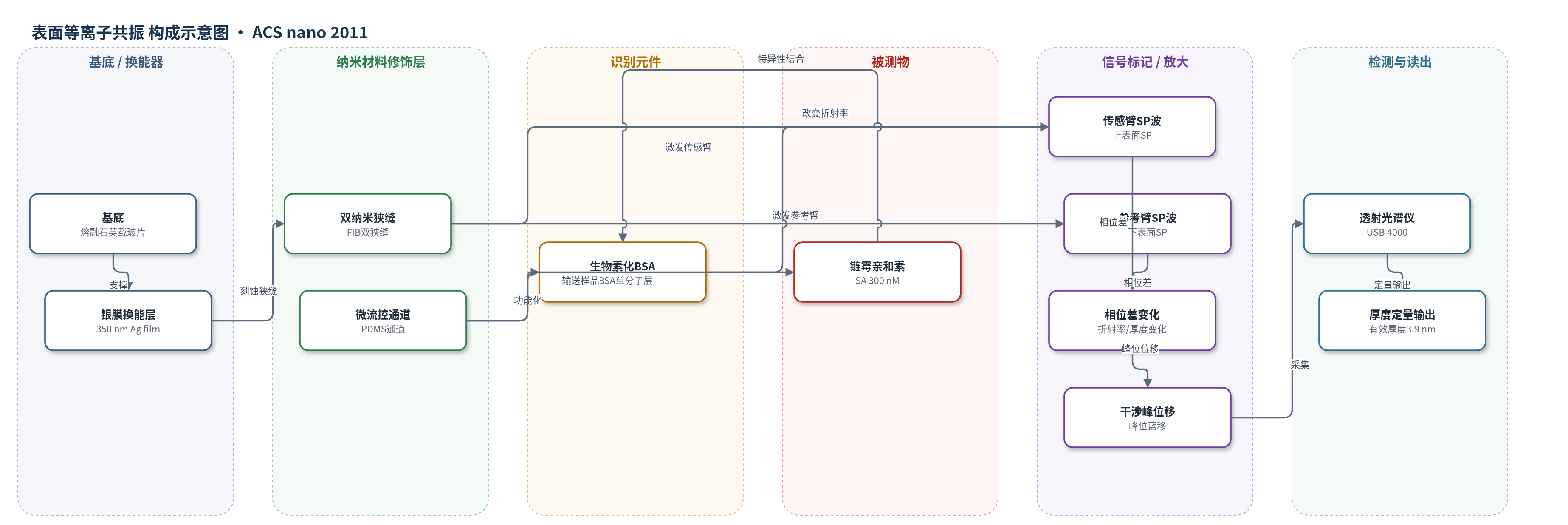
点击图片查看大图 · 依据论文自动绘制
传感器类型
表面等离子共振(SPR)生物传感器
检测对象
链霉亲和素(streptavidin, SA);样品基质:10 mM HEPES缓冲液(pH 7.4)水相微流控通道
检测原理
器件在350 nm银膜上刻蚀两条平行纳米狭缝,构成马赫-曾德尔干涉仪。TM偏振白光经左狭缝耦合到银膜上表面(传感臂)和银/玻璃下表面(参考臂)传播的表面等离子波,两臂波在右狭缝处干涉,形成远场透射光谱峰/谷。传感臂表面固定bBSA识别层,当链霉亲和素结合时,表面局部折射率增加,SP有效折射率改变,两臂相位差变化,导致干涉峰/谷波长位移。位移量与吸附蛋白层有效厚度相关,可用Δλ=S(nl-nb)(1-e^(-2de/ld))定量提取。参考臂不受结合影响,提供背景抑制;无标记、多峰干涉提高灵敏度。
检测灵敏度
LOD: 1.5 × 10^-5 RIU;灵敏度: 3524 nm/RIU(峰)、3600 nm/RIU(谷)、3470 nm/RIU(L=45.6 μm)、3695 nm/RIU(L=57.6 μm);FOM: 122(L=34.2 μm)、150(L=45.6 μm)、193(L=57.6 μm)、224(L=69.0 μm);噪声: 0.052 nm;信噪比: 288
效应效果
以链霉亲和素-生物素体系验证:300 nM链霉亲和素使峰位移15.7 nm,扣除参考0.7 nm后净位移15 nm,大于金纳米点3.8 nm(370 nM)、纳米颗粒6 nm(370 nM)、金纳米孔3.5–4 nm(5 μM)和单颗粒2–4 nm(2 μM)。计算吸附层厚度3.9 nm,与单分子层一致。噪声0.052 nm,检测限1.5×10^-5 RIU,信噪比288。FOM 193超过EOT纳米孔23、银纳米井14.5、纳米颗粒<10、超材料3.8、高质量纳米孔162及棱镜SPR理论约108。作者认为其微型化、无标记、多峰干涉和微流控集成适合片上高多路复用生物传感。
传感器的构成
- 基底:熔融石英载玻片(fused silica microscope slide),提供平整支撑与下表面参考介质。
- 换能金属层:350 nm银膜(Ag film),激发并传导表面等离子波,同时作为下表面参考臂保护层。
- 纳米结构层:聚焦离子束刻蚀双纳米狭缝(double nanoslits),狭缝长35 μm、宽0.1 μm、间距L,耦合光进入上/下表面SP波并构成MZI两臂。
- 微流控层:PDMS微流控通道(PDMS microfluidic channel,Sylgard 184/SU-8模具),输送缓冲液与样品,实现液相环境。
- 识别元件:生物素化牛血清白蛋白单分子层(biotinylated BSA, bBSA),固定于传感银表面,特异性结合链霉亲和素。
- 参考层:未生物素化BSA单分子层(BSA monolayer),用于参考通道对照并抑制非特异结合。
- 样品介质:10 mM HEPES缓冲液(pH 7.4),维持生物分子活性并提供稳定折射率背景。
- 读出系统:倒置显微镜透射光谱系统(Olympus IX81、X40物镜、Ocean Optics USB 4000),采集干涉光谱并监测峰位位移。
中文摘要
本文实验演示了一种集成微流控芯片的等离子马赫-曾德尔干涉仪(plasmonic MZI)用于超灵敏光学生物传感。该器件在350 nm厚银膜上通过聚焦离子束刻蚀形成两条平行纳米狭缝,构成传感臂与参考臂;入射光经狭缝耦合到银膜上表面和下表面传播的表面等离子波,生物分子吸附改变上表面局部折射率,引起两臂相位差变化,并通过远场透射光谱的干涉峰/谷位移读出。该紧凑平台结合纳米等离子结构与干涉测量,在可见光区实现大于3500 nm/RIU的折射率灵敏度和超过200的传感品质因数,显著超过以往非棱镜等离子传感器,并可通过结构优化进一步提升。作者以链霉亲和素-生物素体系演示实时、无标记、定量监测,获得高信噪比,证明该微型化等离子生物传感器可用于片上生物分子相互作用检测。
英文摘要
We experimentally demonstrate a plasmonic Mach-Zehnder interferometer (MZI) integrated with a microfluidic chip for ultrasensitive optical biosensing. The MZI is formed by patterning two parallel nanoslits in a thin metal film, and the sensor monitors the phase difference, induced by surface biomolecular adsorptions, between surface plasmon waves propagating on top and bottom surfaces of the metal film. The combination of a nanoplasmonic architecture and sensitive interferometric techniques in this compact sensing platform yields enhanced refractive index sensitivities greater than 3500 nm/RIU and record high sensing figures of merit exceeding 200 in the visible region, greatly surpassing those of previous plasmonic sensors and still hold potential for further improvement through optimization of the device structure. We demonstrate real-time, label-free, quantitative monitoring of streptavidin-biotin specific binding with high signal-to-noise ratio in this simple, ultrasensitive, and miniaturized plasmonic biosensor.