组成图示
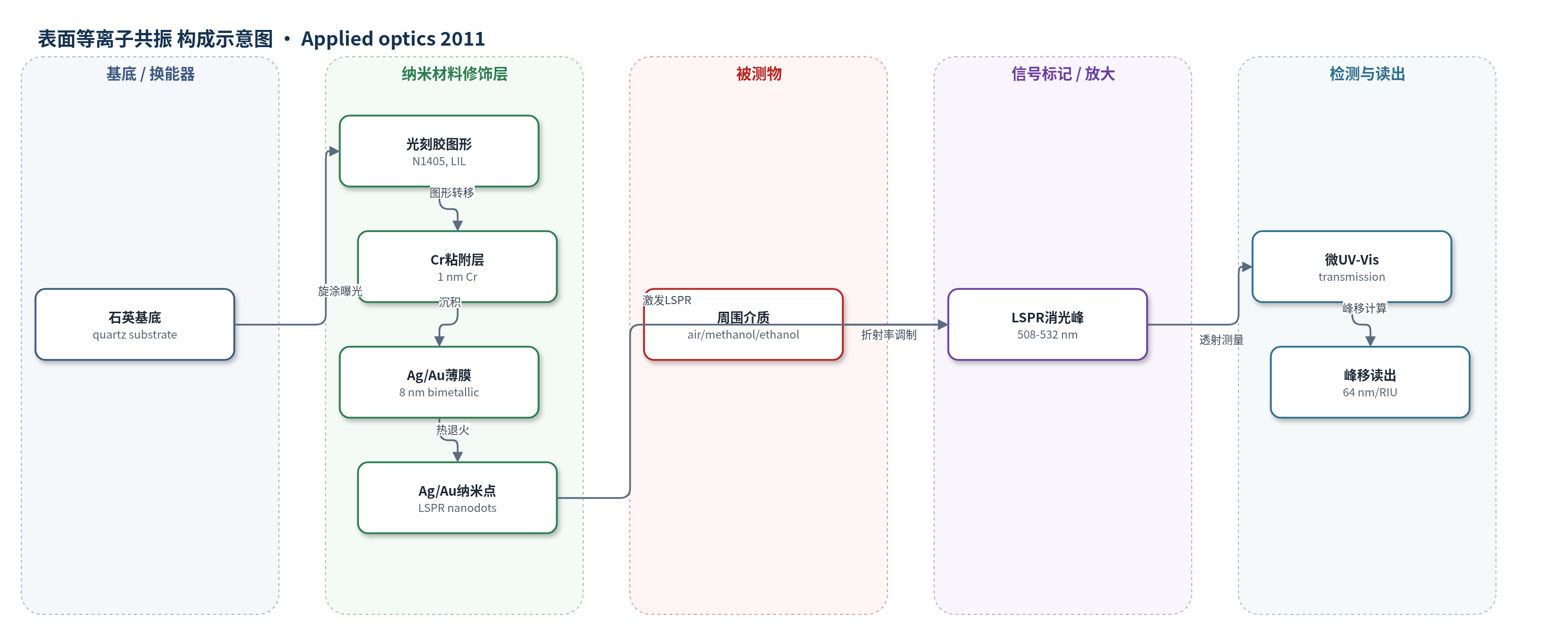
点击图片查看大图 · 依据论文自动绘制
传感器类型
表面等离子共振(SPR)生物传感器
检测对象
周围介质折射率(refractive index, RIU);样品基质:空气、甲醇、乙醇
检测原理
该传感方法基于 Ag/Au 合金纳米点阵列的局域表面等离子共振(LSPR)。当入射光激发纳米点中的自由电子集体振荡时,会在透射消光谱中形成尖锐共振峰。周围介质折射率升高时,纳米点有效介电环境改变,LSPR 共振波长向长波方向移动,因此可通过峰位变化反映环境折射率变化。LIL 先形成周期性纳米盘,热退火使金属薄膜 dewetting 成约 50 nm 纳米点,减小粒径、形成椭球形状并缩短点间距,增强近场偶极耦合,使峰位蓝移、半峰宽变窄、强度增强。Au 浓度改变合金有效介电常数,使共振峰红移,实现波长调谐。最终由微 UV-Vis 分光光度计读取消光峰位置,得到 nm/RIU 灵敏度。
检测灵敏度
灵敏度斜率: 64 nm/RIU;相比仅热退火提高 94%;LSPR峰位: 空气 508 nm、甲醇 529 nm、乙醇 532 nm;折射率: 空气 n=1、甲醇 n=1.3290、乙醇 n=1.3614
效应效果
论文未报道生物分子选择性、抗干扰、稳定性、RSD 或实际样品加标回收率,也未与 ELISA、HPLC、qPCR 等方法直接对比。主要传感性能为折射率响应:Ag0.75/Au0.25 纳米点阵列在空气、甲醇和乙醇中的 LSPR 峰位分别为 508 nm、529 nm 和 532 nm,峰移每 RIU 为 64 nm/RIU,比仅热退火形成的纳米点提高 94%。Au 浓度从 25% 增加到 50% 时,LSPR 峰红移 20 nm,说明可通过金属薄膜厚度灵活调谐。退火后纳米点粒径约 50±30 nm、高度约 45±15 nm、点间距约 45±15 nm,FWHM 从 170 nm 降至 63 nm,峰强增强。作者认为该低成本、大面积有序阵列可提升 LSPR 生物传感器性能。
传感器的构成
- 基底:石英(quartz)衬底,提供透明光学基底与机械支撑
- 光刻模板层:负性光刻胶 N1405,经激光干涉光刻(LIL)形成周期性纳米盘图形
- 粘附层:1 nm Cr,增强 Ag/Au 薄膜与石英结合
- 换能金属层:Ag/Au 双金属薄膜(总厚 8 nm,Ag/Au 厚度比可调),经退火形成 Ag1-xAux 合金纳米点
- 周期纳米点阵列:LIL 周期约 930 nm,退火后粒径约 50±30 nm、点间距约 45±15 nm,产生 LSPR 并增强近场耦合
- 读出介质:空气、甲醇、乙醇等周围介质,折射率变化引起 LSPR 峰移
- 检测仪器:微紫外-可见分光光度计(micro-UV-visible spectrophotometer),透射模式测量消光谱
中文摘要
本文报道了一种利用激光干涉光刻(LIL)与热退火相结合的方法,制备大面积、有序 Ag/Au 双金属纳米点阵列,并研究其局域表面等离子共振(LSPR)特性及生物传感潜力。该方法在石英基底上先形成周期性纳米盘阵列,再通过热退火使 Ag/Au 薄膜 dewetting,在约 530 nm 周期内形成约 50 nm 的合金纳米点。消光谱表明,纳米点阵列的 LSPR 峰位可随 Au 浓度变化而灵活调控,Au 含量增加导致共振峰红移。与仅通过热退火形成的纳米点相比,LIL 加退火所得阵列具有更窄的半峰宽、更高的消光强度和更优的折射率响应。在空气、甲醇和乙醇等不同环境中测量峰移,结果显示其每折射率单位(RIU)峰移提高 94%,达到 64 nm/RIU。这些结果表明,该低成本、大面积有序纳米点阵列为提高 LSPR 生物传感器性能提供了可行途径。
英文摘要
A novel hybrid approach to fabricate large-area well-ordered Ag/Au bimetallic nanodot arrays and its potential applications for biosensing is investigated. With the combination of laser interference lithography and the thermal annealing technique, Ag/Au bimetallic nanodots about ~50 nm are formed inside periodic nanodisk arrays at a dimension of ~530 nm on quartz substrates. Extinction spectra of the fabricated nanostructures show their localized surface plasmon resonance (LSPR) can be well controlled by Au concentration, which offers a means to flexibly tune the optical properties of the nanodot arrays. To study the sensitivity of the nanodot arrays, resonance wavelength changes per refractive index unit (RIU) are performed in different surrounding environments. This shows a 94% increase in peak shift per refractive index unit (nanometers/RIU) compared to the nanodot arrays formed only by thermal annealing. These results demonstrate a feasible approach to improve LSPR-based biosensor performance.