组成图示
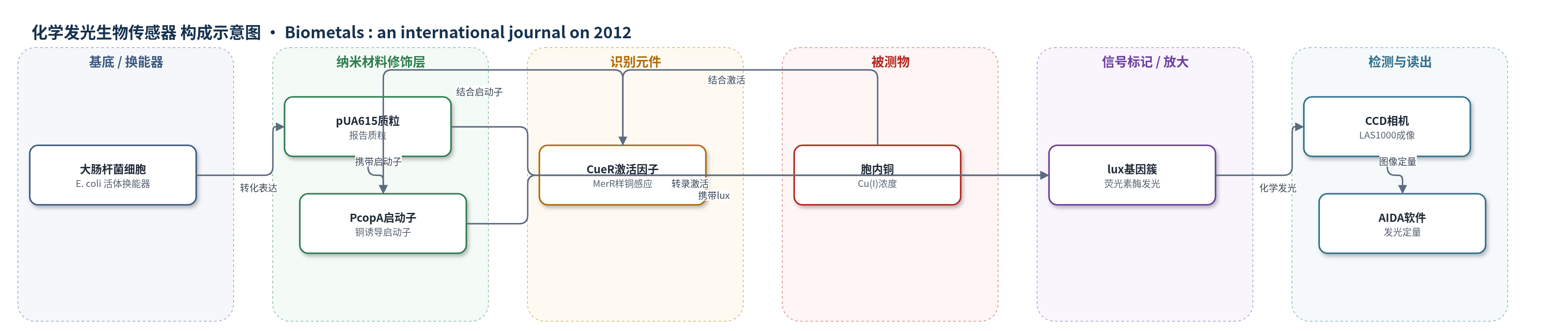
点击图片查看大图 · 依据论文自动绘制
传感器类型
化学发光生物传感器
检测对象
胞内铜(intracellular copper, Cu(I)),样品基质:大肠杆菌细胞培养物(LB 培养基中胞内环境)
检测原理
该传感器以大肠杆菌为活体换能器。当培养体系中加入 CuSO4 后,胞内 Cu(I) 水平变化,MerR 样转录激活因子 CueR 结合 Cu(I) 发生构象变化,并与 copA 启动子(PcopA)结合,激活下游 A. fischeri lux 基因簇转录。lux 基因编码荧光素酶,催化发光底物氧化产生化学发光。胞内铜浓度越高,PcopA 驱动 lux 表达越强,发光强度越大。该过程通过基因转录与酶促发光实现信号放大,最终由冷却 CCD 相机采集图像并定量,从而原位反映胞内铜水平。
检测灵敏度
—
效应效果
该 lux 生物传感器可用于活菌中胞内铜的原位监测,并在含 3 mM CuSO4 的 LB 平板上筛选低发光突变体;两个高发光突变体均携带 copA 插入突变,说明发光可反映胞内铜积累。comC 启动子-lux 报告在 2 mM CuSO4 时最大诱导约 30 倍,qPCR 显示 3 mM CuSO4 诱导 comC 约 30 倍。ΔcomC 突变体在 3 mM CuSO4 中生长速率由约 0.5 h-1 降至 <0.2 h-1,cusCFBA 表达比野生型强 50% 以上。实验以三次独立实验标准差表示,未报告 RSD、回收率或 LOD。
传感器的构成
- 细胞基底:大肠杆菌(E. coli)细胞,作为活体换能器,将胞内铜浓度转换为光信号
- 报告质粒:pUA615,携带受 copA 启动子控制的 lux 基因簇,用于表达报告系统
- 调控启动子:copA 启动子(PcopA),受 CueR 调控,响应胞内铜并驱动报告基因转录
- 识别元件:CueR(MerR 样转录激活因子),感应胞内 Cu(I) 并激活 PcopA
- 信号标记物:A. fischeri lux 基因簇,编码荧光素酶,催化底物氧化产生化学发光
- 读出装置:冷却 CCD 相机(LAS1000)与 AIDA 软件,采集并定量发光图像
中文摘要
大肠杆菌中铜进入细胞的途径仍不清楚。为阐明该过程,作者利用基于 lux 的生物传感器原位监测胞内铜水平。从转座子突变库中筛选出在含铜条件下发光降低的“低发光”菌株,其中一个突变株的 comR 基因发生转座子插入。comR 编码一种 TetR 样转录调控蛋白,可通过质粒互补恢复野生型发光水平。ComR 不调控自身表达,但介导相邻反向转录基因 comC 的铜诱导表达,实时定量 PCR 和启动子-lux 融合实验证实了这一点。纯化的 ComR 可结合 comC 启动子区,并被铜释放。膜分级分离显示 ComC 定位于外膜。与野生型相比,ΔcomC 菌株在含铜培养时周质和胞质铜水平升高,分别由周质 CusRS 传感器和胞质 CueR 传感器激活程度反映。结果表明,ComC 是一种降低外膜对铜通透性的外膜蛋白,其表达受新型 TetR 样铜响应阻遏蛋白 ComR 调控。
英文摘要
The pathway of copper entry into Escherichia coli is still unknown. In an attempt to shed light on this process, a lux-based biosensor was utilized to monitor intracellular copper levels in situ. From a transposon-mutagenized library, strains were selected in which copper entry into cells was reduced, apparent as clones with reduced luminescence when grown in the presence of copper (low-glowers). One low-glower had a transposon insertion in the comR gene, which encodes a TetR-like transcriptional regulator. The mutant strain could be complemented by the comR gene on a plasmid, restoring luminescence to wild-type levels. ComR did not regulate its own expression, but was required for copper-induction of the neighboring, divergently transcribed comC gene, as shown by real-time quantitative PCR and with a promoter-lux fusion. The purified ComR regulator bound to the promoter region of the comC gene in vitro and was released by copper. By membrane fractionation, ComC was shown to be localized in the outer membrane. When grown in the presence of copper, ∆comC cells had higher periplasmic and cytoplasmic copper levels, compared to the wild-type, as assessed by the activation of the periplasmic CusRS sensor and the cytoplasmic CueR sensor, respectively. Thus, ComC is an outer membrane protein which lowers the permeability of the outer membrane to copper. The expression of ComC is controlled by ComR, a novel, TetR-like copper-responsive repressor.