组成图示
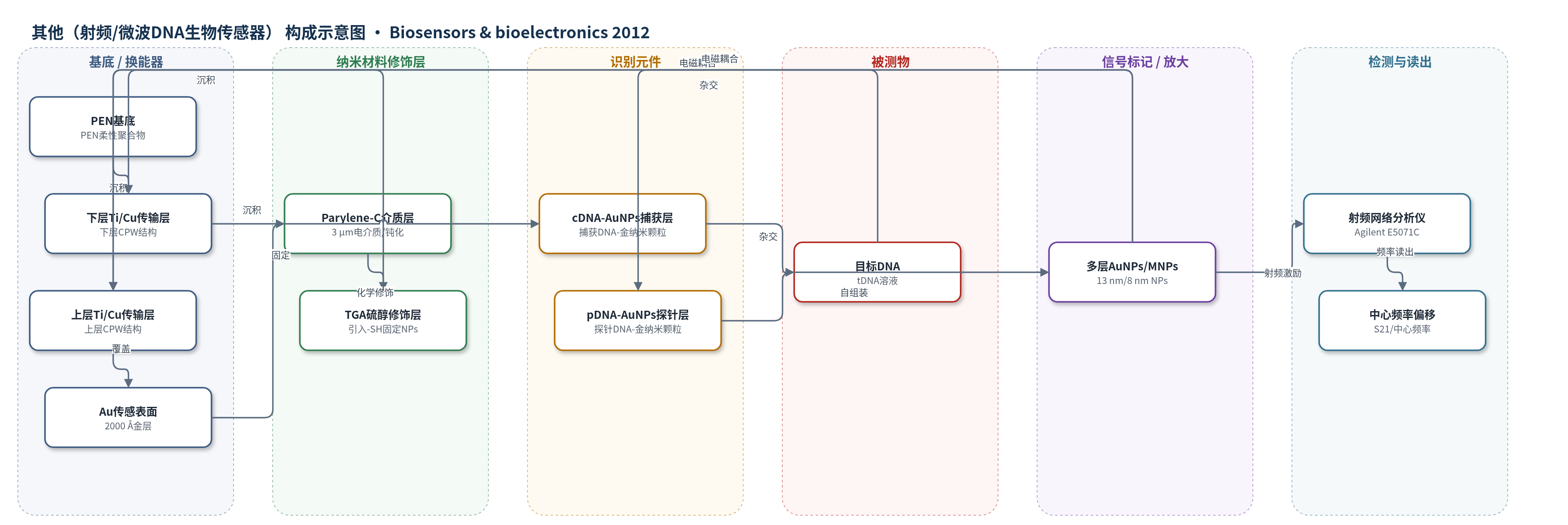
点击图片查看大图 · 依据论文自动绘制
传感器类型
其他(射频/微波DNA生物传感器)
检测对象
目标DNA(target DNA, tDNA);样品基质:PBS缓冲液稀释的单链DNA溶液
检测原理
TGA修饰Parylene-C表面引入硫醇基团,使cDNA-AuNPs通过硫醇-金相互作用固定于传感表面,形成捕获层。目标tDNA滴加后与cDNA杂交,再与pDNA-AuNPs结合,形成第二层AuNPs;己二硫醇连接第二层与第三层AuNPs,形成多层自组装AuNPs/MNPs。纳米颗粒改变共面波导(CPW)表面的介电常数、磁导率和等效电容/电感,使带阻滤波器中心频率发生偏移。tDNA浓度越高,固定纳米颗粒越多,中心频率偏移越大。矢量网络分析仪测量S21响应并提取中心频率偏移,实现无标记检测;多层纳米颗粒结构提供信号放大。
检测灵敏度
LOD: 10 pM(摘要);检出限: 约500 fM(结果);实验上限: 约10 nM(结果)
效应效果
该传感器基于DNA杂交特异性识别,未报告抗干扰、稳定性、RSD或实际样品加标回收率。实验以95%置信区间误差棒约0.1 GHz表征波动;在100 fM–1 pM tDNA浓度下,ΔFG32与ΔFM32可显示超过0.1 GHz的频率偏移。三层AuNPs/MNPs最大中心频率偏移分别约0.9 GHz和0.7 GHz,高于双层结构;AuNPs比MNPs更适合该RF检测体系。作者认为全聚合物多层结构可减小芯片尺寸、降低成本,提供廉价、可抛弃、高灵敏的生物医学诊断和现场检测选择。
传感器的构成
- 基底/柔性聚合物层:PEN(聚萘二甲酸乙二醇酯)柔性基底,提供低成本可替代玻璃/硅的支撑
- 底层金属传输结构:Ti/Cu(钛/铜)种子层与结构层,厚度约500/5000 Å,形成下层共面波导传输结构
- 聚合物介质/钝化层:Parylene-C(聚对二甲苯-C),约3 μm,作为电介质/钝化层并承载表面修饰
- 表面化学修饰层:TGA(硫代乙醇酸)处理 Parylene-C,引入硫醇基团,用于固定纳米颗粒
- 上层金属传输结构:Ti/Cu(钛/铜)第二层,约2000/20000 Å,形成上层共面波导传输结构,增加双电容传感面积
- 传感金属表面:Au(金)层,约2000 Å,覆盖上层蚀刻铜层,构成上层传输/传感金属表面
- 识别元件:cDNA(捕获DNA,硫醇修饰)固定在 AuNPs 表面,再固定于 TGA 修饰表面;pDNA(探针DNA,硫醇修饰)固定在 AuNPs/MNPs 表面,用于与 tDNA 杂交
- 信号标记/放大元件:AuNPs(金纳米颗粒,约13±2 nm)和 MNPs(磁性纳米颗粒,约8±1 nm),通过 DNA 杂交形成多层自组装,改变电磁特性
- 连接/间隔修饰:hexanedithiol(己二硫醇)修饰第二层 AuNPs 表面,两端硫醇连接第二层与第三层 AuNPs,实现多层组装
中文摘要
本研究利用射频(RF)技术开发了一种多层聚合物DNA传感器,并借助金纳米颗粒(AuNPs)和磁性纳米颗粒(MNPs)增强检测性能。柔性聚合物聚对二甲苯(Parylene)和聚萘二甲酸乙二醇酯(PEN)被用作基底,以替代玻璃和硅片等传统刚性基底。所开发的多层聚合物RF生物传感器包含两层聚合物和两层铜传输结构层,用于减小传感器整体尺寸并进一步提高RF DNA检测中生物芯片的灵敏度。硫代乙醇酸(TGA)用于修饰生物芯片表面,形成硫醇修饰的DNA杂交传感表面。AuNPs和MNPs被固定在传感器表面,以提高整体检测灵敏度;除AuNPs外,MNPs也被证明适用于RF DNA检测。该生物传感器的性能通过中心频率偏移进行评估,因为固定在传感器表面的多层纳米颗粒会改变其电磁特性。实验结果表明,DNA浓度检测限可低至10 pM,三层AuNPs和MNPs的最大中心频率偏移分别可接近0.9 GHz和0.7 GHz。上述结果表明,该生物传感器可为生物医学诊断系统提供一种低成本、可抛弃且高灵敏的替代选择,因为全聚合物材料和多层检测结构可有效降低每片生物芯片的价格和尺寸。
英文摘要
This study utilized the radio frequency (RF) technology to develop a multilayered polymeric DNA sensor with the help of gold and magnetic nanoparticles. The flexible polymeric materials, poly (p-xylylene) (Parylene) and polyethylene naphtholate (PEN), were used as substrates to replace the conventional rigid substrates such as glass and silicon wafers. The multilayered polymeric RF biosensor, including the two polymer layers and two copper transmission structure layers, was developed to reduce the total sensor size and further enhance the sensitivity of the biochip in the RF DNA detection. Thioglycolic acid (TGA) was used on the surface of the proposed biochip to form a thiolate-modified sensing surface for DNA hybridization. Gold nanoparticles (AuNPs) and magnetic nanoparticles (MNPs) were used to immobilize on the surface of the biosensor to enhance overall detection sensitivity. In addition to gold nanoparticles, the magnetic nanoparticles has been demonstrated the applicability for RF DNA detection. The performance of the proposed biosensor was evaluated by the shift of the center frequency of the RF biosensor because the electromagnetic characteristic of the biosensors can be altered by the immobilized multilayer nanoparticles on the biosensor. The experimental results show that the detection limit of the DNA concentration can reach as low as 10 pM, and the largest shift of the center frequency with triple-layer AuNPs and MNPs can approach 0.9 and 0.7 GHz, respectively. Such the achievement implies that the developed biosensor can offer an alternative inexpensive, disposable, and highly sensitive option for application in biomedicine diagnostic systems because the price and size of each biochip can be effectively reduced by using fully polymeric materials and multilayer-detecting structures.