组成图示
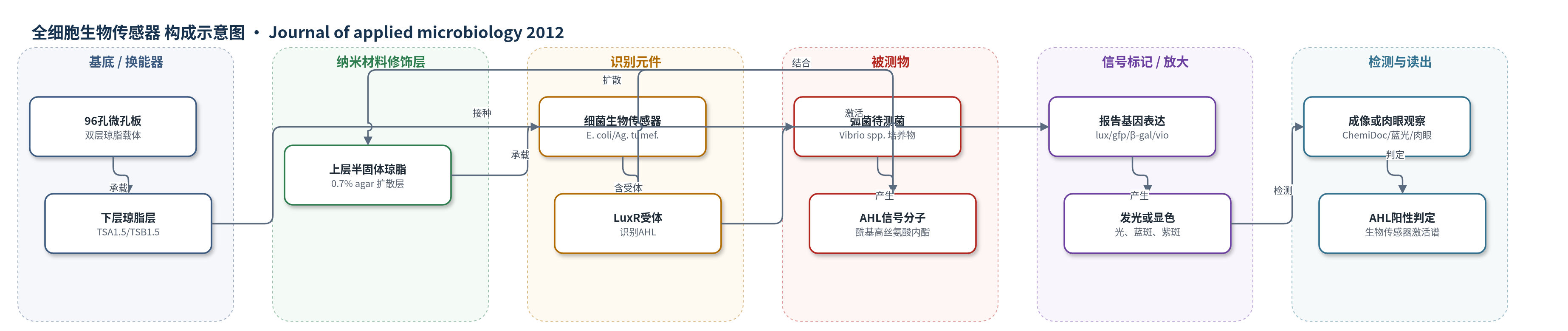
点击图片查看大图 · 依据论文自动绘制
传感器类型
全细胞生物传感器
检测对象
酰基高丝氨酸内酯(acylated homoserine lactones, AHLs);样品基质:弧菌属及相关菌分离株培养物(来自水样和水生生物)
检测原理
待测弧菌在下层TSA1.5/TSB1.5琼脂中生长并分泌AHL,AHL通过琼脂扩散至上层0.7%半固体培养基中的细菌生物传感器。传感器菌内的LuxR同源受体与特定链长或取代基的AHL结合后,启动报告基因转录:E. coli MT102(pSB403)表达lux发光,Ps. putida F117(pAS-C8/pKR-C12)表达gfp绿色荧光,Ag. tumefaciens NTL4(pZLR4)表达β-galactosidase并在X-Gal上显蓝色,C. violaceum CV26产生紫色violacein。不同传感器菌对AHL选择性不同,组合激活谱可反映AHL类型;AHL浓度或扩散量增加通常使光/色信号增强,但本方法主要用于定性筛查。
检测灵敏度
—
效应效果
该方法在96孔板中完成106株、28个种的AHL筛查,85%分离株(20/28种)至少激活一种生物传感器。Ag. tumefaciens激活最多(20种),其次为Ps. putida(pAS-C8)(9种)、E. coli(7种)、Ps. putida(pKR-C12)(5种)和C. violaceum(3种);8种未检出AHL。结果与cross-streak法和TLC法一致,并克服cross-streak法需共用培养基的限制。V. harveyi自身发光会干扰E. coli发光报告,需阴性对照和TLC/cross-streak确认。方法适合高通量定性筛查,但存在非特异性,不能直接给出AHL精确结构。
传感器的构成
- 微孔板基底:96-well microplate,承载双层琼脂扩散体系
- 下层琼脂层:TSA1.5/TSB1.5(含1.5% NaCl的胰酪大豆胨琼脂/肉汤),接种待测弧菌并允许AHL扩散
- 上层半固体琼脂层:0.7% agar半固体TSB或含X-Gal的AB培养基,承载生物传感器菌并允许AHL扩散
- 识别/换能元件:细菌生物传感器菌株E. coli MT102(pSB403)、Ag. tumefaciens NTL4(pZLR4)、Ps. putida F117(pAS-C8/pKR-C12)、C. violaceum CV26,其LuxR同源受体识别AHL
- 信号标记物:报告基因lux、gfp、β-galactosidase(X-Gal显色)和violacein色素合成基因,将识别事件转为光/色信号
- 对照层:单独接种传感器菌或待测菌的阴性对照,排除自身发光与生长干扰
中文摘要
本研究旨在评估弧菌属(Vibrio spp.)及相关种中酰基高丝氨酸内酯(AHLs)产生能力的多样性。作者对来自水样和水生生物的106株分离菌、涵盖28个种进行了AHL检测,并建立了一种基于细菌生物传感器的双层96孔微孔板快速筛查方法。结果显示,20个种中至少有一种生物传感器被激活,其中根癌农杆菌(Agrobacterium tumefaciens)被激活的频率最高;1株鳗弧菌、轮虫弧菌和梅氏弧菌激活了紫色杆菌生物传感器,这在弧菌科中并不常见。对拥有多个分离株的种,生物传感器激活谱基本一致,仅鳗弧菌和梅氏弧菌在不同分离株间存在差异。结论认为,多数受检种可产生AHL,且激活谱多样;8个种未检出AHL,提示其群体感应系统需进一步研究。该结果与弧菌科生态位多样性一致。
英文摘要
AIMS: To assess the diversity in production of acylated homoserine lactones (AHLs) among Vibrio spp and related species.
METHODS AND RESULTS: A total of 106 isolates, with representatives of 28 Vibrio spp and related species, were investigated for the production of AHLs. For this, a rapid method for the screening of AHLs was developed based on the use of bacterial biosensors using a double-layer microplate assay. At least one bacterial biosensor was activated in 20 species, Agrobacterium tumefaciens being the most frequently activated biosensor. One isolate of Vibrio anguillarum, Vibrio rotiferianus and Vibrio metschnikovii activated the Chromobacterium violaceum biosensor, which is not common among the Vibrionaceae family. For those species with more than one isolate, the biosensor activation profile was the same except for two species, V. anguillarum and V. metschnikovii, which varied among the different isolates.
CONCLUSIONS: AHL production was observed in the majority of the studied species, with a diverse biosensor activation profile.
SIGNIFICANCE AND IMPACT OF THE STUDY: The high diversity in AHL production is in consistence with the high diversity in ecological niches of the Vibrionaceae family. The absence of AHL detection in eight species warrants further work on their quorum-sensing systems.