组成图示
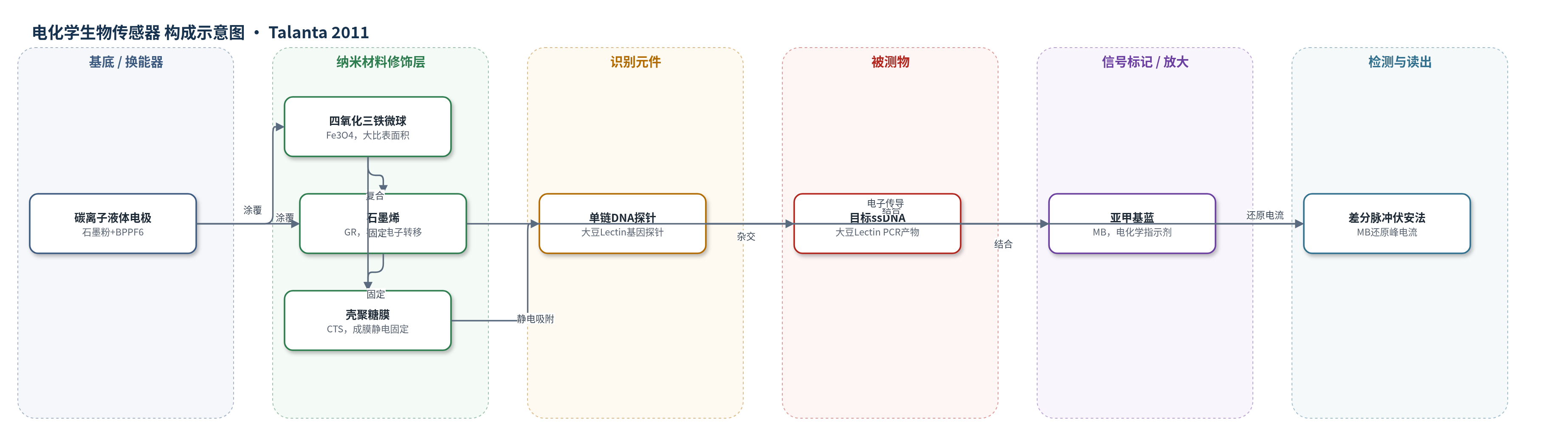
点击图片查看大图 · 依据论文自动绘制
传感器类型
电化学生物传感器
检测对象
大豆凝集素基因序列(soybean Lectin gene sequence)目标ssDNA及PCR产物(样品基质:大豆油提取DNA的PCR产物)、花生阿拉伯糖操纵子D基因(arachis Arabinose operon D gene)PCR产物(样品基质:花生油提取DNA的PCR产物)
检测原理
该传感器以ssDNA探针通过静电作用固定于CTS/Fe3O4–GR/CILE表面作为识别层。目标ssDNA加入后与探针互补杂交形成dsDNA,使电极表面核酸结构由单链变为双链。亚甲基蓝(MB)作为电化学指示剂,与dsDNA的主沟/小沟嵌入及静电作用结合,较ssDNA积累更多MB分子;Fe3O4微球与GR协同增大表观电极面积、粗糙度和电子转移速率,提高探针负载量与MB信号。差分脉冲伏安法测量MB还原峰电流,杂交前后峰电流差ΔI随目标ssDNA浓度升高而增大,在1.0×10−12至1.0×10−6 mol/L范围内线性。
检测灵敏度
LOD: 3.59 × 10⁻¹³ mol/L (3σ);线性范围: 1.0 × 10⁻¹²–1.0 × 10⁻⁶ mol/L;R^2 = 0.998;灵敏度斜率: 2.508 μA/decade(ΔI = 2.508 log[c/(mol/L)] + 53.014)
效应效果
该传感器对完全互补目标ssDNA响应最大,非互补序列仅因MB与ssDNA静电作用出现小幅增加;单碱基错配响应高于三碱基错配,但均明显低于互补序列,显示良好碱基错配区分能力。六个独立制备探针修饰电极的RSD为4.3%。4 ℃保存10天和20天后分别保留97.5%和95.2%初始灵敏度。实际样品中,大豆凝集素基因PCR产物杂交后MB还原峰电流显著增加,花生阿拉伯糖操纵子D基因PCR产物仅小幅增加,表明对大豆基因具有良好选择性。与文献中CTS/Fe3O4/SPE、CTS/MWCNTs/GE和MWCNTs/ZrO2/GCE相比,本方法检出限更低、线性范围更宽,作者认为其制备简单、成本低、响应快,适用于特异性基因序列检测。
传感器的构成
- 基底电极:碳离子液体电极(CILE),由石墨粉与1-丁基吡啶六氟磷酸盐(BPPF6)混合制成,提供高导电性和电化学活性
- 纳米复合修饰层:四氧化三铁微球(Fe3O4)与石墨烯(GR)混合涂覆,增大表观电极面积、粗糙度和电子转移能力
- 成膜固定层:壳聚糖(CTS)膜,成膜性好,通过静电作用固定Fe3O4–GR并吸附ssDNA探针
- 识别元件:单链DNA探针(ssDNA probe,5′-GAA GCT GGC AAC GCT ACC GGT-3′),与大豆凝集素基因目标序列互补杂交
- 信号标记物:亚甲基蓝(MB),与杂交形成的dsDNA结合并积累,提供可还原电化学信号
中文摘要
本文以碳离子液体电极(CILE)为基底,构建壳聚糖(CTS)/四氧化三铁微球(Fe3O4)–石墨烯(GR)纳米复合修饰的电化学DNA生物传感器。单链DNA探针直接固定于CTS/Fe3O4–GR/CILE表面,在优化条件下与目标单链DNA杂交。以亚甲基蓝(MB)为电化学指示剂,通过差分脉冲伏安法测量MB还原峰电流研究杂交反应。Fe3O4微球具有生物相容性、大比表面积,GR具有优异电子转移能力,CTS成膜性好,CILE导电性高,纳米复合协同作用增加电极表面ssDNA负载量,显著提高电化学响应。优化条件下,MB差分脉冲伏安响应与大豆凝集素基因特异性ssDNA浓度在1.0×10−12至1.0×10−6 mol/L范围内呈线性,检出限为3.59×10−13 mol/L(3σ)。该传感器稳定性良好,对单碱基和三碱基错配序列具有良好区分能力,并成功检测大豆凝集素基因PCR产物,表明CTS/Fe3O4–GR/CILE是特异性基因序列灵敏检测的合适传感平台。
英文摘要
In this paper a Fe(3)O(4) microsphere, graphene (GR) and chitosan (CTS) nanocomposite material modified carbon ionic liquid electrode (CILE) was used as the platform for the construction of a new electrochemical DNA biosensor. The single-stranded DNA (ssDNA) probe was immobilized directly on the surface of the CTS/Fe(3)O(4)-GR/CILE, which could hybridize with the target ssDNA sequence at the selected conditions. By using methylene blue (MB) as the electrochemical indicator the hybridization reaction was investigated with the reduction peak current measured. By combining the specific properties such as the biocompatibility and big surface area of Fe(3)O(4) microspheres, the excellent electron transfer ability of GR, the good film-forming ability of CTS and the high conductivity of CILE, the synergistic effects of nanocomposite increased the amounts of ssDNA adsorbed on the electrode surface and then resulted in the greatly increase of the electrochemical responses. Under the optimal conditions differential pulse voltammetric responses of MB were proportional to the specific ssDNA sequences concentration in the range from 1.0×10(-12) to 1.0×10(-6)mol/L with the detection limit as 3.59×10(-13)mol/L (3σ). This DNA biosensor showed good stability and discrimination ability to one-base and three-base mismatched ssDNA sequences. The polymerase chain reaction (PCR) product of soybean Lectin gene sequence was detected by the proposed method with satisfactory result, suggesting that the CTS/Fe(3)O(4)-GR/CILE was a suitable sensing platform for the sensitive detection of specific gene sequence.