组成图示
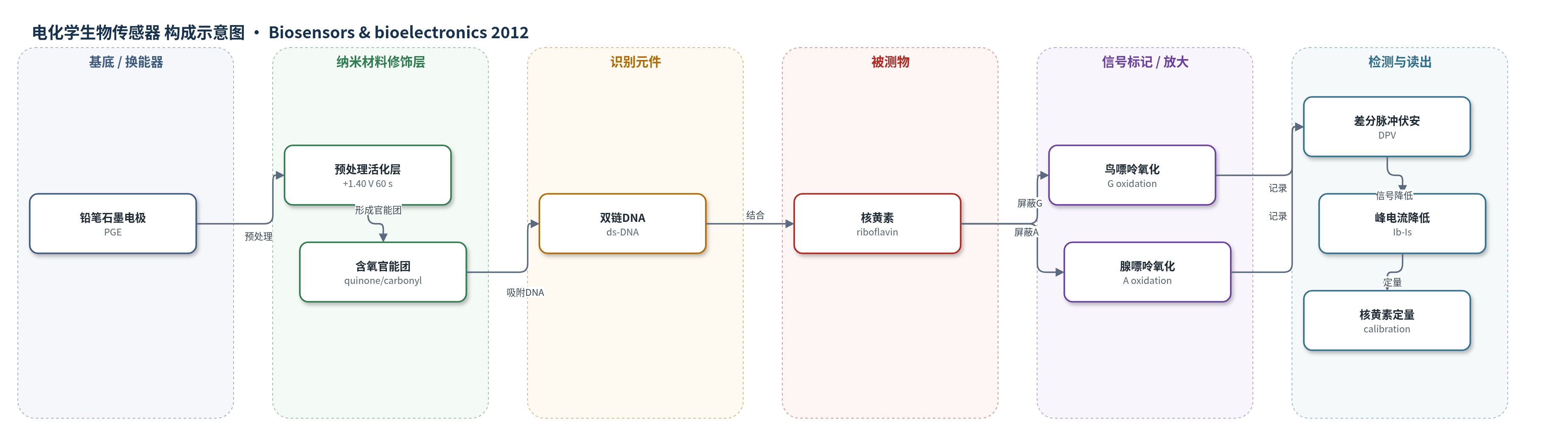
点击图片查看大图 · 依据论文自动绘制
传感器类型
电化学生物传感器
检测对象
核黄素(riboflavin, vitamin B2);样品基质:缓冲液、多维生素药片、尿液
检测原理
铅笔石墨电极经阳极预处理形成含氧官能团,增强双链DNA(ds-DNA)静电吸附。ds-DNA在电极表面形成平铺层,其鸟嘌呤和腺嘌呤具有特征氧化峰。核黄素与ds-DNA结合后,屏蔽或改变鸟嘌呤、腺嘌呤氧化位点的可及性,使氧化峰电流降低。差分脉冲伏安法记录结合前后鸟嘌呤(约+1.02 V)和腺嘌呤(约+1.28 V)氧化峰,净信号Ib-Is随核黄素浓度升高而增大,实现定量。该过程无额外酶或核酸放大,主要依赖DNA识别与伏安读出。另在预处理PGE上,核黄素经富集后在约-0.47 V发生剥离氧化,峰电流随浓度线性增加。
检测灵敏度
ds-DNA修饰PGE:LOD: 0.34 μg/mL(表3另报0.36 μg/mL);线性范围: 0.5-70 μg/mL;G斜率: 0.0082 ± 0.0003 μA/(μg/mL),R^2 = 0.998;A斜率: 0.0080 ± 0.0003 μA/(μg/mL),R^2 = 0.997。PPGE:LOD: 0.076 ng/mL;线性范围: 0.003-0.88 μg/mL;斜率: 101.09 μA·mL/μg,R^2 = 0.999。
效应效果
该DNA生物传感器与预处理PGE均对核黄素选择性高,干扰实验显示主要共存物无明显干扰。重现性方面,ds-DNA修饰PGE在3.0和6.0 μg/mL核黄素下,鸟嘌呤/腺嘌呤信号RSD分别为4.3%/3.9%和4.8%/4.4%。多维生素药片标称1.65 mg,ds-DNA-PGE测得1.61±0.10 mg(RSD 1.88%,偏差2.42%),PPGE测得1.63±0.08 mg(RSD 0.73%,偏差1.21%);加标10.0 mg回收分别为10.18±0.50 mg和10.08±0.30 mg。尿样加标回收率:ds-DNA-PGE为97.0%和96.0%,PPGE为103.0%和101.2%。与AOAC荧光法比较,t检验和F检验无显著差异,且作者认为其更简便、准确略优。预处理PGE还表现出可抛弃、制备简便和富集增强信号的特点。
传感器的构成
- 基底/换能器电极:铅笔石墨电极(PGE),经+1.40 V预处理活化,提供导电基底与吸附位点
- 活化修饰层:PGE表面电化学预处理形成的含氧官能团(如醌、羰基、羟基等),增强ds-DNA吸附
- 识别元件:鲑鱼精子双链DNA(ds-DNA),在+0.50 V下吸附于PGE表面,作为核黄素识别元件
- 信号读出:差分脉冲伏安法(DPV),记录鸟嘌呤和腺嘌呤氧化峰电流变化
中文摘要
本研究以铅笔石墨电极为基底,采用差分脉冲伏安法研究核黄素与鲑鱼精子双链DNA的电化学相互作用。核黄素与双链DNA结合后,电极表面鸟嘌呤和腺嘌呤的氧化峰电流降低,作者将该降低作为指示信号用于核黄素的灵敏测定。在优化条件下,双链DNA修饰铅笔石墨电极上核黄素浓度在0.5-70 μg/mL范围内,鸟嘌呤和腺嘌呤氧化信号呈线性关系,检出限为0.34 μg/mL。研究还考察了方法的重现性及其在药物制剂和尿样中的应用,结果表明该DNA生物传感器可用于快速、简便、低成本地检测核黄素与双链DNA的相互作用。此外,预处理铅笔石墨电极通过差分脉冲吸附剥离伏安法测定核黄素,在0.003-0.88 μg/mL范围内呈线性,检出限为0.076 ng/mL。两种方法均经过验证并应用于核黄素分析。
英文摘要
The interaction of riboflavin with salmon sperm double-stranded DNA based on the decreasing of the oxidation signal of guanine and adenine bases was studied electrochemically with a pencil graphite electrode (PGE) using differential pulse voltammetry. The decrease in the intensity of the guanine and adenine oxidation signals after interaction with riboflavin was used as an indicator signals for the sensitive determination of riboflavin. Under the optimum conditions, a linear dependence of the guanine and adenine oxidation signals was observed for the riboflavin concentration in the range of 0.5-70 μg mL(-1) with a detection limit of 0.34 μg mL(-1) at ds-DNA modified PGE. The reproducibility and applicability of the analysis to pharmaceutical dosage forms and urine sample were also investigated. These results showed that this DNA biosensor could be used for the sensitive, rapid, simple and cost effective detection and determination of riboflavin-ds-DNA interaction. Pretreated pencil graphite electrode (PPGE) was also used for the determination of riboflavin by differential pulse adsorptive stripping voltammetry. With PPGE, a linear relationship was obtained for riboflavin over the concentration range of 0.003-0.88 μg mL(-1) with differential pulse adsorptive stripping voltammetric signal and with a detection limit of 0.076 ng mL(-1). Both determination methods were fully validated and applied for the analysis of riboflavin.