组成图示
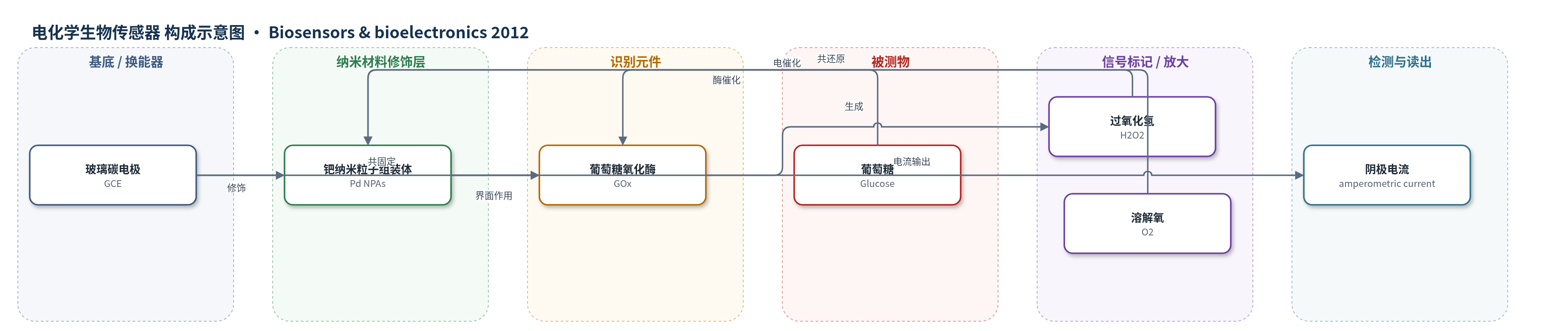
点击图片查看大图 · 依据论文自动绘制
传感器类型
电化学生物传感器
检测对象
过氧化氢(H2O2,PBS缓冲液)、葡萄糖(glucose,PBS缓冲液及血液/血清样品)
检测原理
该传感器以玻璃碳电极为换能基底,Pd NPAs作为电催化层和HRP替代物,GOx作为生物识别/催化元件。检测H2O2时,H2O2在−0.45 V下被Pd NPAs电催化还原,产生与浓度成正比的阴极电流。检测葡萄糖时,GOx特异性催化葡萄糖氧化生成H2O2,Pd NPAs同时电催化还原溶解氧和原位生成的H2O2,使阴极电流随葡萄糖浓度增加而增大。球形多孔结构增大界面并促进底物扩散,相邻Pd纳米粒子强耦合提高电子态密度和电子转移速率,从而放大信号。
检测灵敏度
H2O2: LOD: 6.8 × 10⁻⁷ M;线性范围: 1.0 × 10⁻⁶–8.2 × 10⁻⁴ M;R^2 = 0.9994
Glucose: LOD: 6.1 × 10⁻⁶ M;线性范围: 4.0 × 10⁻⁵–2.2 × 10⁻² M;R^2 = 0.9991
效应效果
传感器响应快(95%稳态<10 s),抗干扰好(0.5 mM尿酸、对乙酰氨基酚几乎无干扰,抗坏血酸响应约7.5%)。PBS 4 ℃保存60 d保留90%活性,空气中60%。RSD:电极间5.1%,单电极3.2%,曲线4.6%。血液加标回收率95.7–105.1%(1.0–10.0 mM),低/中/高浓度RSD 6.3/4.3/3.8,与HPLC一致。H2O2线性范围宽于C@Au(5.0×10−6–1.35×10−4 M),LOD低于Ag纳米粒子修饰聚对苯二胺(4.7×10⁻⁶ M);葡萄糖LOD低于GOx/MCM-41(180 μM)和氮掺杂碳纳米管(0.01 mM)。
传感器的构成
- 基底电极:玻璃碳电极(GCE),提供导电换能界面
- 纳米催化修饰层:球形多孔钯纳米粒子组装体(Pd NPAs),增大界面、促进电子转移并电催化还原H2O2
- 生物催化识别层:葡萄糖氧化酶(GOx),特异性催化葡萄糖氧化生成H2O2
中文摘要
本文报道了球形多孔钯纳米粒子组装体(Pd NPAs)的合成及其在过氧化氢和葡萄糖生物传感中的应用。Pd NPAs通过淀粉辅助化学还原Pd(II)在室温下制得,不仅可增大表面积并促进电子转移,还能催化H2O2还原,因而可作为辣根过氧化物酶(HRP)的替代物。以Pd NPAs为电催化剂,可检测低至6.8×10⁻⁷ M的H2O2,线性范围为1.0×10⁻⁶–8.2×10⁻⁴ M。进一步将Pd NPAs与葡萄糖氧化酶(GOx)共固定,构建了灵敏、选择性葡萄糖生物传感器。其检测原理是测量酶促反应中溶解氧与原位生成H2O2共同还原所引起的阴极电流增加。在最优条件下,葡萄糖检测限为6.1×10⁻⁶ M,线性范围为4.0×10⁻⁵–2.2×10⁻² M。该传感器响应快、稳定性好、选择性和血清葡萄糖检测重现性高,为构建用于糖尿病早期诊断与预防的快速、灵敏、稳定且抗干扰的安培生物传感器提供了策略。
英文摘要
The spherical porous Pd nanoparticle assemblies (NPAs) have been successfully synthesized by starch-assisted chemical reduction of Pd(II) species at room temperature. Such Pd NPAs are not simply used to enlarge the surface area and to promote the electron transfer. They also catalyze the reduction of H(2)O(2) which are regarded as horseradish peroxidase (HRP) substitutes in electron transfer process. By using them as electrocatalysts, as low as 6.8×10(-7) M H(2)O(2) can be detected with a linear range from 1.0×10(-6) to 8.2×10(-4) M. Moreover, through co-immobilization of such Pd NPAs and glucose oxidase (GOx), a sensitive and selective glucose biosensor is developed. The detection principle lies on measuring the increase of cathodic current by co-reduction of dissolved oxygen and the in situ generated H(2)O(2) during the enzymatic reaction. Under optimal conditions, the detection limit is down to 6.1×10(-6) M with a very wide linear range from 4.0×10(-5) to 2.2×10(-2) M. The proposed biosensor shows a fast response, good stability, high selectivity and reproducibility of serum glucose level. It provides a promising strategy to construct fast, sensitive, stable and anti-interferential amperometric biosensors for early diagnosis and prevention of diabetes.