组成图示
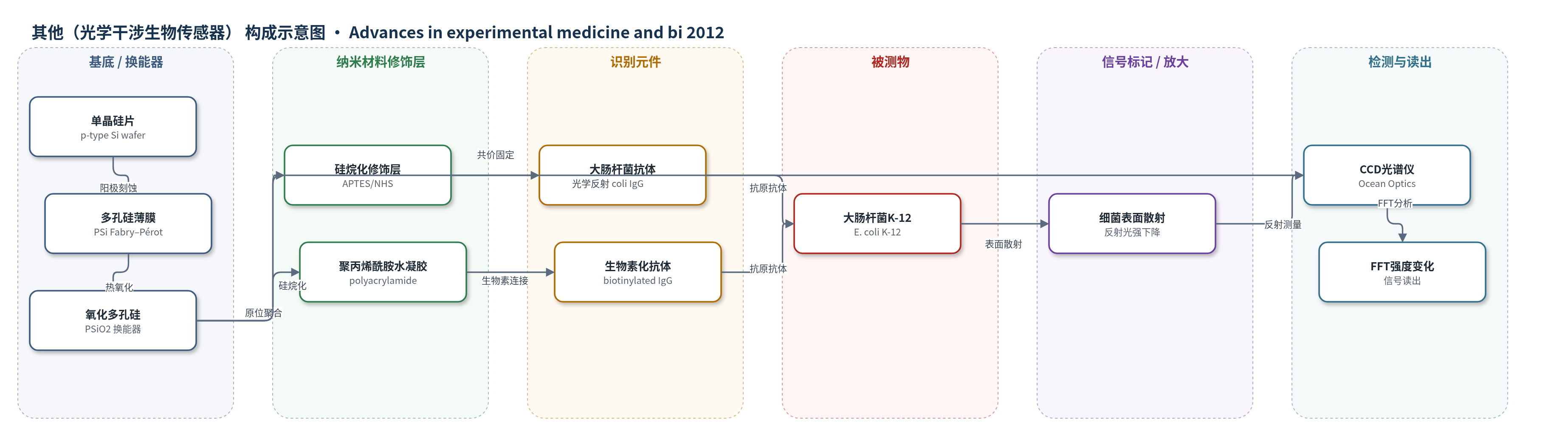
点击图片查看大图 · 依据论文自动绘制
传感器类型
其他(光学干涉生物传感器)
检测对象
大肠杆菌 K-12(Escherichia coli K-12,E. coli K-12);样品基质:LB 培养基细菌悬液
检测原理
该传感器采用无标记光学干涉检测。PSiO2 薄膜构成 Fabry–Pérot 干涉结构,其反射谱由有效光学厚度 EOT=2nL 决定。表面固定的大肠杆菌单克隆抗体特异性捕获 E. coli K-12;由于细菌尺寸较大,结合主要发生在传感器表面而非孔道内部。捕获的细菌改变表面光散射与局部光学环境,使反射光强度下降。CCD 光谱仪记录 400–1000 nm 反射谱,经 FFT 处理后峰强度变化百分比随细菌浓度增加而增大,从而在 10^3–10^5 cell/mL 范围内实现定量检测。PSiO2/水凝胶杂化体系通过水凝胶稳定多孔硅结构并维持抗体构象,提高信号稳定性与灵敏度。
检测灵敏度
LOD: 10^3 cell/mL(PSiO2/水凝胶杂化)、10^4 cell/mL(纯 PSiO2);线性范围: 10^3–10^5 cell/mL
效应效果
在 0.5 mL/min PBS 流动 5 h 的稳定性测试中,PSiO2/水凝胶杂化换能器反射强度变化小于 0.5%,EOT 变化小于 10 nm,无明显基线漂移;而硅烷化纯 PSiO2 的 EOT 在 5 h 内下降约 90 nm,反射强度下降 13%。与未修饰对照相比,IgG 修饰表面可捕获细菌,光镜下可见固定细胞,未修饰表面无细胞,说明检测具有特异性。杂化体系对 E. coli 的强度变化约为纯 PSiO2 体系的 4 倍,检出限分别为 10^3 和 10^4 cell/mL,响应时间为数分钟,与 SPR 细菌检测相当;作者认为其可用于快速、无标记细菌检测。
传感器的构成
- 基底/换能器:高掺杂 p 型单晶硅片(p-type Si wafer),经 HF 阳极电化学刻蚀形成多孔硅(PSi)Fabry–Pérot 薄膜,再于 800°C 热氧化为氧化多孔硅(PSiO2),作为光学干涉换能器。
- 纯 PSiO2 修饰层:(3-aminopropyl)triethoxysilane(APTES)硅烷化引入氨基,Bis(N-succinimidyl) carbonate(SC)引入 NHS 活性酯,用于共价固定抗体。
- 纯 PSiO2 识别元件:大肠杆菌单克隆抗体(E. coli IgG),通过 NHS 酯与 APTES 氨基共价结合,特异性捕获目标细菌。
- 杂化修饰层:在 PSiO2 孔道内原位光聚合聚丙烯酰胺(polyacrylamide)水凝胶,交联剂为 N,N'-methylenebis(acrylamide)(BIS)和 bis(acryloyl)cystamine(BIS-CA),光引发剂为 2,2-dimethoxy-2-phenyl-acetophenone(DMAP),用于稳定多孔硅并维持抗体构象。
- 杂化连接层:tris(2-carboxyethyl) phosphine(TCEP)还原二硫键生成巯基,PEO-iodoacetyl biotin 连接生物素,链霉亲和素(SA)固定于水凝胶,用于连接生物素化抗体。
- 杂化识别元件:生物素化大肠杆菌单克隆抗体(biotinylated E. coli IgG),通过生物素–链霉亲和素结合固定,特异性捕获细菌。
- 信号读出:Ocean Optics CCD USB 4000 光谱仪、光纤和显微物镜,测量 400–1000 nm 反射干涉谱并做 FFT 强度分析。
中文摘要
本文报道了两类基于氧化多孔硅(PSiO2)Fabry–Pérot 薄膜的光学无标记生物传感器,用于快速检测细菌。传感器无需细胞裂解等样品前处理,可直接将目标细菌捕获到表面。第一类在电化学加工得到的纯 PSiO2 表面,通过硅烷化化学接枝特异性单克隆抗体(IgG);第二类为 PSiO2/水凝胶杂化体系,其中聚丙烯酰胺水凝胶在纳米结构 PSiO2 内部原位合成,并与特异性单克隆抗体偶联,作为生物识别活性组分。当修饰后的表面接触目标细菌时,发生“直接细胞捕获”,特异性结合事件引起薄膜光学干涉谱的可预测变化。研究表明,这些传感器可在数分钟内检测 10^3–10^5 cell/mL 的低浓度细菌。作者比较了两种平台在水相介质中的稳定性和灵敏度,初步结果表明 PSiO2/水凝胶杂化体系优于纯 PSiO2 体系。
英文摘要
Optical label-free porous Si-based biosensors for rapid bacteria detection are introduced. The biosensors are designed to directly capture the target bacteria cells onto their surface with no prior sample processing (such as cell lysis). Two types of nanostructured optical transducers based on oxidized porous Si (PSiO(2)) Fabry-Pérot thin films are synthesized and used to construct the biosensors. In the first system, we graft specific monoclonal antibodies (immunoglobulin G's) onto a neat electrochemically-machined PSiO(2) surface, based on well-established silanization chemistry. The second biosensor class consists of a PSiO(2)/hydrogel hybrid. The hydrogel, polyacrylamide, is synthesized in situ within the nanostructured PSiO(2) host and conjugated with specific monoclonal antibodies to provide the active component of the biosensor. Exposure of these modified-surfaces to the target bacteria results in "direct-cell-capture" onto the biosensor surface. These specific binding events induce predictable changes in the thin-film optical interference spectrum of the biosensor. Our studies demonstrate the applicability of these biosensors for the detection of low bacterial concentrations, in the range of 10(3)-10(5) cell/ml, within minutes. The sensing performance of the two different platforms, in terms of their stability in aqueous media and sensitivity, are compared and discussed. This preliminary study suggests that biosensors based on PSiO(2)/hydrogel hybrid outperform the neat PSiO(2) system.